

2026 has brought additional context. The Shiller PE ratio stood at 41.43 as of June 2026, well above its historical median of 16.10, while global capital flows have shown mixed signals — making phased, well-structured international allocations more relevant than ever.
This guide covers five top international mutual funds available to Indian investors, how they were selected, their verified performance data, tax rules for 2026, and allocation guidance for sophisticated investors.
Key Takeaways
- International mutual funds (IMFs) let Indian investors access global companies through domestic AMCs — no foreign brokerage required
- Coverage spans US tech, US blue-chip, global emerging markets, and gold mining equities
- IMFs are taxed as non-equity (debt-like) funds — STCG at slab rate under 24 months; consult a tax advisor for current LTCG rules
- SEBI's industry-wide overseas investment cap is USD 7 billion; verify fund availability before investing
- iVentures Wealth typically recommends 10–30% global allocation, sized to individual risk profile and portfolio composition
What Are International Mutual Funds?
International mutual funds (IMFs) are SEBI-regulated Indian mutual fund schemes that pool domestic capital and invest it in foreign securities. They come in two primary structures:
- Feeder Funds — collect INR from Indian investors, convert to foreign currency, and route capital into a specific offshore master fund
- Fund of Funds (FoF) — invest into established foreign funds or ETFs, adding one layer of fee structure but offering access to institutional-grade global mandates
In both cases, the Indian fund manager handles currency conversion, compliance, and overseas remittance on the investor's behalf. Investors hold Indian mutual fund units — not foreign securities directly.
Why Investors Use International Mutual Funds
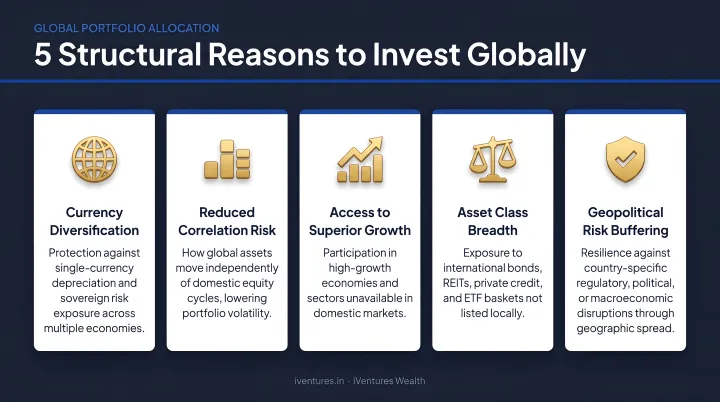
Five structural reasons drive most client conversations on global allocation at iVentures Wealth:
- Geographic diversification — reducing concentration in a single country's economic cycle
- Access to global market leaders — companies like NVIDIA, Apple, and TSMC not listed on Indian exchanges
- INR depreciation hedge — dollar-denominated assets provide a natural currency buffer over long periods
- Thematic exposure — semiconductors, AI infrastructure, genomics, and EV supply chains unavailable through domestic indices
- Portfolio de-correlation — global markets don't always move in sync with Indian indices, which can reduce overall portfolio volatility
Top International Mutual Funds in India for 2026
The funds below were shortlisted based on 3- and 5-year annualised returns, AUM size, expense ratio, fund structure clarity, and track record length. Data is sourced from Value Research (updated June 15, 2026) and AMC factsheets unless otherwise noted.
Disclaimer: This list is for informational purposes only. Past performance is not indicative of future results. Consult a SEBI-registered investment advisor before making investment decisions.
Edelweiss US Technology Equity Fund of Fund
This FoF invests primarily in the JPMorgan Funds – US Technology Fund, giving Indian investors concentrated exposure to US tech mega-caps including NVIDIA, Apple, and Microsoft through a single Edelweiss AMC scheme.
With a 5-year CAGR of 17.96%, this fund has delivered strong results through the tech-heavy market cycle. Its concentrated mandate suits aggressive growth investors as a satellite holding, not a core position. Given elevated valuations, a minimum 7–10 year horizon is appropriate and meaningful volatility should be expected along the way.
| Parameter | Details |
|---|---|
| Fund Structure | FoF investing in JPMorgan Funds – US Technology Fund |
| AUM (Direct Plan) | ₹4,557 Cr |
| Expense Ratio (Direct) | 0.60% |
| 5-Year CAGR | 17.96% |
| 3-Year CAGR | Not available from verified sources |
Franklin India Feeder – Franklin U.S. Opportunities Fund
A feeder fund that channels Indian investor capital into the Franklin U.S. Opportunities Fund, a well-established offshore scheme focused on US growth equities across sectors. Less concentrated than pure tech-focused FoFs, it offers a more diversified US market entry point.
With one of the longer operational track records among Indian international funds, this fund suits moderate-aggressive investors who want US equity exposure without concentrating on a single sector. Its 5-year CAGR of 12.39% reflects broader US market participation rather than tech-driven spikes.
| Parameter | Details |
|---|---|
| Fund Structure | Feeder fund routing into Franklin U.S. Opportunities offshore master fund |
| AUM (Direct Plan) | ₹5,939 Cr |
| Expense Ratio (Direct) | 0.46% |
| 5-Year CAGR | 12.39% |
| 3-Year CAGR | Not available from verified sources |
ICICI Prudential US Bluechip Equity Fund
One of the largest international funds by AUM in India, this fund directly invests in US large-cap blue-chip companies rather than through a FoF wrapper. It targets stable, cash-generative US corporations across financials, healthcare, and technology.
Its direct overseas equity structure eliminates one fee layer compared to most IMFs, which is reflected in a moderate expense ratio. The fund suits conservative-to-moderate investors seeking reliable long-term US exposure with lower volatility than tech-concentrated alternatives. Note: 10-year CAGR data was unavailable from verified primary sources at the time of writing.
| Parameter | Details |
|---|---|
| Fund Structure | Direct overseas equity — invests in US-listed large-cap blue chips (not FoF) |
| AUM (Direct Plan) | ₹3,699 Cr |
| Expense Ratio (Direct) | 0.97% |
| 5-Year CAGR | 11.79% |
| 3-Year / 10-Year CAGR | Not available from verified sources |
Kotak Global Emerging Market Fund
Unlike the three US-focused funds above, this FoF provides exposure to equity markets across emerging economies: China, Taiwan, Brazil, South Korea, and others. The underlying fund (CI Emerging Markets Fund I) targets geographies that often move independently of both India and the US.
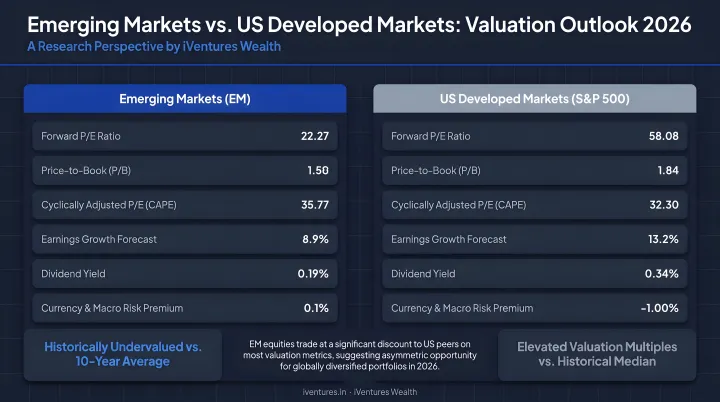
Kotak offered the most complete verified return disclosure of the five funds reviewed. Its 3-year CAGR of 27.30% and 5-year CAGR of 11.77% reflect strong recent performance. With US equity valuations at historically elevated levels, emerging market funds make a stronger relative value case for investors seeking genuine geographical diversification beyond developed markets.
| Parameter | Details |
|---|---|
| Fund Structure | FoF investing in CI Emerging Markets Fund I |
| AUM (Direct Plan) | ₹1,792 Cr |
| Expense Ratio (Direct) | 0.65–0.77% (varies by source) |
| 3-Year CAGR | 27.30% |
| 5-Year CAGR | 11.77% |
DSP World Gold Mining Fund
This fund differs from all the above. It invests in gold mining companies globally through a FoF linked to BlackRock Global Funds – World Gold Fund and the VanEck Gold Miners ETF, combining gold price exposure with equity risk from mining operations.
A 5-year CAGR of 22.13% reflects gold's strong multi-year run alongside mining equity leverage. For UHNIs and family offices seeking assets with low correlation to mainstream equity markets, this fund serves as a genuine diversifier, particularly useful during periods of domestic market stress or sharp INR depreciation.
| Parameter | Details |
|---|---|
| Fund Structure | FoF linked to BlackRock World Gold Fund and VanEck Gold Miners ETF |
| AUM (Direct Plan) | ₹1,679 Cr |
| Expense Ratio (Direct) | 1.54% |
| 5-Year CAGR | 22.13% |
| 3-Year CAGR | Not available from verified sources |
How These Funds Were Selected
The evaluation framework covered five dimensions:
- 3-year and 5-year CAGR — prioritising consistency over single-year spikes
- AUM size — larger AUM signals investor confidence and operational stability
- Expense ratio — especially critical in FoF structures where two fee layers compound over time
- Fund structure clarity — feeder vs. direct overseas equity vs. FoF, since this affects expense structure, tracking behaviour, and tax treatment
- Track record length — minimum 5 years preferred for pattern recognition across a cycle
A common selection mistake: Choosing funds based on 1-year returns. This often means buying into momentum that has already peaked — the fund looks attractive precisely because it has already run.
The fee layer problem in FoF structures
DSP's KIM (Key Information Memorandum) notes that total expense ratio for FoF structures is capped at 2.25% of daily net assets. With a high-expense FoF — like DSP World Gold at 1.54% direct — the compounding cost over a 10-year horizon is material. For a ₹1 Cr investment, the difference between a 0.50% and 1.50% expense ratio compounds to a meaningful return differential.
ICICI Prudential US Bluechip's direct overseas equity structure avoids this second fee layer entirely, which is one reason it features as a core holding for investors with a long horizon.
The role of professional advisory
Fee structure complexity is only part of the picture. Global macro variables — Fed policy direction, currency trends, EM political risk — require ongoing assessment, not a one-time fund selection decision.
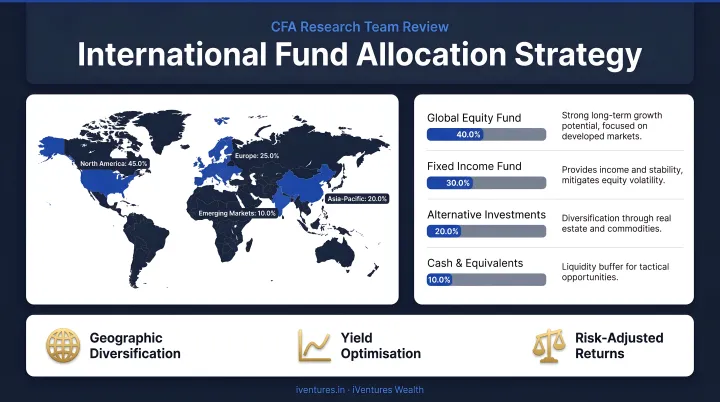
iVentures Wealth actively helps clients size international allocations within a complete portfolio review, rather than treating global funds as a standalone product choice. The firm's CFA-led research team tracks fund performance, structure changes, and macro developments on an ongoing basis — so allocation decisions stay calibrated as conditions shift.
Tax Treatment of International Mutual Funds in 2026
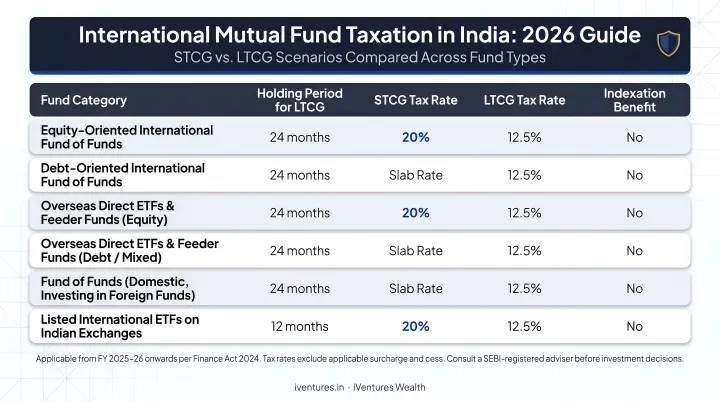
International mutual funds do not meet the 65% domestic equity threshold required for equity fund status in India. This has significant tax implications.
How international funds are classified
Under Section 50AA of the Income Tax Act, a "specified mutual fund" — one where not more than 35% of proceeds is invested in domestic equity — has gains from units acquired on or after April 1, 2023 treated as short-term capital gains (STCG), taxable at the investor's applicable slab rate.
Important caveat: The exact tax treatment for units purchased on or after April 1, 2026 — including a potential 12.5% LTCG rate after a 24-month holding period — was not confirmed from primary Income Tax Department sources at time of writing. iVentures Wealth includes tax impact modelling as part of its international fund advisory and coordinates with external tax counsel for UHNI clients with complex redemption schedules.
Do not rely on any single published article — including this one — for your tax position. Get independent tax counsel before investing or redeeming.
Key tax points to understand
| Scenario | Tax Treatment |
|---|---|
| STCG (Section 50AA) | Taxed at investor's income slab rate (up to 30% for HNIs) |
| Potential LTCG (post-April 2026) | 12.5% rate after 24-month holding — not yet confirmed by primary sources; verify before acting |
| Dividend income | Added to total income; taxed at slab rate post-April 2020 DDT removal |
| Foreign withholding tax | For US dividends (~25% withholding), foreign tax credit may be claimable in India |
The SEBI overseas investment cap
Tax efficiency is only one side of the equation — you also need to confirm that a fund is actually open for investment before committing capital.
SEBI's June 2021 circular set the industry-wide overseas investment limit at USD 7 billion, with each AMC capped at USD 1 billion. When industry headroom runs thin, AMCs pause new lump-sum investments and SIP registrations — as Motilal Oswal did when limits were breached, only reopening select funds in December 2022.
Before committing a lump sum to any international fund, verify current subscription status directly with the AMC or your advisor.
Conclusion
International mutual funds are not a speculative add-on. For investors with significant domestic equity concentration — particularly UHNIs, family offices, and NRI clients — they represent a structural response to a genuine portfolio gap.
The five funds above cover a reasonable range of mandates: concentrated US tech, diversified US growth, US blue-chip stability, global emerging market exposure, and gold mining equity. The right choice depends on existing portfolio composition, risk tolerance, tax situation, and investment horizon — no single fund suits every investor.
A fund's mandate, fee structure, underlying assets, and correlation with your existing holdings matter more than trailing 1-year returns. iVentures Wealth works with UHNI and family office clients to evaluate international allocations within the full context of their portfolios — assessing overlap, sizing the allocation appropriately (typically 10–30% of total investible assets), and managing rebalancing as global market conditions shift.
As a SEBI-registered investment advisory firm (INA000019026) with over 20 years of experience, iVentures Wealth can help you size, select, and rebalance international fund allocations alongside your broader portfolio — so global diversification works as a deliberate strategy, not an afterthought.
Frequently Asked Questions
Which international mutual fund is best in India?
No single fund fits every investor. US tech exposure points toward Edelweiss US Technology FoF; diversified US growth toward Franklin or ICICI US Bluechip; non-US diversification toward Kotak Global Emerging Market. Compare 5-year CAGR, expense ratio, and fund structure before deciding.
Should I invest in international funds in 2026?
2026 presents a case for selective allocation — US equity valuations are historically stretched (Shiller PE at 41.43), and emerging market relative valuations look more attractive. Any allocation should be phased rather than lump-sum, and sized at 10–30% of total portfolio depending on your existing holdings and risk profile.
How are international mutual funds taxed in India in 2026?
Under the current framework, gains are treated as STCG and taxed at your applicable income slab rate. Holding period rules and LTCG treatment remain subject to legislative interpretation — consult a qualified tax advisor before investing or redeeming.
What is the SEBI overseas investment limit for mutual funds?
SEBI permits each AMC up to USD 1 billion in overseas investments, within an industry-wide cap of USD 7 billion. When limits are approached, AMCs suspend new subscriptions and SIPs. Always verify fund availability with the AMC or your advisor before committing funds.
What percentage of my portfolio should be in international mutual funds?
Most financial planners suggest 10–30% of investible assets in international exposure, with the upper end appropriate for investors with heavy domestic equity concentration. iVentures Wealth sizes this allocation individually based on existing holdings, risk profile, and long-term goals.
Can NRI or OCI investors invest in international mutual funds through Indian AMCs?
NRIs and OCIs can invest in domestic mutual fund schemes subject to KYC and FEMA compliance, though eligibility for specific international funds varies by AMC and jurisdiction. US and Canadian residents face additional FATCA requirements. Consult a cross-border tax advisor to navigate potential double-taxation implications before investing.