

Introduction
Remittances into India remain among the highest of any country in the world, and a large share of that money needs a secure place to park. For many NRIs, the NRE fixed deposit is the default answer — a rupee account that promises tax-free returns and easy repatriation.
But "tax-free" isn't the same as "risk-free." Many NRIs open an NRE FD without checking how currency movement, lock-in penalties, or their own residency timeline could change the outcome.
This article breaks down the real advantages, the risks that get glossed over, how NRE FD stacks up against NRO and FCNR, and how to decide whether it actually fits your financial plan.
Key Takeaways
- NRE FD interest is tax-free in India, with principal and interest fully repatriable
- Best suited for India-linked goals like property or family support, not currency stability
- Currency conversion risk and early-withdrawal penalties can erode returns over time
- NRE, NRO, and FCNR serve different income sources, so most NRIs need more than one
- Works best as one piece of a diversified portfolio, not a standalone strategy
What Is an NRE Fixed Deposit
An NRE (Non-Resident External) FD is a rupee-denominated term deposit available only to NRIs, PIOs, and OCIs. You fund it with foreign earnings. The bank then converts that money to INR at the prevailing exchange rate, and it stays locked for a fixed tenure.
Here's how the mechanics actually work:
- Funding source: Inward remittances from abroad, or transfers from an existing NRE or FCNR(B) account — you don't need a fresh remittance every time you open one
- Currency conversion: Foreign currency converts to INR at booking, which is where the exchange-rate exposure begins
- Tenure: Typically 1 to 10 years, depending on the bank; RBI's base guidance covers 1-3 years, with longer tenures offered at individual banks' discretion
An NRE FD works like a parking spot for India-linked foreign savings, not a complete wealth strategy on its own. It solves for safety and tax efficiency, but it doesn't solve for growth, and it won't protect you from a weakening rupee.
Key Advantages of NRE FD for NRIs
These advantages hold up on measurable outcomes: tax savings, transfer flexibility, and capital safety, not just what the marketing brochure promises.
Tax-Free Returns That Compound
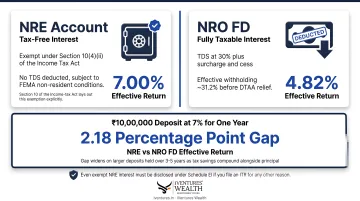
Under Section 10(4)(ii) of the Income Tax Act, interest earned on an NRE account is exempt from Indian income tax. Banks don't deduct TDS on it either, provided you meet the non-resident conditions under FEMA at the time. Section 10 of the Income-tax Act lays out this exemption explicitly.
Compare that to an NRO FD, where interest is fully taxable and subject to TDS at 30% plus surcharge and cess. That pushes the effective withholding to roughly 31.2% for many depositors, before any DTAA relief.
Run the numbers on a ₹10,00,000 deposit at 7% for one year:
| NRE FD | NRO FD (base 31.2% TDS) | |
|---|---|---|
| Gross interest | ₹70,000 | ₹70,000 |
| Tax withheld | ₹0 | ₹21,840 |
| Net yield | 7.00% | 4.82% |
That's a 2.18 percentage point gap in a single year, and it widens on larger deposits held over 3-5 years since the tax saved compounds alongside the principal. One caveat: even though NRE interest isn't taxed, if you file an ITR for any other reason, it still needs disclosure under Schedule EI as exempt income.
Full and Free Repatriation
Both principal and interest in an NRE FD can move abroad without RBI approval and without any upper limit, through your bank's normal transfer process.
NRO accounts don't offer that same freedom:
- Capital-account remittances (property sale, gift, inheritance proceeds) are capped at USD 1 million per financial year
- Current income like rent, dividends, or pension can move separately without that cap, but only after tax
- Repatriation over ₹5,00,000 in a year typically needs Form 15CA, and Form 15CB from a CA when the remittance is taxable
For NRIs who aren't sure if they'll settle back in India, or who need funds accessible in multiple countries, this difference matters more than the interest rate itself.
Capital Safety With Predictable, Fixed Returns
NRE FDs are held with RBI-regulated banks and insured under DICGC coverage up to ₹5,00,000 per depositor per bank (principal plus interest combined). This limit has been in effect since February 2020, per the DICGC's deposit insurance guide.
Current representative rates across major banks run in a fairly tight band:
- SBI: 6.25%-6.45% depending on tenure
- HDFC Bank: 6.25%-6.50% depending on tenure
- ICICI Bank: around 6.25% for shorter tenures
The rate you lock in at booking stays fixed for the entire tenure. That's useful if you're saving toward something specific, like a property down payment, and want your maturity value to stay predictable regardless of what markets do in between.
What Happens When the Risks Are Overlooked
The rate is guaranteed. Your foreign-currency return isn't. That distinction trips up more NRIs than any other feature of this product.
Currency risk is the big one. Take ₹10,00,000 compounding at 7% annually over four years — it grows to roughly ₹13,10,796, a 31% gain in rupee terms. Convert that using exchange rates from late 2021 (around 74.29/USD) versus early 2026 (around 92/USD), per Business Standard's rupee-at-92 report, and the picture changes:
- Initial USD value: $13,461
- Maturity USD value: $14,248
- Actual USD growth: just 5.85% over four years (about 1.4% annualised)
A 31% INR gain turning into under 6% USD growth is the real cost of rupee depreciation, even when your INR rate never wavered.
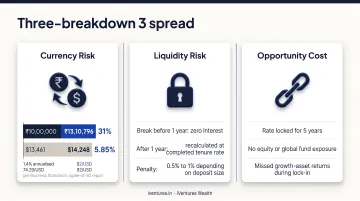
Liquidity risk is the second trap. Break an NRE FD before one year at most banks, and you earn zero interest. After one year, banks typically recalculate at the rate for your actual completed tenure (not your original contracted rate) and deduct a penalty of 0.5% to 1%, depending on the deposit size.
Opportunity cost rounds out the list. Lock in a rate for five years, and you're stuck there even if global rates climb or better options emerge. An NRE FD with zero equity or global fund exposure also means missing out entirely on growth-asset returns during that lock-in window.
NRE FD vs NRO vs FCNR: Which Should You Choose?
Each account solves a different problem. NRE parks foreign earnings tax-free, while NRO manages India-sourced income like rent, pension, or dividends. FCNR, by contrast, holds foreign currency without ever converting it to INR.
| Feature | NRE FD | NRO FD | FCNR(B) FD |
|---|---|---|---|
| Deposit currency | INR (converted at booking) | INR | Foreign currency (USD, GBP, etc.) |
| Tax on interest | Exempt | Taxable, ~30% TDS + cess | Exempt |
| Repatriation | Full, no cap | Capital: USD 1M/year cap; income: uncapped after tax | Full, no cap |
| Typical tenure | 1-10 years | 7 days-10 years | 1-5 years |
| Best for | Foreign earnings, India goals | India-sourced income | Avoiding currency conversion risk |
Is NRO or NRE better? For pure foreign income with no India-sourced receipts, NRE wins on tax and repatriation. But NRO isn't optional if you have rental income, a pension, or dividends from Indian investments — that money has to route through NRO.
Where does FCNR fit? If currency risk is your primary concern, FCNR sidesteps INR conversion entirely, though it usually comes with lower flexibility and, at times, a narrower rate band.
Realistically, this isn't an either/or decision. Most NRIs end up holding some combination of all three, based on where their income actually originates.
Is NRE FD Right for You? Fitting It Into Your Portfolio
An NRE FD works best as the stability layer within a broader portfolio, complementing growth-oriented assets rather than replacing them.
How much stability you need depends on your stage:
- Conservative investors nearing retirement may hold a larger share in NRE FDs and bonds for predictable, low-volatility cash flow
- Mid-career NRIs balancing multiple goals often split allocation between FDs for near-term needs and equities for long-term compounding
- Younger, growth-focused NRIs typically limit FDs to a smaller buffer, keeping the bulk of their money in equities and global funds where compounding works harder

Your investment stage is only part of the equation; your goals matter just as much in determining fit. NRE FD suits NRIs with near-term, India-specific goals: a property purchase, funding a child's education, or supporting family back home. It's a poor fit if your only objective is long-term wealth growth in your country of residence.
Where this gets genuinely complicated is coordinating FD tenure, allocation size, and tax treatment across two jurisdictions simultaneously. You must navigate your resident country's tax rules alongside India's, often involving DTAA provisions that most people don't review until something goes wrong.
This is where firms like iVentures Wealth come in. As a SEBI-registered advisory (INA000019026) with dedicated NRI and OCI investment and tax advisory services, they help clients consolidate portfolios spread across multiple countries and structure allocations that balance safety, growth, and cross-border tax efficiency.
Get the sizing right, and an NRE FD strengthens your portfolio's foundation without capping its long-term growth potential.
Frequently Asked Questions
Which FD is better, NRO or NRE?
NRE suits foreign income seeking tax-free, fully repatriable returns. NRO is necessary if you have India-sourced income like rent or pension, since that money must route through it regardless of preference.
Can NRIs jointly hold an NRE FD with a resident Indian?
Yes, but only with a close relative as defined under RBI norms, and the NRI must be the first holder. The resident relative typically operates the account as a mandate holder, not a co-owner with independent rights.
What happens to my NRE FD if I return to India permanently?
Once you become a resident under FEMA, the FD must be converted to a resident deposit (or run to maturity first, per some banks). After conversion, interest becomes taxable and repatriation benefits stop.
Is there a lock-in period for NRE FDs, and what are the penalties for early withdrawal?
Most banks require a minimum one-year tenure, and breaking the FD before that usually earns zero interest. After one year, expect a 0.5-1% penalty plus recalculation at the rate for your actual holding period.
Can I get a loan against my NRE FD?
Yes, most banks offer loans or overdrafts against NRE FDs, generally at 1-2% above your FD's contracted rate, while the deposit keeps earning its original interest.
Is there a maximum limit on how much I can invest in an NRE FD?
RBI hasn't set a blanket ceiling, and several major banks state no upper limit on their NRE term deposits. Individual banks may still apply internal product-specific caps, so confirm the exact cap with your bank before investing.