He's not alone. Only 20% of Indian family businesses have a succession plan that is robust, documented, and communicated, according to PwC's Family Business Survey. Roughly four out of five founders are running crore-worth businesses with no clear roadmap for what comes next.
This isn't a knowledge gap. Most owners know succession matters. What stops them is a mix of psychology, family dynamics, and genuine structural complexity. This article unpacks why the delay happens, what it actually costs, and a practical way to start before a crisis forces the decision.
Key Takeaways
- Delay stems from fear of mortality, loss of identity, and family conflict, not laziness.
- Legal complexity and unclear successor readiness make the practical side equally daunting.
- Weak governance habits are common: many boards never even put succession on the annual agenda.
- Unresolved succession threatens business value and family harmony, undermining investor trust.
- Early, professional-led planning protects both the business and the family's wealth.
The Emotional Reasons Business Owners Avoid the Conversation
For most founders, succession planning means confronting the idea that the business, and eventually the founder, won't be there forever. Industry panel discussions on family business governance often boil it down to one blunt observation: talking about succession feels like talking about death. Nobody rushes to schedule that meeting.
That discomfort explains far more of the delay than any legal or tax complication ever could.
Fear of Losing Relevance and Identity
For many Indian founders, the business has become inseparable from personal identity. Decades of being the person everyone calls for a decision can't be switched off with a retirement date.
- Many leaders stay in top roles well into their 70s and 80s, treating stepping back as fading into irrelevance rather than a natural transition.
- Even founders who technically "hand over" often stay involved indefinitely in an advisory capacity, still approving decisions, still the last word on anything that matters.
- This half-step rarely helps the successor. It keeps authority split and signals that the founder hasn't really left.
Avoidance of Family Conflict
When more than one child or family member could plausibly take over, choosing a successor can feel like publicly picking a favourite. So owners avoid the decision entirely, hoping time will sort it out on its own.
- The confusion deepens when "company succession" gets treated as identical to "family succession" — the assumption that a child must lead, regardless of whether they want to or are equipped for it.
- Without a neutral, structured process, succession becomes a person-to-person negotiation, and family negotiations rarely stay calm.
- Family governance charters exist precisely to depersonalise these decisions, replacing "who does dad prefer" with criteria the whole family agreed to in advance.
Practical and Structural Barriers That Stall Planning
Beyond the emotional weight, real operational complexity gives owners an easy excuse to defer. When a decision feels this tangled, procrastination starts looking like the rational choice.
Lack of a Formal, Ongoing Process
Most businesses treat succession as a one-time event to sort out "eventually," rather than a process reviewed on a calendar like budgeting or audits.
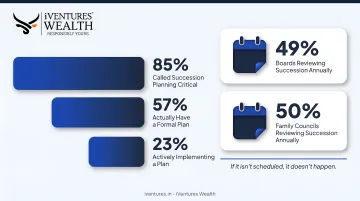
- 85% of family enterprise executives called succession planning critical in a recent Deloitte survey, yet only 57% actually had a plan, and just 23% were actively implementing one.
- Even more telling: only 49% of boards and 50% of family councils put succession on the agenda at least once a year.
- If it isn't scheduled, it doesn't happen. Succession competes with quarterly targets and daily fires, and it consistently loses out.
Complexity of Legal, Tax, and Wealth Structuring
Business wealth in India is rarely tidy. It's tangled up with real estate, cross-holdings between group entities, and personal investments that were never mapped against the business.
- Untangling all of it without expert guidance feels like opening a drawer you'd rather keep shut.
- Tools exist, including wills, private trusts, and family agreements, to structure the transfer clearly.
- A properly drafted trust, executed correctly under the Indian Trusts Act, can move assets to the next generation without a lengthy probate process.
- Many owners avoid these tools simply assuming the cost or complexity outweighs the benefit, often without ever getting an actual quote or consultation.
Uncertainty About Successor Readiness
Owners often have no real framework for judging whether the next generation, or an internal leader, is genuinely ready.
- Without clear criteria, "wait and watch" becomes the default position, sometimes for years.
- Reactive planning, triggered only by retirement, illness, or crisis, leaves almost no time to build a ready pipeline of successors.
- A structured framework, evaluating decision-making experience, stakeholder trust, and financial literacy, gives owners something concrete to measure against gut instinct.
The Real Cost of Delaying Succession Planning
Succession planning is a risk management exercise. Delaying it doesn't remove the risk, it just hands the decision to whoever's in the room when a crisis hits.
The financial evidence is sobering, even outside India:
| Source | Key Finding |
|---|---|
| Harvard Business Review analysis of 17 years of S&P 1500 data | Poorly managed transitions erase nearly $1 trillion in market value annually across US public companies |
| Family-business study of 200 publicly traded family firms | Shareholder returns fell 5.7 percentage points in the five years after a CEO transition; only 29% of handovers created value |
These are global, large-company figures. The underlying mechanism, though, an abrupt or poorly planned transition destroying value, applies just as much to a ₹50 crore family business as to a listed conglomerate.
Beyond the balance sheet, delayed planning raises the odds of family litigation once a founder passes away without a documented framework. Disputes over unequal contributions, informal promises, or ambiguous ownership stakes often end up in court, sometimes fragmenting a single business into competing factions overnight.
There's also a newer pressure: succession readiness now factors directly into investor due diligence. Private equity and institutional investors want clarity on leadership continuity before committing capital. A business entirely dependent on one person, with no visible succession plan, is a harder sell, regardless of how strong the numbers look.
Common Myths That Keep Owners Stuck
Three misconceptions do more damage than the actual complexity of succession planning:
| Myth | Reality |
|---|---|
| "Succession planning means giving up control now." | Proper planning allows a phased transition. You decide how much authority to retain, and for how long. |
| "We're not big enough to need this." | SMEs, LLPs, and professional practices face abrupt disruption without a plan. The need scales with dependency on one person, not company size. |
| "It's a legal document, so it can wait until we're older." | Succession planning is an ongoing governance and wealth-structuring practice, not a single form signed once and filed away. |
The second myth deserves closer scrutiny. A single-owner professional practice or a mid-sized manufacturing firm can be more exposed than a large conglomerate, simply because there's no bench of leadership to absorb a sudden gap.
A Practical Framework to Start Succession Planning Now
Succession planning doesn't have to start in a lawyer's office. It starts with a conversation, treated as a governance exercise rather than a personal confrontation.
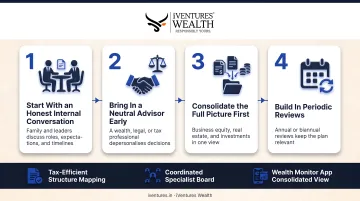
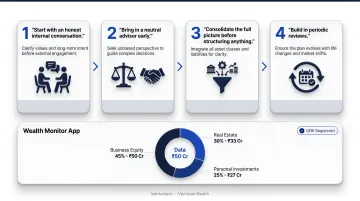
- Start with an honest internal conversation. Bring family members and key leaders together to discuss roles, expectations, and realistic timelines, framed as planning for the business's future, not a verdict on anyone's readiness.
- Bring in a neutral advisor early. A wealth, legal, or tax professional depersonalises decisions that feel loaded inside a family, and can help structure the actual transition through vehicles like private trusts or family agreements.
- Consolidate the full picture before structuring anything. Many founders have business equity, real estate, and personal investments scattered across entities, with nobody holding a single consolidated view. This is where a wealth partner earns its keep.
- Build in periodic reviews. A plan drafted once and filed away is already out of date the moment family circumstances, tax rules, or the business itself change. Annual or biannual reviews keep it relevant.
This is roughly where a firm like iVentures Wealth typically gets involved, bringing over 20 years of experience advising founders, CEOs, and family offices. Rather than drafting your will or registering your trust — work that sits with legal counsel — the firm focuses on architecting the framework first.
That framework typically includes:
- Mapping tax-efficient structures suited to your specific holdings
- Coordinating a board of specialists, including estate planners and legal advisors
- Giving families a consolidated view of their assets through tools like the Wealth Monitor App
As a SEBI-registered advisory firm, iVentures turns a vague intention to "sort out succession someday" into an actual, executable plan.
Frequently Asked Questions
Why do family business owners avoid succession planning?
Emotional factors, fear of losing control, mortality anxiety, and the risk of triggering family conflict drive the delay far more than a lack of awareness. Most owners know they need a plan; they just find it easier to defer.
What happens if a business owner dies without a succession plan?
The business often faces an immediate leadership vacuum, disrupting operations, client relationships, and lender confidence. Without documented intent, families are also far more likely to end up in disputes over ownership and asset division.
At what age should a business owner start succession planning?
There's no single correct age, but industry guidance favours starting years before retirement becomes imminent. Building a genuinely ready family or internal successor takes time that reactive planning doesn't allow.
Is succession planning only necessary for large businesses?
No. SMEs, family businesses, and professional practices are often more exposed, since they typically depend on one or two key individuals. The need scales with that dependency, not company size.
What is the difference between succession planning and estate planning?
Succession planning focuses on continuity of business leadership and control. Estate planning deals with distributing personal assets. The two overlap significantly for founders but solve different problems.
How does a family constitution help prevent succession disputes?
It sets out agreed, non-binding rules for roles, decision-making, and conflict resolution before a crisis forces the issue. That clarity removes much of the ambiguity that turns disagreements into lasting disputes.