The challenge is that not all global ETFs are equal — and 2025–2026 brought meaningful regulatory and tax changes that affect how these instruments work in practice.
This article covers the best global ETFs available to Indian investors in 2026, how to evaluate them properly, and what changed on the tax and regulatory front.
Key Takeaways
- Global ETFs on NSE/BSE give direct demat-account access to indices like Nasdaq 100, NYSE FANG+, and Hang Seng — no LRS required
- SEBI's overseas investment cap stands at USD 7 billion industry-wide, with a separate USD 1 billion cap for overseas ETFs
- Evaluate ETFs on expense ratio, tracking error, AUM, liquidity, and index concentration — not on 1-year returns alone
- USD-denominated global ETFs offer a dual return: asset growth plus potential rupee depreciation upside
- Post-Finance Act 2023, global ETFs on Indian exchanges are taxed as non-equity (debt) funds
Why Indian Investors Are Turning to Global ETFs in 2026
The Structural Case for Going Beyond India
India is a fast-growing market, but it represents a small slice of global listed equity. The US alone holds 63.5% of MSCI ACWI weight — India doesn't appear in the top five countries. An India-concentrated portfolio participates in one country's economic cycle while missing most of the world's investable opportunity.
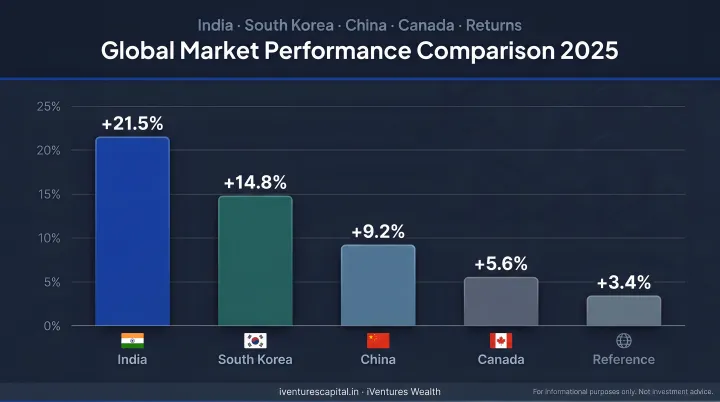
iVentures Wealth's advisory experience reinforces this directly: "Overconcentration in one country and currency squeezes both returns and safety." Their internal analysis found that while Indian equities delivered mid-single-digit returns in 2025, several global markets generated 2–4x higher performance during the same period — with South Korea delivering 77%, China 33%, and Canada 33%.
Global ETFs are also the cleanest solution to a sector gap. India's listed equity universe has limited representation in semiconductors, AI infrastructure, global healthcare innovation, and platform businesses. US-listed indices cover these themes directly.
The Rupee Depreciation Tailwind
FY2025-26 was the rupee's sharpest annual decline since FY2011-12, with a 9.85% fall against the US dollar. The RBI reference rate stood at ₹95.38/USD as of June 2026.
For global ETFs with USD-denominated underlying assets, this creates a dual-return mechanism:
- Asset return: the underlying index appreciates in USD terms
- Currency return: rupee depreciation means those USD gains are worth more in INR at redemption
iVentures structures dollar-denominated global portfolios partly for this reason — particularly for clients whose expenses or future obligations are linked to the US dollar.
What Changed in 2025–2026: SEBI and AMFI Updates
That currency tailwind is real — but regulatory limits shape how much of it Indian investors can actually capture through new fund inflows. Two constraints remain in place:
- SEBI's overseas investment caps: The industry-wide limit remains USD 7 billion for overseas securities, with a USD 1 billion per mutual fund ceiling. A separate USD 1 billion cap applies specifically to overseas ETFs (USD 300 million per fund), per SEBI's investor FAQ.
- AMFI's partial restoration: AMFI's June 2022 press note allowed fresh overseas subscriptions only to the extent of headroom created by redemptions after February 2022. SEBI's November 2024 circular addressed conditions for overseas mutual fund investments but did not lift the USD caps — so the constraint remains partially in place, not fully normalised.
This matters less than it sounds for most investors. Secondary-market trading in existing ETF units on NSE/BSE is not the same as an AMC deploying fresh overseas capital.
You can buy and sell listed global ETF units through your demat account without these caps directly affecting your transaction — but the AMC's ability to create new units backed by fresh overseas assets remains subject to headroom constraints.
Best Global ETFs to Invest in India 2026
The following ETFs are evaluated on AUM, liquidity, underlying index quality, expense ratio, and exchange availability. They are not ranked in order of preference — each serves a different risk-return profile.
Motilal Oswal Nasdaq 100 ETF (N100)
Launched on 29 March 2011, this is the oldest and largest US-focused international ETF on Indian exchanges. It tracks the Nasdaq 100 Total Return Index — 100 of the largest non-financial companies listed on Nasdaq, dominated by US technology and consumer internet names.
With 13+ years of history, N100 is the only international ETF on Indian exchanges with a full multi-cycle track record — including the 2022 tech correction and the recovery that followed. Its ₹12,800+ Cr AUM also translates into tighter secondary-market spreads, which matters for HNIs transacting in size.
| Parameter | Details |
|---|---|
| Underlying Index | Nasdaq 100 |
| Expense Ratio (TER) | 0.59% (as of April 2026) |
| 3-Year CAGR | ~34–36% (as of April–December 2025, verify on AMC page before investing) |
| AUM | ₹12,814.96 Cr |
| Tracking Error | 0.10% |
Mirae Asset NYSE FANG+ ETF (MAFANG)
Launched 6 May 2021, MAFANG tracks the NYSE FANG+ Index — a concentrated, equal-weighted basket of 10 highly traded global technology and tech-enabled companies. The index is designed and maintained by ICE with a rules-based methodology.
The concentration is both the appeal and the risk. Equal weighting across 10 positions means each company drives roughly 10% of returns — so strong cycles in US mega-cap tech translate into sharp outperformance, but drawdowns are equally amplified. This is suitable for investors with a high-conviction view on US technology and a clear risk appetite.
| Parameter | Details |
|---|---|
| Underlying Index | NYSE FANG+ Index |
| Expense Ratio (TER) | 0.66% (as of June 2026) |
| 3-Year CAGR | 37.74% |
| 1-Year Return | 33.90% |
| AUM | ₹4,258.21 Cr (June 2026) |
| Tracking Error | 0.05% |
Mirae Asset S&P 500 Top 50 ETF (MASPTOP50)
This ETF tracks the S&P 500 Top 50 Index — the 50 largest companies by market capitalisation within the S&P 500. Unlike the Nasdaq 100, which excludes financials and is heavily concentrated in growth tech, the S&P 500 Top 50 spans multiple sectors.
S&P Dow Jones's index methodology shows the sector breakdown: Information Technology 46.8%, Communication Services 16.0%, Consumer Discretionary 11.2%, Financials 9.0%, Healthcare 7.0%, and Consumer Staples 5.2%. Still mega-cap heavy, but more balanced than a 10-stock FANG+ basket.
| Parameter | Details |
|---|---|
| Underlying Index | S&P 500 Top 50 |
| Expense Ratio (TER) | 0.30% (verify current figure on AMC website) |
Note: AUM and return figures should be confirmed on the Mirae Asset ETF website before investing. Earlier data showed AUM of approximately ₹100 Cr as of early 2024 — liquidity should be checked before transacting.
Nippon India ETF Hang Seng BeES (HNGSNGBEES)
Launched 9 March 2010, this is one of the oldest international ETFs on Indian exchanges. It tracks the Hang Seng Index (HSI) — the benchmark for Hong Kong-listed large-cap stocks, which includes major Chinese platform companies.
The Hang Seng Index factsheet confirms that Alibaba, Tencent, and Meituan are among constituents. The HSI applies an 8% individual stock cap to control concentration.
This is the primary China/Hong Kong proxy available on Indian exchanges. Its 3-year CAGR of 17.82% trails N100's ~34–36% by a wide margin — a gap driven by China's regulatory crackdowns, property sector stress, and persistent geopolitical sentiment. The recent 1-year recovery to 31.90% is worth watching, but warrants scrutiny before reading as a structural re-rating.
| Parameter | Details |
|---|---|
| Underlying Index | Hang Seng Index |
| 1-Year Return | 31.90% (as of April 2026) |
| 3-Year CAGR | 17.82% (as of April 2026) |
| Expense Ratio (TER) | Verify current figure on Nippon AMC website |
Verify whether the recent Hang Seng recovery reflects structural re-rating or a short-term bounce before allocating.
How to Evaluate a Global ETF: What to Look For
The most common mistake investors make is selecting a global ETF based on 1-year returns, which often means buying after a peak. A proper evaluation framework combines four parameters:
1. Expense Ratio (TER)
Verified TERs across the ETFs above range from 0.30% to 0.66%. That spread compounds materially over a 10–15 year holding period. On a ₹1 Cr position held for 15 years, a 0.36% TER difference equals lakhs in fees, before accounting for compounding effects.
2. Tracking Error
Tracking error measures how closely the ETF mirrors its underlying index. Lower is better. From verified AMC data:
- MAFANG: 0.05% tracking error, indicating very tight replication
- MON100: 0.10% tracking error, which remains efficient
A high tracking error doesn't just mean underperformance. It signals the fund manager is struggling to replicate the index efficiently, often due to overseas headroom constraints or cash drag.
3. AUM and Liquidity
Higher AUM generally supports tighter bid-ask spreads on exchange. NSE classifies impact cost as the practical liquidity measure, not AUM alone.
Key checks before buying:
- Review live market depth (not just NAV)
- Use limit orders for HNI-sized tickets
- Avoid market orders in low-volume sessions
No official SEBI minimum AUM threshold exists. In practice, combining AUM, daily traded value, and bid-ask spread gives a more reliable read on real-world liquidity.
4. Underlying Index Concentration
| Index | Stocks | Structure |
|---|---|---|
| NYSE FANG+ | 10 | Equal-weighted |
| Nasdaq 100 | 100 | Modified market-cap weighted |
| S&P 500 Top 50 | 50 | Float-adjusted market-cap weighted |
| Hang Seng | ~80 | Free-float, 8% cap per stock |
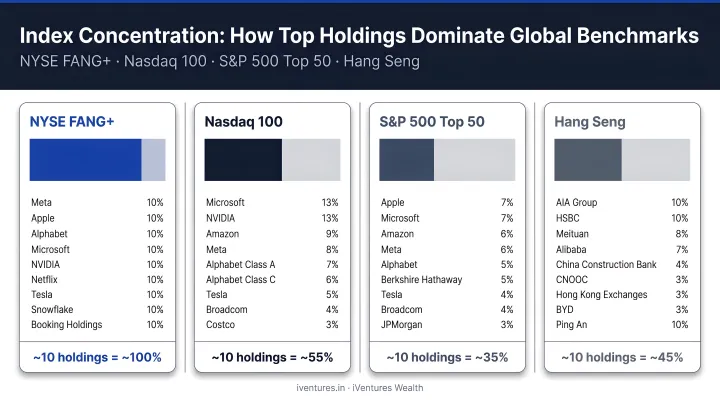
A 10-stock index like FANG+ behaves very differently from a 100-stock index like Nasdaq 100. Neither is inherently better: the right choice depends on how the ETF fits within a client's complete portfolio, not how it performs in isolation. At iVentures Wealth, ETF selection is always mapped against existing allocations, risk tolerance, and long-term objectives before a recommendation is made.
Tax Treatment of Global ETFs in India: 2026 Update
How Global ETFs Are Classified
Global ETFs listed on Indian exchanges — because they invest in foreign equities — are not classified as equity-oriented funds for tax purposes. This matters significantly for holding period and rate calculations.
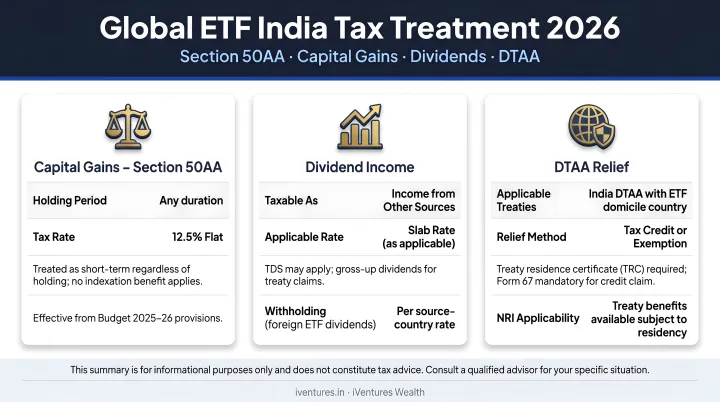
Finance Act 2023 introduced Section 50AA, which deems gains on units of specified mutual funds acquired on or after 1 April 2023 as short-term capital gains, regardless of holding period. Finance (No. 2) Act 2024 amended the definition further. Before making any specific tax assumption about your global ETF holdings, verify directly with AMFI's tax regime page or a qualified tax adviser — the treatment can differ based on acquisition date and the fund's specific classification.
Dividend Taxation
Dividends received from global ETFs are added to your income and taxed at your applicable slab rate. For UHNIs in the 30%+ bracket, this is a meaningful cost.
Where withholding tax is deducted at source — for example, under the US-India tax treaty or the India-Hong Kong DTAA — you can claim a foreign tax credit to offset the withholding against your Indian tax liability. Documentation for these credits requires coordination with a qualified tax adviser and careful ITR filing — something worth planning before the holding period closes.
Practical Implication for High-Net-Worth Investors
Taken together, dividend slab taxation and the Section 50AA treatment of capital gains point to the same conclusion: holding period management is the central tax discipline for global ETF investors.
Short-term gains taxed at slab rate (which can be 30%+ with surcharge) are materially more expensive than long-term gains. Always structure global ETF positions with a clear tax plan — and review it against the current Finance Act before acting.
Key tax considerations at a glance:
- Classification: Global ETFs are not equity-oriented funds — Section 50AA applies to acquisitions from 1 April 2023 onward
- Capital gains: Treated as short-term regardless of holding period under current rules; taxed at slab rate
- Dividends: Added to income and taxed at applicable slab rate (30%+ for most UHNIs)
- DTAA credits: Available for withholding taxes under US-India and India-Hong Kong treaties — requires documentation
- Review cycle: Verify classification and applicable rates against the current Finance Act before each transaction
Conclusion
Global ETFs on Indian exchanges remove the friction that previously kept domestic investors underexposed to international markets. No LRS transaction, no overseas brokerage account — just a standard demat account and a clear allocation decision.
The selection discipline matters as much as the access. Expense ratios, tracking error, index concentration, and liquidity all determine whether a global ETF actually delivers what its headline index promises. Recent returns are the least reliable input.
Getting that selection right within a broader, tax-efficient portfolio strategy is where independent advisory adds real value. iVentures Wealth, a SEBI-registered investment advisory firm (INA000019026), brings 20+ years of experience managing ₹1,200+ Cr for UHNIs and family offices — offering research-driven guidance aligned to your specific goals, tax bracket, and risk profile.
Frequently Asked Questions
Which global ETF is best in India?
The right choice depends on your risk appetite, geographic preference, and holding horizon. Motilal Oswal Nasdaq 100 (N100) offers the longest track record and largest AUM among US-focused ETFs; Mirae Asset FANG+ has delivered stronger recent 3-year returns but carries higher concentration risk. Verify current AUM rankings on AMFI or NSE before investing.
What are the top 3 international ETFs in India by AUM?
Based on verified data, Motilal Oswal Nasdaq 100 ETF (₹12,814 Cr) and Mirae Asset NYSE FANG+ ETF (₹4,258 Cr) are among the largest. For the third, check current AMFI AUM data for Nippon India Hang Seng BeES and Mirae Asset S&P 500 Top 50 ETF — AUM figures update monthly.
How are global ETFs taxed in India in 2026?
Global ETFs on Indian exchanges are generally treated as non-equity funds — and under the Finance Act 2023 and Finance (No. 2) Act 2024 amendments, gains on units acquired after 1 April 2023 may be deemed short-term regardless of holding period. Confirm the applicable rate with a SEBI-registered adviser based on your acquisition date.
Is there a limit on how much I can invest in global ETFs in India?
Exchange-listed global ETFs bought on NSE/BSE in INR do not require LRS remittance, but SEBI's industry-wide overseas cap (USD 7 billion; USD 1 billion for overseas ETFs) can restrict new unit creation at the AMC level even when secondary-market trading continues. Direct overseas investments through international brokers remain subject to the USD 250,000 annual LRS limit.
What is the difference between a global ETF and an international fund of funds?
Global ETFs trade on NSE/BSE like shares — intraday pricing, lower expense ratios, and direct index replication. International FoFs are mutual funds investing in overseas ETFs, priced at end-of-day NAV with an additional expense layer; AMFI's 2022 press note partially restored FoF inflows within redemption headroom, so confirm current status on AMFI's website before investing.
Can NRIs invest in global ETFs listed on Indian exchanges?
Yes — NRIs can invest through an NRE or NRO demat account, subject to standard FEMA regulations and SEBI guidelines. Tax treatment for NRIs may differ from resident Indians, and FEMA repatriation rules add compliance considerations. iVentures Wealth advises NRI and OCI clients on FEMA-compliant investment structuring and DTAA planning as part of its cross-border wealth management practice.