
SEBI built this framework back in August 2021 to give financially sophisticated investors a lighter-touch regulatory path. Three years on, awareness remains so low that even seasoned HNIs often discover it only when a wealth manager mentions it in passing.
This guide covers who qualifies, what accreditation actually unlocks, how the application works, and why adoption in India still lags so far behind markets like the US.
Key Takeaways
- SEBI's 2021 accredited investor framework cuts the PMS entry ticket to ₹10 lakh from ₹50 lakh.
- Eligibility depends on income, net worth, or both, verified via ITRs and a CA certificate.
- Only two agencies, CDSL Ventures and NSDL Data Management, currently grant certification.
- India had just 649 accredited investors as of May 2025, versus roughly 24 million in the US.
What Is a SEBI Accredited Investor?
An accredited investor is an individual or entity that a SEBI-recognised accreditation agency has formally certified as having the financial capacity and market sophistication to handle higher-risk, less-regulated products. It's a status you apply for and receive as a certificate, not something you're automatically granted just because your bank balance looks healthy.
This certified status became official through a series of regulatory actions in 2021:
- August 3, 2021: SEBI notified the AIF (Third Amendment) Regulations, creating the legal basis for accreditation
- August 6, 2021: The framework was confirmed at SEBI's board meeting
- August 26, 2021: A circular detailed the operational requirements for accreditation agencies
The logic behind it is straightforward. Retail investors need guardrails: disclosure norms, investment caps, standard fee structures. Someone who can absorb losses and understand complex structures doesn't need the same level of protection. So SEBI created a "regulation-light" arena where accredited investors trade some regulatory hand-holding for lower entry barriers and more flexible terms.
Eligibility Criteria: Who Can Become an Accredited Investor in India
Under SEBI's accredited investor framework, eligibility comes down to income, net worth, or a combination of both. You prove it through your income tax returns or a net worth certificate from a practising Chartered Accountant. One useful detail: your primary residence is excluded from net worth calculations, so you can't inflate eligibility just by owning an expensive home.
Individuals, HUFs, and Family Trusts
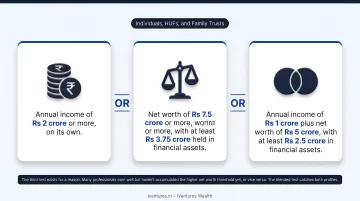
You qualify if you meet any one of these three tests:
- Annual income of Rs 2 crore or more, on its own
- Net worth of Rs 7.5 crore or more, with at least Rs 3.75 crore held in financial assets
- Annual income of Rs 1 crore plus net worth of Rs 5 crore, with at least Rs 2.5 crore in financial assets
The third test exists for a reason. Many professionals earn well but haven't accumulated the higher net worth threshold yet, or vice versa. The blended test catches both profiles.
Body Corporates, LLPs, and Partnership Firms
Companies and LLPs need a net worth of Rs 50 crore or more, based on their latest audited financials. Partnership firms work differently: there's no single entity-level test. Instead, each partner individually must meet the personal eligibility criteria listed above.
Trusts (Other Than Family Trusts) and Institutional Entities
Non-family trusts need a net worth of Rs 50 crore or more to qualify. Certain institutions skip the application altogether and are automatically deemed accredited, including:
- Qualified Institutional Buyers (QIBs)
- Category I Foreign Portfolio Investors
- Sovereign wealth funds
- Government-backed development agencies such as SIDBI and NABARD
Benefits of Becoming an SEBI Accredited Investor
The core advantage is access to products and terms that simply aren't on the table for regular investors. Once certified, you step into a regulation-light framework where fund managers can offer more flexible structures because SEBI assumes you understand the risks.
Lower Minimum Investment Thresholds
This is usually the biggest draw. Standard PMS entry sits at Rs 50 lakh, but SEBI's December 2021 circular on portfolio management services for accredited investors permits accredited clients to enter at Rs 10 lakh. That's a fifth of the usual ticket size.
Practically, this means:
- Diversifying across 4-5 PMS strategies with the same corpus that would previously buy into just one
- Testing a manager's approach with a smaller allocation before committing more
- Building a genuinely multi-strategy portfolio rather than betting everything on a single house view
AIF thresholds work differently. The standard minimum for most AIF schemes is Rs 1 crore, and employees or directors of the fund manager get a reduced Rs 25 lakh entry point. SEBI has also proposed AI-only AIF schemes with no fixed minimum at all, letting fund managers set commitment sizes on a case-by-case basis.
Access to GIFT City and Overseas Opportunities
Regular investors need to commit at least USD 150,000 to invest in restricted schemes at GIFT City, India's international financial services centre. Accredited investors are exempt from this numeric threshold entirely, meaning individual funds can set far lower entry points for AI clients.
Why does this matter beyond the lower ticket size? Your Liberalised Remittance Scheme (LRS) limit of USD 250,000 a year gets used up fast when a single GIFT City commitment eats USD 150,000 of it. A lower entry point frees up headroom for other goals, whether that's a child's overseas education fund or a separate global equity allocation.
Relaxed Exposure Limits and Exit Flexibility
Ordinary non-discretionary PMS mandates typically cap unlisted securities at 25% of client assets. Under the large-value accredited investor structure, that concentration limit can go up to 100% in unlisted securities, provided the client commits at least Rs 10 crore. Exit terms in these large-value structures also tend to be more tailored, negotiated between the manager and investor rather than fixed by a standard template.
Flexible Fee Structures and Combined Advisory-Distribution Services
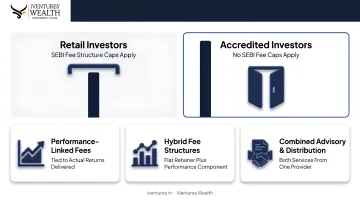
SEBI caps how registered investment advisers structure fees for retail clients. Those caps don't apply to accredited investors. That opens the door to:
- Performance-linked fee arrangements tied to actual returns delivered
- Hybrid structures blending a flat retainer with performance components
- Advisory and distribution services from the same provider, which regular investors typically can't combine under the standard RIA framework
How to Get Accredited: Step-by-Step Process
Right now, only two agencies handle accreditation in India: CDSL Ventures Limited (CVL) and NSDL Data Management Limited (NDML). SEBI's June 2025 consultation paper proposed expanding this to all five SEBI-registered KYC Registration Agencies, so the applicant pool for agencies should widen over time.
Documents you'll need:
- PAN card
- Aadhaar, passport, or driving licence for identity verification
- Income tax returns for the last three years, or acknowledgements
- A net worth or income certificate from a practising Chartered Accountant (issued within the last six months)
- A declaration confirming no regulatory debarment
The application itself follows a simple sequence:
- Submit your documents to the accreditation agency of choice
- The agency verifies your financial details against the eligibility criteria
- You receive your accreditation certificate once verification clears
CVL states that a complete, error-free application can be processed in as little as 3 business days, though real-world timelines often stretch longer if documents need revisions or clarifications.
Validity and cost: Certificates last 2 years by default, extending to 3 years if you've met the eligibility criteria for the two preceding financial years.
For individuals, HUFs, and sole proprietors applying through CVL, the total cost breaks down as follows:
| Validity Period | Total Cost |
|---|---|
| 2 years | ₹10,000 |
| 3 years | ₹14,500 |
Corporate and trust applicants pay more, since their tariff slabs are higher.
SEBI has also floated a reform allowing provisional onboarding by AIFs while certification is pending, which should reduce the friction that currently discourages both advisers and investors from completing the process.
Why So Few Indians Are Accredited Investors
Here's the gap that should concern anyone tracking India's private markets: as of May 29, 2025, SEBI's data shows just 649 accredited investors across individuals, trusts, and corporates combined. Compare that to the roughly 24 million accredited investors in the US, and the scale of the disconnect becomes obvious.
A few reasons explain this:
- Low awareness. Most HNIs and even some family offices simply don't know the framework exists.
- Disclosure reluctance. Sharing detailed net worth and income documentation with a third-party agency feels intrusive to many affluent Indians.
- Process friction. A sequential, multi-week application discourages both investors and the wealth advisers who would otherwise recommend it.
- Limited incentive to accredit. Accreditation isn't mandatory to invest in PMS or AIFs at standard thresholds, so many simply skip it.
SEBI's proposed fixes, expanding the list of accreditation agencies and permitting provisional onboarding, should reduce some of this friction. Whether that translates into meaningfully higher adoption remains to be seen.
How iVentures Wealth Helps You Navigate Accreditation
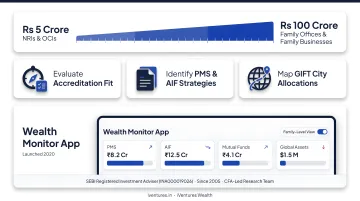
At iVentures Wealth, we work almost exclusively with the segment SEBI designed this framework for. Our minimum engagement thresholds start at Rs 5 crore for NRIs and OCIs and go up to Rs 100 crore for family offices and family businesses. This means many of our clients already meet or exceed the accredited investor net worth criteria before we've had the first conversation.
Meeting the threshold is only the starting point. We've been advising clients since 2005 and hold SEBI Registered Investment Adviser status (INA000019026), backed by a CFA-led research team that evaluates PMS, AIF, and GIFT City opportunities on a product-neutral basis. That matters here because accreditation only creates value if you know what to do with it. Getting certified and then defaulting to the first fund a distributor pitches defeats the purpose.
Our role is to help clients understand:
- Evaluate whether the accreditation route fits their specific goals and time horizon
- Identify which PMS or AIF strategies suit their risk profile once lower entry thresholds open up
- Map how GIFT City allocations fit into a broader cross-border wealth structure alongside LRS planning
Once you're accredited and invested across multiple mandates, tracking becomes its own challenge. Our Wealth Monitor App, launched in 2020, consolidates holdings across PMS, AIF, mutual funds, and global assets into one dashboard, with family-level views so nothing sits in a silo. For a client running four or five diversified PMS strategies post-accreditation, that consolidated view is often more valuable than the accreditation itself.
Frequently Asked Questions
How to be an accredited investor in India?
You need to meet SEBI's income or net worth criteria and apply through a recognised accreditation agency, currently CDSL Ventures or NSDL Data Management, with supporting ITRs and a CA-certified net worth statement.
What are the benefits of being an accredited investor in India?
Key benefits include PMS entry at ₹10 lakh instead of ₹50 lakh, lower GIFT City thresholds, relaxed exposure limits in large-value structures, flexible fee negotiations, and access to private placements not open to retail investors.
How many accredited investors are there in India?
SEBI data shows just 649 accredited investors as of May 2025, a fraction of the roughly 24 million in the US, reflecting how little awareness this framework has despite being three years old.
Who are the SEBI-approved accreditation agencies in India?
Currently, only CDSL Ventures Limited and NSDL Data Management Limited are authorised to grant accreditation. SEBI has proposed expanding this to all five registered KYC Registration Agencies to widen access.
Is SEBI accreditation mandatory to invest in PMS or AIF?
No, accreditation is entirely optional. Regular investors can still invest in PMS and AIFs at standard thresholds; accreditation simply unlocks lower entry points and relaxed norms for those who qualify.
How long is the accredited investor certificate valid?
Certificates are valid for 2 years by default, extending to 3 years if you met the eligibility criteria in each of the two preceding financial years. Renewal requires updated financial proof.