Introduction
Leadership transitions at the C-suite level are inevitable. Yet most boards are caught off guard when one actually arrives.
The numbers are striking: only 51% of directors report their company has a written CEO succession plan, meaning nearly half of all boards are operating without one. The cost of that gap isn't abstract — Harvard Business Review estimates that poorly managed successions destroy approximately US$112 billion in market value annually across the S&P 1500.
This guide covers the full picture of CXO succession planning, including:
- The four types of succession events boards face
- A five-step planning framework for structured transitions
- The most common failure modes — and how to avoid them
- What a leadership transition means for the departing executive's personal wealth (a dimension most governance guides skip entirely)
Whether you're a board member formalising a succession policy or a CXO thinking about what comes next, this guide gives you the framework to act before the transition is forced upon you.
Key Takeaways
- Most boards globally have no written CXO succession plan — a gap that destroys significant enterprise value when transitions hit
- Succession planning covers four distinct scenarios: planned, board-initiated, emergency, and developmental pipeline
- The five-step framework starts with future strategy, not current candidates
- Close to half of leadership transitions fail due to poor onboarding; naming a successor is not the finish line
- For the transitioning CXO, a career change is a major personal financial event requiring ESOP, equity, and estate planning — ideally 12–24 months before exit
What Is CXO Succession Planning — And Why It Goes Beyond CEO
Most boards think about succession planning as a CEO-level concern. It isn't. Every C-suite role — CFO, COO, CHRO, CTO — carries institutional knowledge and strategic relationships that can destabilise an organisation when they walk out the door unexpectedly.
CXO succession planning is the ongoing process of identifying, developing, and preparing qualified successors for all critical executive roles, not just the top seat.
Reactive vs. Proactive Succession
The distinction that separates well-governed organisations from poorly prepared ones:
- Reactive succession means scrambling to fill a vacancy after it appears — interviewing under pressure, making rushed decisions, and accepting avoidable risk
- Proactive succession means maintaining a living plan built years in advance, with assessed candidates, development programmes, and a clear handover playbook ready before anyone announces they're leaving
Sound governance treats succession as a continuous organisational strategy — one that's built long before any resignation letter arrives.
The Indian Regulatory Context
For listed companies in India, this isn't just good governance — it's a regulatory expectation. Two key frameworks define the regulatory baseline:
- SEBI LODR Regulation 17(4): Requires boards to satisfy themselves that plans are in place for orderly succession across both board-level and senior management appointments
- Kotak Committee on Corporate Governance (2017): Recommended that boards meet at least once annually to specifically address succession planning and KMP transitions
Boards of listed entities without a documented, board-approved succession policy are operating outside governance best practice — and outside the spirit of these requirements.
Why Most CXO Succession Plans Fail Before They Start
Understanding why succession plans fail is as important as knowing what a good one looks like.
The Readiness Gap
Research cited by NACD shows 17% of boards report having no viable internal CEO candidates at all. Meanwhile, CEO turnover has remained elevated — Strategy& recorded 17.5% CEO turnover among the world's 2,500 largest companies, with roughly 20% of exits being forced. Activist investors, AI-driven disruption, and faster board cycles have compressed the window between a performance concern and an exit demand.
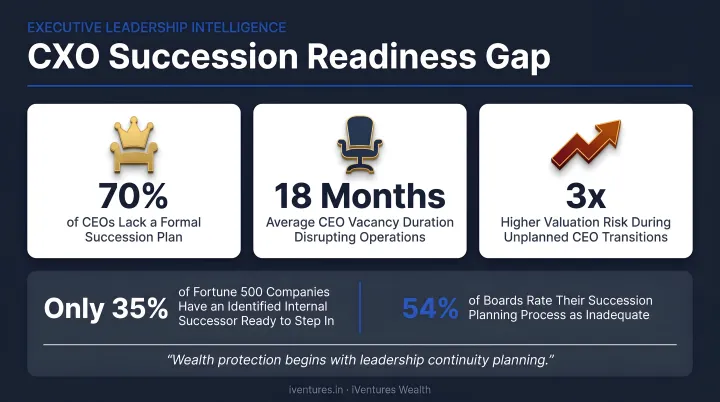
When that window closes without a credible successor in place, boards are left managing a crisis rather than executing a strategy.
The Cloning Problem
Boards and incumbent CXOs frequently identify successors in their own image — someone who performs well in the current environment, reflects the existing culture, and validates the outgoing leader's decisions. The result: a successor built for yesterday's challenges.
HBR identifies incumbent-CEO bias, recency bias, and visibility bias as the three most persistent failure modes in executive selection. The CFO who presents most confidently in board meetings may not be the right choice if the organisation's next chapter demands operational transformation or international expansion capabilities.
That gap between visible performance and actual future-readiness is where most succession decisions quietly go wrong.
The Delay Trap
Most organisations wait too long. By the time a transition feels imminent, there isn't enough runway to assess, develop, or properly onboard a successor. The consequences follow a familiar pattern: shortcuts in assessment, inadequate development, and a new leader who arrives without the preparation or stakeholder relationships needed to succeed.
Starting fewer than 12 months before a transition is needed leaves almost no margin for course correction — particularly if the primary internal candidate turns out to be less ready than expected.
The 4 Types of CXO Succession
Not all succession events look alike. Organisations must plan for four distinct scenarios — each requiring a different level of readiness and a different response.
Planned Succession
The ideal scenario. The incumbent CXO announces their intent to step down months or years in advance, giving the board time to develop an internal candidate, structure the handover, and communicate thoughtfully with investors and employees.
A well-managed planned succession includes:
- A defined overlap period where outgoing and incoming leaders work in parallel
- Milestone-based transition timelines (not just a calendar hand-off date)
- A proactive investor and stakeholder communication strategy
- A clear articulation of what continuity looks like under new leadership
Board-Initiated Succession
These transitions — driven by performance failure, strategic misalignment, or cultural breakdown — require discretion, speed, and a credible interim option that's already in place. The organisation cannot afford a leadership vacuum while conducting a formal search.
Boards that have handled this well almost always had the following in place before the decision was made:
- A pre-identified interim candidate with clear authority
- A communications playbook covering employees, investors, and key stakeholders
- A timeline for initiating a permanent search
Emergency Succession
Sudden incapacitation, death, or a forced exit with no notice — this is the highest-risk scenario, and the one organisations are least prepared for. An emergency succession protocol must include:
- A pre-identified interim leader and an alternate
- A first-72-hours action plan with clear decision authority
- Pre-drafted communications for employees, investors, regulators, and clients
- A formal trigger mechanism to launch a permanent search
McDonald's demonstrated what this looks like in practice. When CEO Jim Cantalupo died suddenly in 2004, the board elevated Charlie Bell within hours — a function of deep bench preparation, not luck.
Developmental/Pipeline Succession
The most sophisticated form: an always-on model where the organisation continuously identifies, assesses, and develops a bench of CXO-ready leaders across all critical functions.
Organisations that operate this way are rarely blindsided. They maintain multiple credible options in development at any given time — so no single departure restarts the entire process from scratch.
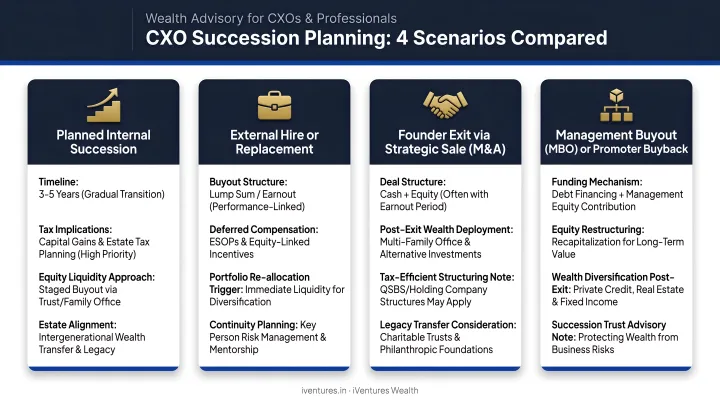
The 5-Step CXO Succession Planning Framework
This framework applies to any CXO role, whether the transition is 12 months or 5 years away.
Step 1: Define the Leadership Requirements for the Future
Start here — not with candidates. The first step is defining what the next CXO must be built for.
Anchor the successor profile to the organisation's 3–5 year strategy, not its current state. A CFO whose successor must navigate an IPO requires very different criteria than one whose successor will manage post-acquisition integration. These criteria must be refreshed annually as strategy evolves — a profile built in 2022 may be the wrong template in 2025.
Step 2: Assess the Internal Talent Pool
Systematically evaluate which internal executives have genuine successor potential — distinct from those who are strong performers in their current role but not yet CXO-ready. Use structured assessments, skills matrices, and external benchmarking to keep this evaluation objective rather than political.
The goal is an honest answer to: "Who is genuinely 18–24 months away from being ready, and what specifically would make them ready?"
Step 3: Benchmark Against External Candidates
Even when a strong internal successor exists, boards should maintain a short list of external candidates. This serves three purposes:
- Keeps internal assessments calibrated against market reality
- Signals to investors that the process is rigorous and unbiased
- Provides a genuine fallback if the internal candidate departs unexpectedly
Step 4: Build Targeted Development Plans
Identified successors need structured development across multiple dimensions:
- Rotational assignments that stretch their functional exposure
- Board-level visibility to build governance experience
- Crisis leadership opportunities, real or simulated
- Direct mentorship from the incumbent CXO
Be cautious about premature promotion into a COO or deputy role unless both the board and CEO are confident the candidate will be ready in time.
Step 5: Execute the Transition and Onboard Deliberately
Naming a successor is not the finish line. McKinsey research shows nearly half of leadership transitions fail — not because of the wrong choice, but because the new leader wasn't set up to succeed.
A thoughtful transition includes:
- Structured overlap with the outgoing CXO
- Clear 30-60-90 day milestone expectations
- A stakeholder communication and relationship-transfer strategy
- An explicit understanding of the outgoing executive's post-transition role (advisory, board, full exit)
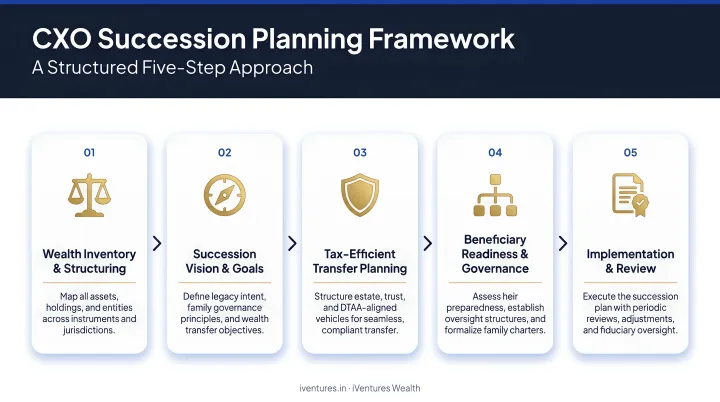
Common Mistakes in CXO Succession Planning
The Delegation Trap
Boards often delegate succession planning entirely to the incumbent CXO. This is structurally flawed. An incumbent may — consciously or not — stall the process, favour loyal lieutenants, or protect their own tenure by keeping successors underdeveloped.
The Nomination or Governance Committee must own the process. The incumbent CXO should serve in an advisory and talent development capacity, but should step back meaningfully as final selection nears.
Recency Bias in Candidate Selection
Boards default to the most visible internal candidate rather than the most development-ready one. Candidates tend to get evaluated on visibility — not readiness. The executive who:
- performs well in board presentations
- has been in post the longest
- managed the most recent high-profile project
...gets favoured over someone better prepared for the organisation's next strategic phase.
The Communications Failure
When succession planning becomes an open secret without an official narrative, destabilising speculation fills the gap. High-potential executives wonder if they're in contention. Current CXOs feel undermined, and teams start hedging.
The two-track approach works best: maintain appropriate confidentiality during the planning phase, then communicate transparently and specifically when a transition is announced. Timing and sequencing matter — a poorly staged announcement can undo months of careful planning in a single week.
Each of these mistakes shares a common thread: they treat succession as an administrative event rather than a strategic priority. Addressing them early determines whether a leadership transition strengthens the organisation or destabilises it.
The Personal Wealth Implications of a CXO Transition
For the organisation, a leadership change is a governance event. For the transitioning CXO, it's a major personal financial event — and most don't plan for it nearly early enough.
Equity Compensation: The Complexity Is Real
Depending on how the exit is structured, a departing CXO may be sitting on a significant concentration of:
- ESOPs — taxed as a perquisite at exercise under Income Tax Act Section 17(2); gains above FMV taxed as capital gains on sale
- Unvested equity — typically lapses on exit, making resignation timing financially consequential
- Deferred compensation — payouts may be tied to vesting schedules and blackout windows
- Performance-linked payouts — often contingent on conditions that a mid-tenure exit can forfeit
Each carries distinct timing, tax, and liquidity considerations.
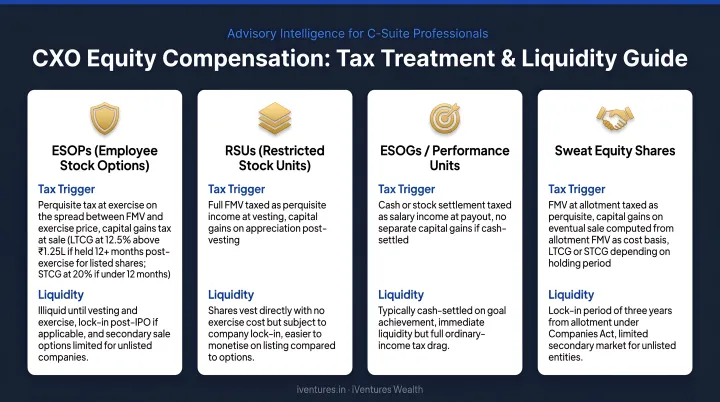
The tax outcome from a voluntary exit versus a board-initiated one can differ substantially — shaped by vesting schedules, blackout windows, and how quickly equity can be liquidated post-departure. Executives who model these scenarios only after announcing their exit often find their options already constrained.
Start the Conversation Early
CXOs should begin working with a wealth advisor 12–24 months before an anticipated transition to model exercise and sale scenarios, structure the timing of realised gains, and build a post-exit portfolio plan before urgency forces decisions.
iVentures Wealth works with CXOs navigating exactly this: ESOP structuring, equity monetisation, and post-exit portfolio planning. As a fee-only, SEBI-registered adviser, the firm has no product commissions and no shelf restrictions — advice is structured entirely around the client's financial outcome.
Estate Planning: The Overlooked Trigger
For CXOs who have accumulated significant wealth, a leadership transition is often the right moment to review wills, trust structures, and intergenerational transfer plans. The organisational succession event and the personal wealth succession event frequently need to happen in parallel.
A post-exit liquidity event (ESOP exercises, deferred compensation payouts, equity monetisation) changes the composition of a CXO's estate materially. Without updated structures, the default outcome — intestate succession or an outdated will may bear no resemblance to what the executive actually intends.
iVentures coordinates across tax advisory, legal counsel, and investment planning for clients at this stage — providing a single point of accountability across specialists rather than leaving the executive to manage fragmented advice independently.
Frequently Asked Questions
What are the 5 steps of succession planning for CXOs?
The five steps are:
- Define future leadership requirements anchored to strategy
- Assess the internal talent pool objectively
- Benchmark against external candidates
- Build targeted development plans for identified successors
- Execute a deliberate transition with structured onboarding
The process starts years before a vacancy — not after one appears.
What are the 4 types of succession in CXO succession planning?
The four types are:
- Planned succession — advance notice, structured handover
- Board-initiated succession — performance or strategic exit
- Emergency succession — sudden vacancy with no notice
- Developmental/pipeline succession — always-on bench building
Each type demands a different readiness level and a distinct response plan.
How do you create a succession plan for CXOs?
Start by anchoring the successor criteria to where the organisation is headed — not where it is today and not on the incumbent's personal profile. Then systematically build and assess a pipeline of internal and external candidates, with structured development plans that close identified gaps over a multi-year horizon.
When should CXO succession planning begin?
The moment a CXO steps into the role. No later than 2–3 years before an anticipated transition. Starting late leaves insufficient runway to develop internal candidates and forces the rushed, reactive decisions that create value destruction.
What is the board's role in CXO succession planning?
The board — through its Nomination or Governance Committee — owns the process. The incumbent CXO plays an advisory and talent development role but should step back as final selection nears to avoid the bias and conflict of interest that comes from an outgoing leader controlling their own replacement.
How does succession planning affect the personal wealth of a departing CXO?
A CXO exit triggers major financial events — ESOP exercises, equity liquidation, deferred compensation payouts, and estate structure reviews. The timing of these decisions, especially ESOP tax treatment at exercise versus sale, can materially shift the net outcome. Engaging a fiduciary wealth advisor 12–24 months before a planned exit gives you enough runway to manage this well.