
Introduction
Every trustee eventually faces the same question: surplus money is sitting in a bank account earning next to nothing, and mutual funds look tempting. Can the trust actually invest that money?
The honest answer isn't a simple yes or no. It depends entirely on what kind of trust you're running.
A private family trust set up for succession planning operates under completely different rules than a charitable trust registered for tax exemption. Trustees who don't understand this distinction risk either losing tax benefits or breaching their fiduciary duty.
This article breaks down the legal basis for trust investments in mutual funds and the restrictions that apply to each trust type. It also covers the practical steps trustees need to follow before writing that first cheque.
Key Takeaways
- Private trusts need express trust deed authorisation to invest in mutual funds
- Charitable trusts must invest per Income Tax Act Section 11(5), including Section 10(23D) funds
- Maharashtra's 2025 Circular No. 619 permits up to 50% in listed shares and mutual funds
- Foreign contributions under FCRA can never be routed into mutual funds
- A SEBI-registered advisor keeps trustees compliant while meeting the trust's financial goals
Legal Framework: Can a Trust Legally Invest in Mutual Funds in India?
The legal answer splits into two tracks, and mixing them up is where most trustees go wrong.
Private trusts and Section 20
Section 20 of the Indian Trusts Act, 1882, substituted in 2016 and effective from April 2017, governs private trust investments. It requires trust money to go into a security or class of securities expressly authorised by the trust instrument, or one notified by the Central Government if the deed is silent.
A silent trust deed doesn't automatically permit mutual fund investment — it defaults to Government-notified securities only. Trustees need the deed to clearly authorise mutual fund units or a broad enough security class before proceeding.
Charitable trusts and Rule 17C
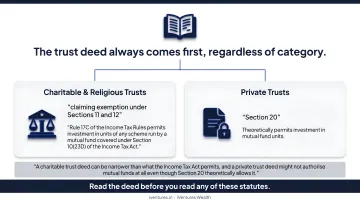
Charitable and religious trusts claiming exemption under Sections 11 and 12 answer to a different authority. Rule 17C of the Income Tax Rules permits investment in units of any scheme run by a mutual fund covered under Section 10(23D) of the Income Tax Act.
Here's the core distinction trustees must internalise:
| Trust Type | Governing Law | Investment Basis |
|---|---|---|
| Private/Family Trust | Indian Trusts Act + Trust Deed | Deed must expressly authorise mutual funds |
| Charitable/Religious Trust | Income Tax Act Section 11(5) + Rule 17C | Must be Section 10(23D) qualifying schemes |
The trust deed always comes first, regardless of category. A charitable trust deed can be narrower than what the Income Tax Act permits, and a private trust deed might not authorise mutual funds at all even though Section 20 theoretically allows it. Read the deed before you read any of these statutes.
Private Trusts vs Charitable Trusts: Why the Rules Differ
Private and Family Trusts
Family trusts built for estate planning and intergenerational wealth transfer enjoy far more flexibility than their charitable counterparts. They aren't bound by Section 11(5) at all. Their constraints come from the deed and general trust law instead.
Practically, this means a well-drafted family trust can invest across:
- Equity mutual funds for long-term wealth compounding
- Debt funds for stability and near-term liquidity
- Hybrid schemes for a blended risk profile
Family offices frequently use this latitude to build diversified, multi-generational portfolios instead of parking everything in fixed deposits. The trade-off is fiduciary responsibility: trustees still owe beneficiaries a duty of care, and that duty limits how aggressively they can invest.
Charitable, Public, and Religious Trusts
Charitable trusts operate inside a much tighter box. Under Section 11(5), permissible investments must be in mutual funds recognised under Section 10(23D). Some states go further:
- Maharashtra requires investments to align with Charity Commissioner-approved criteria
- Trusts must satisfy the 85% income application rule under Section 11(1)(a); any unapplied balance stays within Section 11(5) modes
There's one restriction that trips up NGOs constantly: foreign contributions cannot go into mutual funds. FCRA, 2010 rules explicitly classify mutual funds as speculative investments when funded by foreign money.
A trust can hold domestic surplus in a compliant mutual fund scheme while keeping every rupee of foreign contribution in a segregated, FCRA-compliant account. Mixing the two is a compliance disaster waiting to happen.
Practical Steps for Trustees to Invest in Mutual Funds
Getting this right isn't complicated, but skipping a step can cost the trust its tax exemption. Follow this sequence:
- Review the deed and pass a resolution. Confirm the investment clause authorises mutual funds, then have the trustee board formally resolve to proceed.
- Complete trust-specific KYC. AMCs and RTAs will need the trust deed, registration certificate, PAN, and details of authorised signatories before opening an account.
- Match schemes to purpose. Liquid or debt schemes suit near-term charitable disbursements; equity or hybrid schemes suit long-term family wealth growth. Charitable trusts must additionally confirm the scheme qualifies under Section 10(23D).
- Maintain compliance records. Charitable trusts need Form 10B (or 10BB) audit reporting annually, plus any state trust act filings that apply.
- Rebalance and monitor periodically. Markets shift, and so do a trust's objectives. Working with a SEBI-registered advisor like iVentures Wealth helps trustees build portfolios aligned to the trust's purpose without drifting into non-compliant territory.
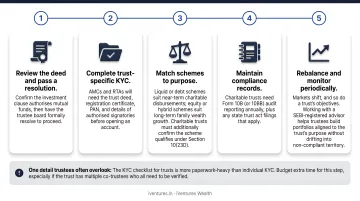
One detail trustees often overlook: the KYC checklist for trusts is more paperwork-heavy than individual KYC. Budget extra time for this step, especially if the trust has multiple co-trustees who all need to be verified.
Key Restrictions and Compliance Pitfalls to Avoid
Compliance failures here aren't minor — they can be expensive.
The big one: under Section 13(1)(d), even a single investment outside the permissible Section 11(5) modes can jeopardise the exemption on the trust's relevant income, taxed instead at the maximum marginal rate. One wrong scheme selection can undo years of careful tax planning.
The Maharashtra exception (and its limits): Circular No. 619, dated 21 July 2025 allows Maharashtra public trusts to invest up to 50% of trust money in listed shares and mutual funds, subject to conditions:
- Equity-oriented mutual funds need at least 65% invested in listed body corporates
- Listed shares require the issuer to have a market capitalisation of at least ₹5,000 crore
- Debt instruments need minimum AA ratings from two SEBI-registered credit rating agencies
This permission comes with strict conditions attached. Trusts registered in other states can't assume the same liberalisation applies to them; Rajasthan, for instance, still operates under its own, more conservative framework.
Because CBDT rules and state notifications change periodically, trustees should schedule a legal and tax review at least once a year, not just when a new investment is being considered.
Why Trusts Choose Professional Wealth Advisory for Mutual Fund Investments
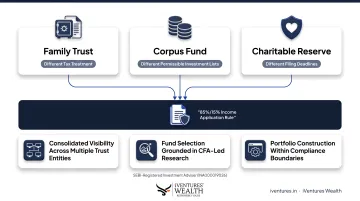
Trustees managing multiple entities — a family trust, a corpus fund, a charitable reserve — face a reporting and compliance load that individual investors simply don't deal with. Each entity may have different tax treatment, different permissible investment lists, and different filing deadlines.
This is where a dedicated advisory relationship earns its keep. iVentures Wealth, a SEBI-registered investment advisory firm (INA000019026) based in Gurugram, works with trusts, family offices, and charitable institutions among its client segments. The firm's research-driven, product-neutral approach means fund recommendations aren't tied to commissions or in-house products.
For trustees, this translates into:
- Consolidated visibility across multiple trust entities rather than fragmented statements from different AMCs
- Fund selection grounded in CFA-led research rather than distributor incentives
- Portfolio construction that respects the trust's specific compliance boundaries, whether that's the 85%/15% income application rule or a family trust's long-term growth mandate
Bringing in a fiduciary advisor doesn't remove the trustee's legal responsibility, but it does reduce the odds of an avoidable compliance misstep.
Frequently Asked Questions
Can a trust invest in mutual funds?
Yes. Both private and charitable trusts can invest in mutual funds, but private trusts follow the Indian Trusts Act and their deed, while charitable trusts must comply with Section 11(5) of the Income Tax Act.
Should I invest through a trust?
Trusts offer real benefits for estate planning, succession, and asset protection, but they come with compliance overhead. A SEBI-registered adviser like iVentures Wealth can help assess whether the structure actually fits your goals before you set one up.
What is the average return on a trust fund?
There's no such thing as a fixed "trust fund return" — a trust's returns depend entirely on the underlying mutual funds or assets chosen. Check the specific fund category's benchmark and historical performance instead.
Which mutual funds are approved for charitable trust investment in India?
Funds registered under Section 10(23D) of the Income Tax Act qualify for charitable trust investment. Some states, including Maharashtra, also maintain Charity Commissioner-approved scheme criteria.
Does a trust need special KYC to invest in mutual funds?
Yes. Trust-specific KYC is mandatory before investing, and AMCs/RTAs will require the trust deed, registration certificate, PAN, and authorised signatory details.
Can a private family trust invest in equity mutual funds without restriction?
Largely yes, provided the trust deed expressly permits it. Private trusts fall under the Indian Trusts Act rather than the Section 11(5) restrictions that apply to charitable trusts.