

That assumption breaks down fast. Many families discover years later — often through a tax notice or a sibling dispute — that this rent was never treated as reportable, plannable income. India abolished estate duty back in 1985, which means inheriting a property itself attracts no tax. The rent it generates is a completely different story.
This article reframes inherited rental income as what it actually is: an asset that demands tax planning, honest cost accounting, and a long-term strategy, not passive collection.
Key Takeaways
- Rental income from inherited property is taxable under "Income from House Property"—the inheritance itself isn't
- Municipal taxes, repairs, and compliance costs erode what feels like free cash flow
- Selling later triggers capital gains tax based on the original owner's cost and holding period
- NRIs face added FEMA, TDS, and repatriation rules most first-time heirs never anticipate
- A structured wealth plan beats passively collecting rent for decades
The "Free Money" Myth: What Inherited Rental Income Really Costs You
Heirs tend to mentally separate inherited income from earned income. Rent from a property you didn't buy feels like a windfall, so it gets under-reported, under-planned, or simply ignored until a notice arrives.
Here's the legal reality: inheriting the property is exempt, but renting it out is not. The Income Tax Act treats this rent exactly like rent from any property you purchased yourself.
The Costs and Compliance Burden That Erode Your "Free" Income
Several recurring expenses reduce what actually lands in your account:
- Municipal property tax — payable annually regardless of whether the property is rented
- Society maintenance charges — often non-negotiable, especially in urban apartments
- Repairs and renovation — older ancestral properties typically need more upkeep
- Property management costs — relevant if you live in a different city or country
Beyond these direct costs, a paperwork trail catches many heirs off guard:
- Mandatory disclosure in your income tax return, every single year
- Advance tax obligations if the rental income crosses relevant thresholds
- Record-keeping for the original owner's purchase documents, which you'll need decades later when you sell
When Multiple Heirs Share One Property
If siblings or cousins co-inherit a property, rental income must be split and declared individually based on each person's ownership share. This isn't optional or informal.
According to Economic Times coverage on inherited property tax questions, where ownership shares are legally definite, each co-owner must report their attributable share, not an ad hoc rent-sharing arrangement.
Undocumented splits create two problems: mismatched tax filings across siblings, and family friction when memories of "who agreed to what" diverge over time.
The Opportunity Cost You're Not Seeing
Here's the part most heirs never calculate. Rental yields on Indian residential property typically hover in the 2–4% range. That's a modest return on an asset that might be worth several crores.
Heirs who simply "let the rent come in" for twenty years are often leaving significant long-term wealth growth on the table, compared to what the same capital could earn if diversified into other asset classes.
How Inherited Property Rental Income Is Actually Taxed
Once you accept that this rent is taxable, the next question is: taxed how? The computation follows a specific structure under "Income from House Property."
- Calculate Gross Annual Value (GAV): the actual rent received, or notional rent if the property sits vacant.
- Subtract municipal taxes actually paid during the year to arrive at Net Annual Value (NAV).
- Deduct a flat 30% of NAV under Section 24(a). This applies regardless of actual repair spending: spend nothing and you still get the deduction, spend more and you don't get extra.
- Deduct interest on any loan taken for repair, renovation, or reconstruction. For a let-out property, this Section 24(b) deduction isn't capped like it is for self-occupied homes, where the ceiling is ₹2,00,000 for acquisition/construction loans or ₹30,000 for repair loans.
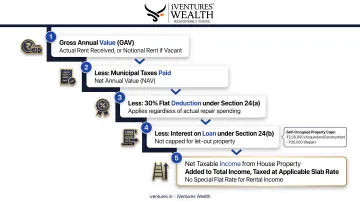
The resulting net figure gets added to your total income and taxed at your applicable income tax slab rate. There's no special flat rate for rental income.
A Note on Gifted vs. Inherited Property
If a family member gifted you the property, rather than you inheriting it through a will or succession, different rules can apply once you rent it out. Section 64's clubbing provisions may apply in specific cases, such as gifts to a spouse or a son's wife without adequate consideration. Inheritance itself doesn't trigger this clubbing, but gifting arrangements within the family can.
TDS: A Detail Landlords Often Overlook
Tenants paying rent above prescribed thresholds must deduct TDS before paying you. Make sure your PAN is correctly updated with your tenant. An incorrect PAN causes mismatches in your Form 26AS, which can delay refunds or trigger unnecessary scrutiny.
What Happens When You Eventually Sell the Property
This is where the real tax exposure shows up. When you sell an inherited property, the holding period is measured from the original owner's date of acquisition, not the date you inherited it.
If your grandfather bought the house in 1995, your holding period clock started in 1995 — not the day the property transferred to you.
The Indexation Calculation
The cost of acquisition is generally deemed to be the previous owner's cost, adjusted for inflation using the Cost Inflation Index (CII). Here's a simplified worked example:
| Detail | Value |
|---|---|
| Original purchase (FY 2010-11) | ₹20,00,000 |
| Sale price (FY 2024-25) | ₹80,00,000 |
| CII for FY 2010-11 | 167 |
| CII for FY 2024-25 | 363 |
| Indexed cost of acquisition | ₹43,47,305 |
| Indexed long-term capital gain | ₹36,52,695 |
| Tax at old 20% (with indexation) | ₹7,30,539 |
Under Finance Act 2024 changes, transfers on or after 23 July 2024 generally attract 12.5% tax without indexation. In this example, that would mean a gain of ₹60,00,000 and base tax of ₹7,50,000.
Resident individuals selling property acquired before that cutoff get a grandfathering comparison, allowing them to pay whichever calculation results in lower tax. NRIs don't get this same protection.
Ways to Reduce the Tax Bill
Two exemption routes can meaningfully reduce what you owe:
- Section 54: Reinvest the gain in a residential property in India within 1-2 years of the sale (3 years if constructing); a one-time exception allows two properties if the gain is under ₹2 crore.
- Section 54EC: Invest up to ₹50 lakh in specified capital gains bonds (like NHAI or REC bonds) within six months of the sale, though these carry a five-year lock-in.

Both routes require careful timing, so plan the sale well before you actually need the proceeds.
Special Considerations for NRIs and OCIs Inheriting Rental Property
NRIs, OCIs, and PIOs face an added compliance layer that resident heirs don't deal with.
Can You Even Inherit the Property?
Yes. Under FEMA, NRIs and OCIs can legally inherit both movable and immovable property in India from a resident relative, or from a person resident outside India who acquired the property in accordance with FEMA rules. This holds regardless of whether you're based in the US, UK, Gulf, or elsewhere, and PIOs retain the same inheritance rights as OCIs under FEMA. Foreign nationals without Indian origin face additional restrictions on other acquisition modes.
Yes, You Still Owe Indian Tax
Rental income from Indian property is taxable in India regardless of where you live. It must be reported in your Indian income tax return (typically ITR-2, or ITR-3 if business income applies), computed under the same house-property rules as resident heirs.
One key difference: tenants paying rent to an NRI landlord deduct TDS under Section 195, not the 194-IB rules that apply to resident landlords.
Moving the Money Abroad
- Rental income (post-tax) can generally be remitted through your NRO account via an authorised dealer
- Sale proceeds fall under the broader USD 1 million per financial year repatriation facility, subject to documentary evidence and tax clearance
- Form 15CA/15CB requirements depend on the remittance amount and whether an Assessing Officer certificate exists — it's not a blanket requirement for every transfer
- Check your DTAA provisions to avoid double taxation; India taxing this income doesn't automatically eliminate a tax obligation in your country of residence, but a foreign tax credit mechanism usually applies
Turning Inherited Rental Income Into a Wealth-Building Asset
Once the tax and compliance picture is clear, the real question becomes strategic: what should this cash flow actually do for your family?
Instead of letting rent sit as leftover money, treat it as fresh capital with a purpose. Given that residential rental yields typically run at 2–4%, holding the property purely for rent may not be the highest-value option compared to reinvesting proceeds across diversified assets.
That purpose could be:
- Paying down existing debt faster
- Reinvesting into diversified assets for stronger yields
- Funding a specific family financial goal
Ask honestly: does holding, renting, or selling this property actually serve your family's broader goals? For multi-heir situations especially, consolidating the property, its rental income, and any co-owned shares into a single tracked view avoids missed compliance deadlines and reduces the guesswork that fuels disputes.
This is where a product-neutral, fiduciary advisor earns its keep. iVentures Wealth, a SEBI-registered investment adviser (INA000019026), has advised NRI families on structuring family trusts for exactly this kind of cross-border inheritance. In several cases, children based overseas needed:
- A clear, legally binding governance framework for Indian real estate and business assets
- Elimination of the ambiguity that typically triggers sibling disputes
- Consolidated visibility into rental income and co-owned shares
For NRI and OCI families with investable assets above ₹5 crore, this kind of structuring turns an inherited property from a source of quiet tax exposure into an asset that compounds across generations. Tools like the firm's Wealth Monitor App add consolidated portfolio visibility, making the transition easier to track.

Frequently Asked Questions
How to avoid capital gains tax on inherited property in India?
You can't eliminate it, but you can reduce it. Reinvest the gain in a residential property under Section 54, or invest up to ₹50 lakh in NHAI/REC bonds under Section 54EC within six months of sale.
Can I rent out an inherited property?
Yes, heirs can freely rent out inherited property. You must declare the rental income under "Income from House Property" and pay tax at your applicable slab rate, just like any other rental income.
Can a US citizen inherit ancestral properties in India?
Yes, NRIs and OCIs, including US citizens of Indian origin, can inherit immovable property in India under FEMA. Foreign nationals without Indian origin, however, face additional restrictions on acquisition.
Do I have to pay tax on rental income immediately after inheriting a property?
Tax applies from the point rental income starts accruing to you as the new owner. It must be reported in the same financial year's income tax return, not deferred to a later date.
How is rental income split and taxed when multiple siblings inherit one property together?
Each co-heir declares their proportionate share of rental income based on their ownership percentage. This should ideally be documented through a family settlement deed or formal succession record to avoid disputes.
Is rental income from inherited property taxed differently than income from a self-purchased property?
No, the tax treatment is identical under the Income Tax Act. The only difference appears later if you sell: the cost of acquisition and holding period follow the original owner's records, not yours.