
Here's why the timing matters: according to the MSCI ACWI factsheet, the US represents 63.5% of the global equity index—meaning non-US markets account for 36.5% of global opportunity. An India-only portfolio misses most of that. Add to this the Nasdaq-100's 21% total return in 2025 and the rupee's steady depreciation from ₹83.19 per dollar at end-2023 to ₹89.84 by end-2025, and the case for international diversification becomes harder to ignore.
This guide covers the top international mutual funds available to Indian investors in 2026—what they invest in, who they suit, and what risks to factor in before investing.
Key Takeaways
- Access global markets via SEBI-regulated FoFs and feeder funds—no LRS route needed.
- The rupee has depreciated roughly 8% against the dollar since end-2023, making dollar-denominated returns more valuable in INR terms.
- Since April 2023, all gains from international mutual funds are taxed as short-term capital gains at your income slab rate—regardless of how long you hold.
- SEBI's overseas investment cap causes some funds to periodically suspend fresh subscriptions—verify availability before investing.
- iVentures Wealth recommends a 10–30% global allocation for HNI/UHNI portfolios to cut India-specific concentration risk.
What Are International Mutual Funds and Why Do They Matter for Indian Investors in 2026?
What International Mutual Funds Are
International mutual funds are pooled investment schemes that invest in stocks, indices, or funds of companies listed outside India. Unlike domestic equity funds, they provide exposure to foreign markets through two structures commonly available to Indian investors:
- Feeder funds — route money directly into a foreign parent fund (example: Franklin India Feeder investing into the Franklin U.S. Opportunities Fund in the US)
- Fund of Funds (FoFs) — invest in international ETFs or mutual funds listed/registered abroad (example: Motilal Oswal Nasdaq 100 FoF investing into the Motilal Oswal Nasdaq 100 ETF)
Both structures are regulated by SEBI and AMFI, so Indian investor protections apply fully. That regulatory clarity makes 2026 a practical moment to act on the case for global allocation.
Why 2026 Is a Relevant Year to Add Global Exposure
Three factors converge this year to make international allocation worth revisiting:
- US tech cycle acceleration — global semiconductor sales hit USD 791.7 billion in 2025, up 25.6% from 2024, reflecting the AI-driven hardware supercycle that benefits Nasdaq-heavy funds
- Rupee depreciation — INR has weakened consistently against the dollar, turning currency movement into a return tailwind for unhedged international funds
- India's limited global sector exposure — semiconductors, global cloud infrastructure, and next-gen biotech remain largely absent from Indian indices, creating genuine diversification value in global allocations
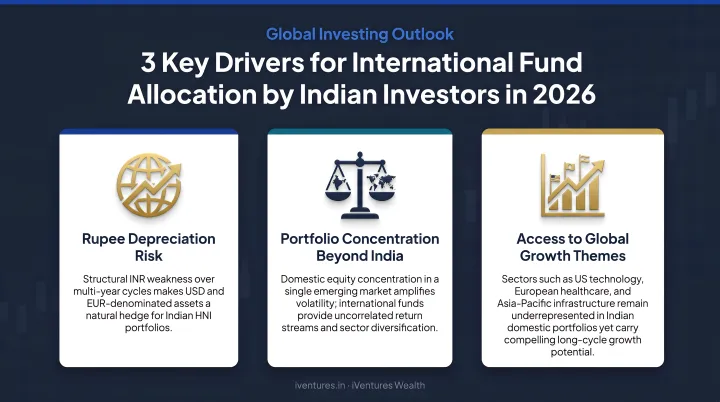
For investors already concentrated in Indian equities, these aren't theoretical diversification benefits — semiconductors, cloud infrastructure, and biotech are sectors Indian indices simply don't offer meaningful access to.
Top International Mutual Funds to Invest in India for 2026
The five funds below were selected based on track record, geographic diversity, AMC credibility, benchmark alignment, and current subscription availability under SEBI's overseas investment limits. Always verify subscription status directly with the AMC before investing.
Motilal Oswal Nasdaq 100 FoF
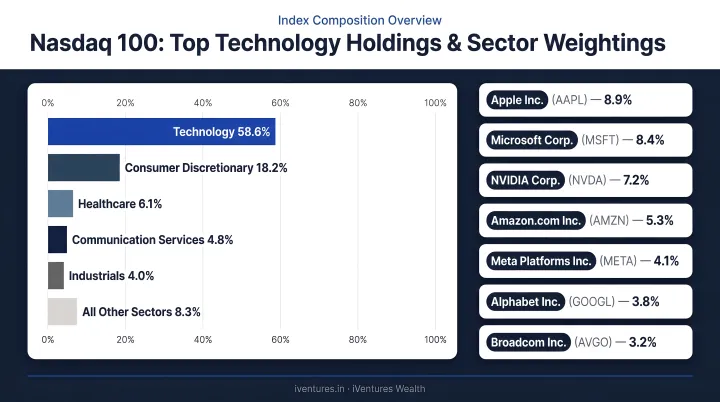
This FoF invests in the Motilal Oswal Nasdaq 100 ETF, giving investors exposure to 100 of the largest non-financial companies listed on Nasdaq. The underlying index is dominated by US technology leaders. As of March 2026, the top holdings included NVIDIA (8.69%), Apple (7.64%), Microsoft (5.64%), Amazon (4.59%), and Meta (3.46%).
Fund highlights:
- AUM: ₹7,690.83 crore (as of April 30, 2026)
- Expense ratio (Direct): 0.20%
- 3-year return (Direct): 42.45% | 5-year return: 27.45%
- Subscription note: Reopened December 2022; accepts up to ₹2,00,000 per PAN per calendar month via lumpsum; SIP/STP restrictions continue
This fund suits investors who want concentrated, direct exposure to US tech growth. The cap on monthly investment amounts is a practical constraint to plan around.
| Parameter | Detail |
|---|---|
| Fund Type | Fund of Funds (domestic, investing in ETF) |
| Benchmark | Nasdaq-100 TRI (USD) |
| Risk Profile | Very High |
Mirae Asset NYSE FANG+ ETF FoF
This FoF invests in the Mirae Asset NYSE FANG+ ETF, which tracks the NYSE FANG+ Total Return Index: an equally weighted index of 10 mega-cap technology names including Meta, Amazon, Netflix, Alphabet, and others.
Where the Nasdaq 100 spreads exposure across 100 companies, FANG+ concentrates in just 10. For investors who want a focused bet on the world's most-traded growth stocks, that concentration is the point. For everyone else, it's the risk.
Key note on subscriptions: Mirae Asset suspended lumpsum subscriptions, fresh SIP registrations, and switch-ins in certain overseas schemes as of January 5, 2024. This was to stay within SEBI's overseas investment limits. Verify current availability directly with Mirae Asset before investing.
| Parameter | Detail |
|---|---|
| Fund Type | Fund of Funds (domestic, investing in ETF) |
| Benchmark | NYSE FANG+ Total Return Index (USD) |
| Risk Profile | Very High |
Best suited for: Investors with a high risk appetite who already hold broad market exposure and want targeted mega-cap tech concentration.
Franklin U.S. Opportunities Equity Active Fund of Funds
Formerly known as Franklin India Feeder – Franklin U.S. Opportunities Fund, this scheme was renamed in May 2025. It routes investments into the Franklin U.S. Opportunities Fund, a growth-oriented US equity fund with exposure across technology, healthcare, and consumer sectors.
The active management here sets it apart from the Nasdaq 100 and FANG+ options. Investors get US growth participation without the full concentration in tech.
Fund highlights:
- AUM: ₹5,190.02 crore (as of April 30, 2026)
- Expense ratio (Direct): 0.50% | Regular: 1.25%
- 3-year return: 26.17% | 5-year return: 12.20% (as of September 30, 2025)
| Parameter | Detail |
|---|---|
| Fund Type | Feeder Fund (invests in overseas parent fund) |
| Benchmark | Russell 3000 Growth Index TRI (USD) |
| Risk Profile | High |
Performance data spanning multiple market cycles makes this one of the better-documented options on this list for evaluating drawdown behavior.
Edelweiss Greater China Equity Off-Shore Fund
This feeder fund invests in the JPMorgan Funds – Greater China Fund, providing exposure to equities in China, Hong Kong, and Taiwan. Greater China represents one of the world's largest consumer economies, and the region carries significant weight in global indices. China alone accounts for 20.36% of the MSCI Emerging Markets Index as of May 2026.
Fund highlights:
- AUM: ₹3,251 crore (as of May 31, 2026)
- Expense ratio (Regular): 2.40% | Direct: 1.51%
- 3-year return (Regular): 6.78% CAGR (as of July 31, 2025)
| Parameter | Detail |
|---|---|
| Fund Type | Feeder Fund (invests in offshore fund) |
| Benchmark | MSCI Golden Dragon Index |
| Risk Profile | Very High |
Specific risks to factor in: The World Bank's December 2025 China Economic Update flagged persistent trade policy uncertainty, a weak property sector, and local-government fiscal pressure as headwinds. Geopolitical risk between the US and China adds another layer of volatility not present in developed-market funds.
This fund suits investors seeking genuine Asia diversification, not as a substitute for US-focused funds, but as a distinct geographic allocation.
PGIM India Global Equity Opportunities Fund
This feeder fund invests in the PGIM Jennison Global Equity Opportunities Fund, which holds growth companies across the US, Europe, and Asia. It's the broadest geographic mandate on this list, with no outsized concentration in any single country or sector.
Fund highlights:
- AUM: ₹1,797.45 crore (as of May 31, 2026)
- Expense ratio (Direct): 0.56%
- 3-year return (Direct): 21.50% | 5-year return: 11.08%
- Subscription note: Subscriptions kept open up to available overseas headroom as of July 3, 2023; fresh SIP/STP registrations and switch-ins are not permitted
| Parameter | Detail |
|---|---|
| Fund Type | Feeder Fund (invests in offshore parent fund) |
| Benchmark | MSCI All Country World Index (ACWI) |
| Risk Profile | High |
For investors who want international exposure without over-betting on a single country or sector, this fund's ACWI benchmark is the most genuinely diversified option on this list.
Risks and Tax Implications Every Indian Investor Must Know
Currency Risk
International fund returns are generated in foreign currencies—USD, HKD, EUR—and converted to INR. Rupee depreciation helps (your USD returns are worth more in rupee terms), but rupee appreciation works against you.
A simple illustration: if a US fund returns 10% in USD but the rupee strengthens 5% against the dollar in the same period, your effective INR return is closer to 5%—not 10%. The reverse is also true. Based on Federal Reserve H.10 data, INR moved from ₹73.13 per dollar in December 2020 to ₹89.84 in December 2025—a 22.85% weakening—which materially amplified INR returns for USD-denominated funds over that period.
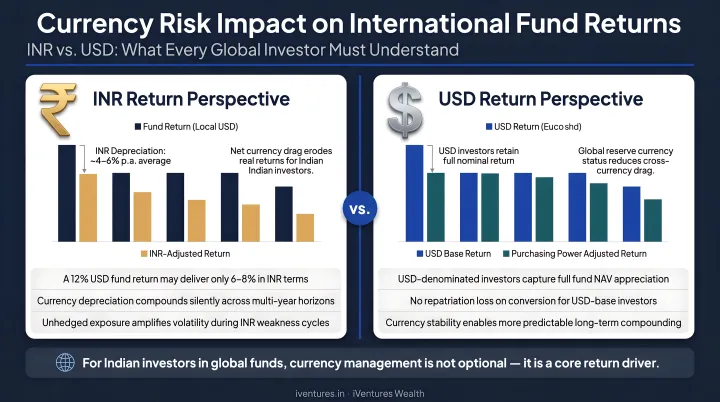
In some years, the rupee-dollar move contributes more to your INR return than the fund's actual performance does. Factor it in before comparing international fund returns to domestic benchmarks.
SEBI's Overseas Investment Limits
SEBI's circular (SEBI/HO/IMD/DF3/CIR/P/2020/225) sets industry-wide caps: USD 7 billion for overseas securities and USD 1 billion for overseas ETFs. When an AMC approaches these limits, it suspends fresh subscriptions—as seen with Mirae Asset in January 2024 and periodically with other fund houses.
As of the research conducted for this article, no official revision to these caps was found in force. This means subscription availability remains a live variable. Before investing in any international fund, check the AMC's current notice board for suspension status.
Taxation After Finance Act 2023
This is the change that most materially impacts long-term investors—understand it before committing capital.
Current tax treatment (post April 1, 2023):
- Section 50AA of the Income Tax Act classifies gains from international mutual funds as short-term capital gains, regardless of holding period
- These gains are added to total income and taxed at your applicable income slab rate—which for high-income investors means rates of 30% or higher
What changed from before:
- Prior to April 2023, international funds held for more than 3 years qualified for LTCG at 20% with indexation benefit—a significantly lower effective tax rate for long-term holders
- The Finance Act 2023 removed this advantage entirely for funds where less than 35% of assets are in domestic equities
AMFI's FY2025-26 Budget proposal requested restoration of indexation benefits for such funds, but no enacted reversal has been confirmed. Plan with current rules, not hoped-for future changes.
Run the numbers under current rules: a 20% gross return for an investor in the 30% slab yields a post-tax return of roughly 14%. Under the pre-2023 LTCG-with-indexation regime, the same return would have faced a substantially lower tax drag. That gap changes how international funds fit into a portfolio.
How We Chose These International Mutual Funds
The five funds above were evaluated across five dimensions:
- Track record and underlying fund manager credibility — particularly for feeder funds, where the quality of the offshore parent fund matters as much as the Indian AMC wrapper
- AMC reputation and SEBI compliance history — funds from established AMCs with clean regulatory records
- Benchmark relevance and geographic exposure — whether the benchmark actually captures the geographic or thematic opportunity the fund claims to address
- Expense ratio relative to peers — especially important for FoFs, which layer Indian AMC fees on top of underlying fund expenses
- Current subscription availability — funds suspended under SEBI's overseas caps were flagged; investors should verify status before acting
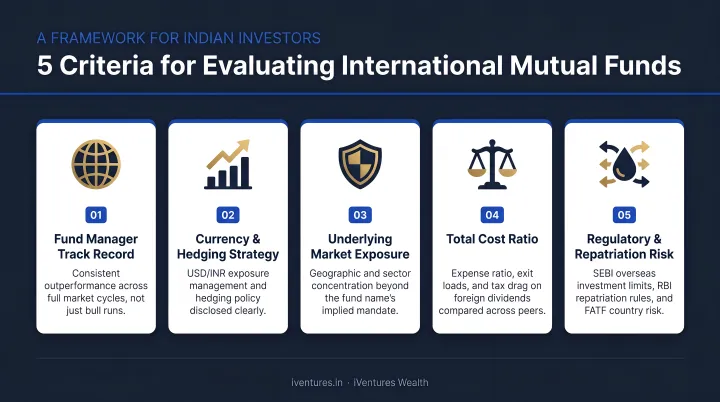
A common mistake to avoid: Many investors select international funds by screening for highest 3-year returns—then discover the top-performing fund is currently suspended for fresh subscriptions. Past returns and current availability are separate questions that both require checking.
Where a fund fits depends on what the rest of the portfolio already holds. For an investor with a heavily India-focused equity portfolio and no foreign currency assets, a Nasdaq 100 FoF offers genuine diversification value. For someone who already holds US-denominated ESOPs or NRI equity accounts, adding more US tech concentration creates overlap—a globally diversified fund like PGIM's ACWI-benchmarked offering or the Asia-focused Edelweiss Greater China fund would add more marginal benefit instead.
iVentures Wealth's advisory framework recommends 10–30% of total portfolio value in global investments for most HNI/UHNI investors, calibrated to existing holdings, currency exposure, risk profile, and long-term wealth goals. This allocation range is not a default—it reflects the actual diversification benefit, which depends entirely on what the rest of the portfolio already holds.
Portfolio fit also shifts as market conditions evolve. The right international fund for 2024 may not be optimal for 2026. Reassessing annually—across performance, currency outlook, and the underlying market's valuation—keeps the allocation earning its place in the portfolio rather than persisting by default.
Conclusion
International mutual funds give Indian investors a regulated, professionally managed route to participate in global growth themes that domestic markets simply don't offer. But selecting them requires more than checking return rankings.
Currency dynamics, the post-April 2023 tax change, SEBI's subscription limits, and the quality of the underlying offshore fund all matter, often more than the 3-year return headline.
Fund structure choices also depend on what you already hold. US ESOP concentration looks very different from a purely India-centric equity portfolio when you're determining where global funds add genuine value.
Bringing those variables together across your domestic holdings, tax situation, and long-term goals is where allocation decisions get made or missed. For investors who want that level of personalized guidance, iVentures Wealth (SEBI-registered RIA, INA000019026) works with UHNIs, family offices, and affluent investors to build international allocation strategies that account for each of these factors, not just the fund factsheet. The firm's CFA-led research team and 20+ years of advisory experience are specifically structured for this kind of cross-border, multi-layered portfolio work.
Frequently Asked Questions
What is an international mutual fund?
An international mutual fund is a SEBI-registered scheme that invests in stocks or funds of companies listed outside India. Indian investors access these through feeder funds (which route money into a foreign parent fund) or Fund of Funds (which invest in international ETFs or mutual funds), both regulated under Indian law.
Can we invest in international mutual funds from India?
Yes. Indian residents can invest in SEBI-registered international mutual funds or FoFs through AMC platforms or distributors without using the LRS route directly. However, subscription availability depends on SEBI's industry-wide overseas investment caps—always check the AMC's current notice before investing.
Which international mutual fund is best?
No single fund fits every investor. The right choice depends on your geographic preference, risk appetite, and existing portfolio. Nasdaq 100 or FANG+ funds suit US tech exposure, while a globally benchmarked FoF (like PGIM's ACWI-linked offering) adds broader diversification.
What is the tax on international mutual funds in India?
Since April 1, 2023, international mutual funds (those with less than 35% in domestic equities) are taxed like debt funds: all capital gains are short-term and taxed at your income slab rate, regardless of holding period. Post-tax return calculations are essential before committing capital.
What is the difference between an international fund and a global fund?
International funds invest exclusively in companies outside India, while global funds may include a mix of Indian and international companies. In the Indian mutual fund context, most overseas schemes are structured as pure international or region-specific rather than blended global-and-India portfolios.
Are international mutual funds safe for Indian investors?
These are SEBI-regulated products with standard investor protections, yet they carry risks beyond domestic funds: currency volatility, geopolitical exposure (particularly in China-focused funds), and the possibility of SEBI-imposed subscription halts. Best suited for informed investors with a long horizon and an established domestic portfolio base.