
Introduction
India added ultra-rich individuals at a striking pace over the past decade. Knight Frank projects the country's UHNI population will hit 25,217 by 2031, a 27% jump from current levels. India is creating more wealth than at almost any point in recent memory.
That growth brings a problem most new investors don't see coming: too many options, not enough clarity. Between mutual funds, PMS, AIFs, and a growing crowd of "advisors," an uninformed choice can cost you through conflicted advice, layered fees, or a portfolio that never matched your actual risk appetite.
This guide breaks down what a wealth manager actually does, the specific factors worth checking before you hire one, and a practical framework for deciding with confidence.
TL;DR
- A wealth manager handles investments, taxes, and estate structuring, not just funds
- Verify SEBI registration, fiduciary duty, fee transparency, and track record
- India has four SEBI-regulated categories - RIA, PMS, MFD, and AIF
- The right fit adapts as your goals, life stage, and the markets change
What is a Wealth Manager?
A wealth manager is a professional or firm that integrates investment advisory, tax planning, estate and succession structuring, and risk management into one coordinated strategy, typically for affluent individuals, families, and businesses. It's a broader mandate than picking stocks or funds.
In India, this work is delivered through four SEBI-regulated licence types, each with a different scope and compensation model:
| Category | Role | How they're paid |
|---|---|---|
| Registered Investment Adviser (RIA) | Fiduciary advice on your total portfolio | Flat fee or fee on assets under advice |
| Portfolio Manager (PMS) | Manages a separate discretionary or non-discretionary portfolio | Management/performance fee |
| Mutual Fund Distributor (MFD) | Recommends and sells mutual fund units | Trail commission from AMCs |
| AIF Manager | Runs a pooled investment vehicle | Management/performance fee |
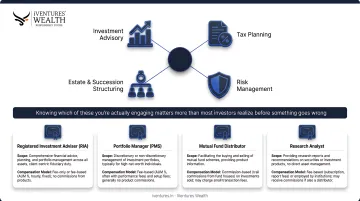
Knowing which of these you're actually engaging matters more than most investors realize before something goes wrong. Once that's clear, the actual mandate breaks down into three connected areas of work:
Investment Advisory & Portfolio Management
This covers asset allocation across equity, debt, and alternates, calibrated to your risk profile, time horizon, and specific goals rather than a generic model portfolio pushed to every client.
Tax Optimization & Estate/Succession Planning
Minimizing tax leakage on gains, income, and transfers, while structuring generational wealth transfer. For NRIs, this extends to cross-border tax treatment and DTAA considerations that a purely domestic advisor might miss entirely.
Financial Planning & Goal-Based Advisory
Mapping cash flows to specific milestones such as retirement, a liquidity event from a business sale, or funding a child's education abroad. Good planning connects today's decisions to tomorrow's obligations.
Benefits of Working with a Wealth Manager
Working with a wealth manager adds value beyond raw returns. That value shows up in specific, measurable ways:
- Fewer behavioral mistakes - a second opinion during a crash often prevents panic-selling near the bottom
- Consolidated visibility - one view across multiple bank accounts, demat accounts, and family entities
- Institutional-grade access - PMS and AIF structures unavailable to retail investors directly
- Better after-tax returns - through tax-aware structuring instead of tax handled as an afterthought
- Continuity across generations - the same advisory relationship carrying forward as wealth passes to heirs
Each of these compounds over decades, turning small advantages into major differences in final wealth. The next step is knowing what to look for when selecting the right manager.
What to Consider When Choosing a Wealth Manager
These factors help you evaluate substance over brand name: regulatory standing, incentive alignment, and genuine fit for your situation. In India specifically, distinguishing a SEBI RIA (bound by fiduciary duty) from a distributor (held only to a suitability standard) is one of the most overlooked checks investors skip.
Regulatory Credentials & Fee Structure
SEBI's own FAQs confirm that a registered investment adviser must act in a fiduciary capacity and put the client's interest first, disclosing conflicts and keeping advisory separate from distribution. A distributor, by contrast, operates under a suitability standard, a materially lower bar.
Concrete due-diligence steps:
- Verify the SEBI registration number directly on SEBI's public registry
- Check for CFA or CFP credentials among the advisory team
- Confirm current NISM certification (Series X-A and X-B for investment advisers)
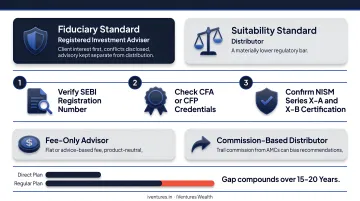
Registration confirms an advisor is licensed; it doesn't guarantee how they get paid. Fee-only advisors charge a flat or advice-based fee regardless of which product they recommend. Commission-based distributors earn trail commission from asset management companies, which can bias recommendations toward higher-margin products.
SEBI's rules separating regular and direct mutual fund plans exist precisely because distribution costs erode returns over time. A direct plan excludes commission entirely from its expense ratio. Over a 15-20 year holding period, that gap compounds into real money.
Track Record & Specialization for Your Profile
Anyone looks competent in a bull market. What matters is how an advisor behaved when it counted.
The Sensex fell 37.9% in FY2008-09, and on March 23, 2020, it dropped 3,935 points in a single session as COVID-19 fears gripped markets. Advisors who guided clients through both events without panic-driven exits have proven something a pitch deck never can.
Check:
- Years in continuous operation
- AUM growth trajectory over time
- Depth and longevity of client relationships, not just headline client count
Track record proves resilience, but fit matters just as much. Different profiles need different expertise:
- UHNIs need succession structuring
- NRIs need cross-border tax planning and DTAA guidance
- Corporates need treasury advisory
- Family offices need governance frameworks
Match a wealth manager's stated target segments to your own profile before engaging; a generalist firm may not have the depth your situation requires.
Investment Philosophy & Ongoing Relationship
Is the firm research-driven or product-push? Active or passive-leaning? Ask to review an actual portfolio construction process, not a marketing brochure. If the philosophy doesn't match your risk tolerance, the relationship will feel wrong the first time markets get volatile.
Philosophy on paper means little without consistent follow-through. Responsiveness during a downturn often matters more than performance during a rally. Look for:
- A defined review cadence, ideally quarterly
- Digital tools for consolidated, real-time portfolio tracking
- A named point of contact, not a rotating call centre
How iVentures Wealth Can Help
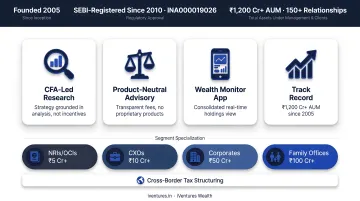
iVentures Wealth has operated as a SEBI-registered investment adviser (registration number INA000019026) since 2010, five years after the firm was founded in 2005. Two decades of fiduciary-first advisory have shaped how the firm works with UHNIs, family offices, and NRIs across India.
A few things separate this approach from commission-driven or product-first firms:
- CFA-led research - the research function is headed by a CFA charterholder, keeping strategy grounded in analysis rather than product incentives
- Product-neutral advisory - a transparent fee structure with no proprietary products pushed onto client portfolios
- Wealth Monitor App - a consolidated, real-time view of holdings across multiple entities and accounts
- Track record - over ₹1,200 crore in AUM and 150+ affluent relationships built since 2005
- Segment specialization - tailored plans for NRIs/OCIs (₹5 crore+), CXOs (₹10 crore+), corporates (₹50 crore+), and family offices (₹100 crore+), plus cross-border tax structuring
For a founder who just exited a business, or an NRI juggling assets across two countries, that combination of fiduciary duty and specialization tends to matter more than brand recognition alone.
Conclusion
Choosing a wealth manager comes down to fit, not fame. The right partner is one whose incentives, philosophy, and service model genuinely align with what you're trying to build.
When evaluating candidates, weigh these priorities:
- Fiduciary duty over sales pitches
- Fee transparency over vague promises
- Communication fit over a polished brochure
And remember, this isn't a one-time decision. As your wealth grows and your life stage changes, revisit the fit periodically. The right partner for your first crore isn't necessarily the right one for your fiftieth.
Frequently Asked Questions
How do I pick a wealth manager?
Verify SEBI registration and fiduciary status first, then check the fee structure, track record across market cycles, and whether their communication style fits your comfort level.
How much do I need to work with a wealth manager?
Thresholds vary by advisor: PMS structures often start at ₹50 lakh, and AIFs typically at ₹1 crore. iVentures Wealth serves NRIs/OCIs from ₹5 Cr, CXOs and professionals from ₹10 Cr, and family offices from ₹100 Cr, reflecting its focus on complex, high-value portfolios.
What is the difference between a wealth manager and a financial advisor?
Wealth managers typically cover investments, tax, estate, and succession planning holistically. Financial advisors often focus more narrowly on planning or specific products.
How much do wealth managers charge in India?
Common models include flat advisory fees, a percentage of assets under advice (capped at 2.5% annually under SEBI norms), or commission-based distribution. Fee-only, SEBI RIA models reduce conflicts of interest.
What qualifications should I look for in a wealth manager?
Look for SEBI RIA registration, CFA or CFP credentials, current NISM certification, and demonstrated experience navigating downturns like 2008 and 2020.
Is hiring a wealth manager worth it for a first-time affluent investor?
Once your finances involve multiple goals, tax complexity, or a liquidity event, professional guidance helps you avoid costly missteps in India's evolving regulatory and market environment.