
Introduction
Both Alternative Investment Funds and mutual funds pool money from investors, but that's largely where the similarity ends. One sits at the sophisticated, high-stakes end of India's investment spectrum. The other was built for the mass market.
Rising HNI wealth and SEBI's evolving AIF framework have pushed both structures into the same conversation for portfolio diversification. Yet many investors confuse "risk" with "return," assuming a higher-return product must be a better bet. That assumption leads to poor allocation decisions.
Consider the scale involved. Total AIF commitments in India stood at ₹16,94,262 crore as of March 2026 — roughly ₹16.9 trillion. The mutual fund industry's AUM, by contrast, grew from ₹33.67 trillion in June 2021 to over ₹82.22 trillion by June 2026. This article isolates risk specifically, not cost or returns, across liquidity, concentration, volatility, and regulatory dimensions.
Key Takeaways
- AIFs carry higher risk from concentrated bets, illiquidity, Category III leverage, and private valuations
- Mutual fund risk varies by category: equity carries the highest market risk, while debt carries credit and interest-rate risk
- SEBI's AIF Categories I, II, and III each carry distinct risk-liquidity-return profiles, unlike mutual funds' standardised structure
- No product is universally "riskier": it depends on capital size, liquidity needs, and time horizon
- A SEBI-registered adviser's risk assessment is essential before committing capital to AIFs
AIF vs Mutual Fund: Risk Comparison at a Glance
Five risk dimensions separate these two structures. Here's how each stacks up.
Liquidity Risk
- AIF: Category I and II funds are close-ended with a three-year minimum tenure, extendable by two years with investor approval, and secondary markets for early exit are thin. Category III lock-in terms vary by scheme.
- Mutual Fund: Redemption proceeds must reach investors within three working days. ELSS is the exception, carrying a mandatory three-year lock-in tied to its Section 80C tax benefit.
Concentration Risk
- AIF: Category I and II funds can commit up to 25% of investable funds to a single investee company (50% for large-value funds catering to accredited investors). This allows outsized bets that can swing portfolio value sharply.
- Mutual Fund: Schemes are typically capped at 10% of NAV in a single company's equity, with sector-level caps also in place. Diversification is built into the structure, not optional.
Market and Volatility Risk
- AIF: Category I/II assets are valued at least every six months (sometimes annually), so paper losses can stay hidden longer. Category III strategies involve derivatives and unlisted exposure that behave less predictably.
- Mutual Fund: NAV is published daily and moves directly with listed market prices. Equity schemes can be volatile, but that volatility is visible and trackable in real time.
Regulatory and Transparency Risk
- AIF: Governance runs through a Private Placement Memorandum rather than a standardised offer document. Annual reports are due within 180 days of year-end; Category III quarterly reports within 60 days.
- Mutual Fund: Strict SEBI disclosure norms require daily NAV publication, monthly portfolio disclosures, and standardised Scheme Information Documents.
Credit and Structural Risk
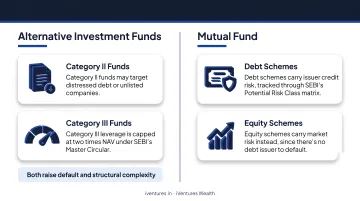
- AIF: Category II funds may target distressed debt or unlisted companies, while Category III leverage is capped at two times NAV under SEBI's Master Circular. Both raise default and structural complexity.
- Mutual Fund: Debt schemes carry issuer credit risk, tracked through SEBI's Potential Risk Class matrix. Equity schemes carry market risk instead, since there's no debt issuer to default.
What Is an AIF? Understanding Its Risk Profile
An Alternative Investment Fund is a privately pooled investment vehicle regulated under the SEBI (Alternative Investment Funds) Regulations, 2012. It requires a minimum investment of ₹1 crore per investor (₹25 lakh for employees or directors of the fund or its manager), which immediately narrows the audience to accredited and high-net-worth investors.
SEBI splits AIFs into three categories, and risk climbs steeply as you move through them:
- Category I - Venture capital, infrastructure, and social venture funds. Growth-oriented with moderate risk; no leverage beyond operational needs.
- Category II - Private equity, real estate, and distressed asset funds. Higher risk than Category I, still restricted from leverage except for day-to-day requirements.
- Category III - Hedge fund-style strategies using leverage up to two times NAV. The highest risk and volatility of the three, given derivative exposure and complex trading approaches.
Core Risk Drivers Unique to AIFs
- Illiquidity from multi-year lock-ins with limited exit routes
- Concentrated exposure with no strict single-investment cap
- Leverage permitted in Category III strategies
- Private valuations that update far less frequently than listed markets
AIF-level risk suits investors with a high risk appetite, a large investable surplus, a long horizon, and no near-term need for the capital.
Where AIF Risk Is Justified
Take a Category II private equity fund investing in pre-IPO growth companies. Investors accept multi-year illiquidity and concentrated exposure to a handful of businesses, betting that the illiquidity premium will outperform listed alternatives over time.
This trade-off has drawn serious capital: AIFs have raised ₹7,02,723 crore in funds against total commitments of ₹16.94 lakh crore. That gap points to a growing pool of sophisticated investors willing to accept this risk-return equation.
At iVentures Wealth, this is exactly the kind of allocation we see play out in real portfolios. In one case, an HNI client with the bulk of a multi-crore portfolio parked in low-yield savings and fixed deposits moved to a multi-asset structure spanning equity funds, quality debt, and select AIFs.
The goal wasn't chasing the highest return in isolation. It was disciplined compounding through multiple return sources rather than dependence on one product.

What Is a Mutual Fund? Understanding Its Risk Profile
A mutual fund is a SEBI-regulated pooled vehicle open to virtually any investor, with SIPs starting as low as ₹100 to ₹500 per month, depending on the scheme. Money flows into listed equities, debt instruments, or a blend of both.
Risk here isn't uniform either. It varies sharply by category:
- Equity funds - Highest market risk among mutual funds, driven by stock price movements
- Debt funds - Interest rate risk and credit risk, tracked via SEBI's Potential Risk Class matrix
- Hybrid funds - Blended risk from combining equity and debt exposure
- Index funds - Passive risk that simply mirrors the underlying benchmark's ups and downs
Built-In Risk Mitigants
Mutual funds carry structural safeguards that AIFs simply don't have:
- Mandatory diversification limits (10% of NAV per company)
- Daily NAV transparency
- High liquidity through open-ended redemption
- Strict, continuous SEBI oversight
This makes mutual funds suitable for investors who want regulated, liquid, diversified exposure without committing large capital upfront.
Where Mutual Fund Risk Fits Best
Picture a retail investor running a monthly SIP into a diversified equity fund. Instead of trying to time entry points, they buy more units when prices fall and fewer when prices rise, smoothing out volatility through rupee-cost averaging over several years.
This approach underpins the industry's growth. According to AMFI data, mutual fund AUM more than doubled from ₹33.67 trillion in June 2021 to ₹82.22 trillion in June 2025, reflecting how mainstream, risk-adjusted investing has become in India.
Which Carries More Risk: AIF or Mutual Fund?
There's no single answer here. Risk has to be judged against four things: capital size, liquidity needs, investment horizon, and your capacity to absorb a loss without it derailing other goals. Labelling one product "riskier" in isolation misses the point.
Situational guidance:
- Choose an AIF if you have ₹1 crore or more to commit, a long horizon, and genuine interest in illiquidity premiums or alternative strategies
- Choose a mutual fund if you need liquidity, broad diversification, or you're investing smaller or recurring amounts
- Choose a blend of both if your goals span near-term liquidity and long-term growth, keeping the bulk in mutual funds with a smaller AIF sleeve
AIF-specific risks such as leverage, concentration, and private valuations are difficult to evaluate independently. This is where working with a SEBI-registered investment adviser like iVentures Wealth adds real value, aligning AIF category selection with your genuine risk capacity within a broader portfolio.
Our advisory thresholds reflect this segmentation:
- NRIs and OCIs typically start at ₹5 crore
- CXOs and professionals typically start at ₹10 crore
- Corporates typically start at ₹50 crore
Each tier carries different liquidity and structuring needs.
A Practical Risk Scenario
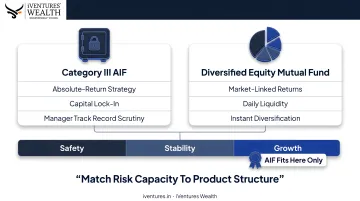
Consider an HNI weighing a Category III AIF against a diversified equity mutual fund for a sizeable allocation. The AIF offers an absolute-return strategy less tied to market direction, but locks up capital and demands scrutiny of the fund manager's track record, fee structure, and drawdown history.
The mutual fund, by contrast, offers daily liquidity and instant diversification, but its returns stay tethered to broad market swings.
Neither choice is wrong. The trade-off is concentration versus diversification, and lock-in versus liquidity.
When iVentures Wealth structures allocations for clients crossing a major liquidity event, we typically bucket capital into Safety, Stability, and Growth tranches. AIFs sit only within the Growth bucket, and only where suitability genuinely supports it.
Takeaway: matching risk capacity to product structure, ideally with expert guidance, prevents forced early exits or panic-driven decisions when markets turn volatile.
Conclusion
There's no universal "riskier" investment between AIFs and mutual funds. Suitability comes down to your liquidity needs, capital size, time horizon, and how much complexity you can actively monitor.
Getting this comparison right protects you from forced liquidation and unnecessary capital erosion during market stress. Personalised risk profiling from an experienced, SEBI-registered wealth partner like iVentures Wealth replaces guesswork with clarity. The same AIF or mutual fund mix can suit one investor and expose another to unnecessary risk, depending on their liquidity needs, capital size, and time horizon.
Frequently Asked Questions
Is AIF better than mutual fund?
Suitability depends on your investment profile and available capital. AIFs fit investors comfortable with higher risk, higher return potential, and alternative asset exposure, while mutual funds suit those prioritizing liquidity, regulation, and broad diversification.
Which is the riskiest type of investment?
Among pooled vehicles, Category III AIFs typically carry the highest risk due to leverage and complex trading strategies. Within mutual funds specifically, equity schemes carry the highest risk.
Is AIF riskier than mutual funds?
Yes, in most cases. AIFs carry higher risk due to illiquidity, concentrated positions, and leverage in Category III schemes. Mutual funds mitigate risk through mandatory diversification norms and continuous regulatory oversight.
What is the minimum investment required for AIF vs mutual funds?
AIFs require a minimum of ₹1 crore (₹25 lakh for certain employees or directors of the fund/manager). Mutual funds, in contrast, allow SIPs starting from as little as ₹100 to ₹500 per month.
Can retail investors invest in AIFs?
AIFs are largely inaccessible to retail investors because of the ₹1 crore minimum investment threshold. Mutual funds, by design, are built for broad public access with no such barrier.
How does liquidity risk differ between AIF and mutual funds?
AIFs generally carry multi-year lock-ins (three years minimum for Category I/II) with limited exit options before maturity. Most mutual funds, barring ELSS, allow redemption within a few working days.