India represents a fraction of global market capitalisation. Concentrating wealth entirely in domestic equities means missing semiconductors, AI platforms, global healthcare, and other structural growth stories that simply don't trade on Indian exchanges. This blog cuts through that uncertainty — covering what global investment funds are, why 2026 presents a particular opportunity, and five funds worth serious consideration for Indian investors across different risk profiles.
Key Takeaways
- Global investment funds invest across multiple countries including the investor's home market — distinct from international funds that exclude it.
- Five funds span passive ETFs (URTH, VT), active growth (ANWPX), defensive value (SGENX), and equity income (Fidelity Global Dividend).
- Indian residents can invest via LRS (up to $250,000 per year), overseas FOFs, or GIFT City-registered structures — tax and cost implications vary by route.
- Expense ratio, manager track record across full market cycles, and Indian tax treatment are the three criteria that matter most.
- Global allocation typically ranges from 10–30% of a UHNI portfolio, depending on existing holdings and currency exposure.
What Are Global Investment Funds?
A global investment fund is a pooled vehicle that allocates capital across securities in multiple countries — including the investor's home country. That last part is what separates it from an international fund, which Vanguard defines as one that "invests only in foreign markets, excluding the United States." For Indian investors, a global fund could hold Reliance Industries alongside Apple and Nestlé; an international fund would exclude Indian equities entirely.
Understanding that definition, though, is only the starting point. How a fund divides capital across market tiers determines its actual risk-return profile far more than its label does.
The Three Market Tiers
Every global fund's character is shaped by how it distributes capital across three tiers:
- Developed markets — US, UK, Japan, Germany; mature institutions, stable regulation, lower volatility
- Emerging markets — India, China, Brazil, South Africa — higher growth potential, but greater political and currency risk
- Frontier markets — least developed economies; highest risk, minimal liquidity, seldom exceeding 1–2% of most global fund portfolios
The FTSE Russell equity classification framework recognises Developed, Advanced Emerging, Secondary Emerging, and Frontier tiers — a useful reference when reading a fund's factsheet.
Fund Structures and Management Styles
| Structure | How It Works | Best For |
|---|---|---|
| Open-end mutual fund | Priced daily at NAV; unlimited shares | Long-term investors, SIP-style investing |
| ETF | Trades on exchange intraday | Cost-conscious, flexible investors |
| Closed-end fund | Fixed shares; trades at premium/discount | Specialist strategies |
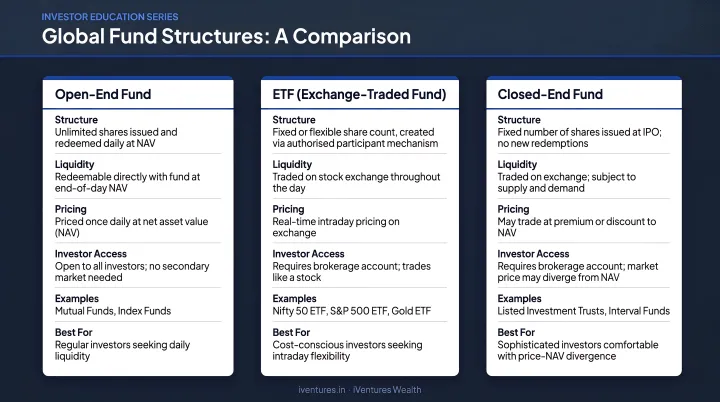
Management style splits into active (fund manager selects securities, aiming to beat a benchmark) and passive (tracks an index like MSCI World or FTSE Global All Cap). Passive funds typically carry lower expense ratios; active funds carry higher costs in exchange for the potential to generate alpha and, in well-run strategies, meaningful downside protection.
Why 2026 Is a Strategic Year for Global Investing
Two macro backdrops converge in 2026 to make global fund exposure particularly timely.
Rate normalisation in developed markets. The US Federal Reserve cut its target rate by 50 basis points to 4.75%–5.00% in September 2024, and the ECB followed with a 25 basis point cut in June 2024. Lower rates historically support equity valuations, particularly for growth-oriented global funds with heavy technology exposure. They also reduce the opportunity cost of holding international equities over cash.
Selective emerging market recovery. The IMF's October 2025 World Economic Outlook projected global growth slowing modestly to 3.1% in 2026, but noted that emerging markets excluding China outperformed expectations in H1 2025, driven by India, Brazil, and Türkiye. Broad all-country funds (which capture developed-market stability alongside emerging-market momentum) are positioned to benefit from both dynamics.
For Indian investors, this global backdrop intersects with a set of regulatory updates that make accessing these funds more straightforward than before.
What's Changed for Indian Investors
- LRS limit remains at USD 250,000 per resident individual per financial year (April–March), per RBI's LRS framework
- Budget 2025 raised the TCS threshold on LRS remittances from ₹7 lakh to ₹10 lakh — reducing friction for moderate-sized annual transfers
- IFSCA notified the Fund Management Regulations, 2025 on February 19, 2025, replacing the earlier GIFT City fund-management framework and creating cleaner structures for NRI and UHNI investors accessing global mandates through IFSC
NRIs and OCIs sit outside LRS limits entirely. They can invest through NRE/NRO accounts under FEMA compliance, making GIFT City's USD-denominated fund structures a particularly efficient route for cross-border portfolio management.
Best Global Investment Funds to Invest in 2026
These five funds were shortlisted on long-term performance consistency, AUM size, expense efficiency, geographic diversification, and practical accessibility for Indian investors.
iShares MSCI World ETF (URTH / SWDA)
BlackRock's iShares MSCI World ETF is one of the most widely held passive global equity products in the world. It tracks the MSCI World Index, which covered 1,308 constituents across 23 developed markets as of May 2026 — not the commonly cited 1,500+ figure.
URTH (US-listed) carries a 0.24% expense ratio with AUM of approximately USD 8.1 billion. SWDA (LSE-listed, UCITS-compliant) has a 0.20% TER and AUM in the USD 73–74 billion range — one of the largest UCITS ETFs by assets. Both track the same index; Indian investors accessing via LRS typically use URTH, while NRIs in the UK or EU may prefer SWDA.
Ten-year annualised returns for URTH stood at 12.07% (NAV) as of May 2026 — strong evidence of the index's consistency across cycles.
| Feature | Detail |
|---|---|
| Fund Type | Passive ETF |
| Index | MSCI World (23 developed markets, 1,308 stocks) |
| Geographic Weight | US ~71%, Japan ~6%, UK ~4%, Canada ~4% |
| Top Sectors | IT 29.5%, Financials 15.7%, Industrials 11.2% |
| Expense Ratio | URTH: 0.24% / SWDA: 0.20% TER |
| Best For | Cost-conscious, long-term buy-and-hold investors |
Vanguard Total World Stock ETF (VT)
VT extends beyond developed markets to cover the entire investable world. Vanguard's Total World Stock ETF tracks the FTSE Global All Cap Index — large, mid, and small-cap stocks across both developed and emerging markets — with AUM of USD 76.0 billion as of May 2026.
The headline number: 0.06% expense ratio as of February 2026. That is among the lowest of any diversified global equity fund anywhere. Unlike MSCI World-based products, VT includes exposure to China, India, Brazil, and other growth economies alongside the US and Europe — making it genuinely all-country rather than just developed-market.
For investors seeking a single fund covering global equities, VT delivers on both cost and breadth — accessible via LRS for Indian investors through US brokerage platforms.
| Feature | Detail |
|---|---|
| Fund Type | Passive ETF |
| Index | FTSE Global All Cap (developed + emerging markets) |
| Coverage | Large, mid, and small-cap globally |
| AUM | USD 76.0 billion |
| Expense Ratio | 0.06% |
| Best For | One-fund global equity exposure including emerging markets |
American Funds New Perspective Fund (ANWPX)
Capital Group's New Perspective Fund has been running since March 1973 — more than 53 years of live track record through every major market cycle. AUM as of May 2026: USD 171.5 billion, making it one of the largest actively managed global equity funds in existence.
The fund's multi-manager structure distributes portfolio decisions across 10 portfolio managers independently, which directly reduces key-person risk — a common vulnerability in active funds.
Geographic allocation skews toward the US (53.5%) but maintains substantial European (24.4%) and Asia-Pacific (15.7%) exposure. Technology dominates at 29.7% of the portfolio.
Performance through May 2026: 14.22% over one year, 7.48% over five years, 12.88% over ten years (Class A). The benchmark is the MSCI ACWI.
| Feature | Detail |
|---|---|
| Fund Type | Active Mutual Fund |
| Manager | Capital Group (multi-manager system, 10 managers) |
| Geographic Weight | US 53.5%, Europe 24.4%, Asia-Pacific 15.7% |
| Top Sectors | IT 29.7%, Industrials 14.4%, Consumer Discretionary 11.8% |
| Expense Ratio | 0.71% |
| Best For | Investors comfortable with active management seeking long-term alpha |
First Eagle Global Fund (SGENX)
SGENX occupies a distinct category: it is a defensive, value-oriented global fund that explicitly holds gold-related investments (~14% of the portfolio as of April 2026) as a hedge. For risk-conscious UHNIs who want global equity exposure without the drawdown profile of a pure growth fund, this is worth serious attention.
AUM stands at approximately USD 74.9 billion. The fund returned +8.31% in 2020 (when markets were volatile) and -6.48% in 2022 (when most equity funds fell considerably harder). These figures reflect the defensive construction in practice.
First Eagle's philosophy centres on margin of safety and a willingness to hold cash when valuations are stretched — accessible to Indian investors via LRS through select international brokerage platforms.
Expense ratio for Class A: 1.10% — higher than passive alternatives, but the cost reflects genuine downside management rather than just index tracking.
| Feature | Detail |
|---|---|
| Fund Type | Active Mutual Fund (Value / Defensive) |
| Manager | First Eagle Investment Management |
| Gold Allocation | ~14% in gold-related investments |
| Geographic Weight | US 38.5%, Europe 21.1% |
| Expense Ratio | 1.10% (Class A) |
| Best For | Conservative investors prioritising capital preservation |
Fidelity Global Dividend Fund
Fidelity's Global Dividend Fund holds approximately 45 high-quality dividend-paying companies globally — concentrated by design. AUM: USD 19.1 billion as of December 2025. OCF: 1.89%.
The strategy tilts toward industrials (21.5%) and financials (19.9%) — sectors with consistent free cash flow generation rather than speculative growth. Geographic exposure skews toward the US (23.2%) and UK (12.9%). One-year return through end-2025: 22.4% versus 22.3% for the MSCI ACWI benchmark — roughly in line, with the income distribution adding practical value for investors who need regular cash flows.
For UHNIs seeking income alongside capital appreciation — particularly retirees or those building passive income streams — the concentrated, quality-filtered approach positions this fund as a cleaner option than broad global equity mandates that sacrifice income for growth.
| Feature | Detail |
|---|---|
| Fund Type | Active Mutual Fund (Equity Income) |
| Holdings | ~45 high-quality dividend-paying companies |
| Geographic Weight | US 23.2%, UK 12.9%, Europe, Asia |
| Top Sectors | Industrials 21.5%, Financials 19.9% |
| OCF | 1.89% |
| Best For | Income-seeking investors and those in or near retirement |
What to Look for When Choosing a Global Investment Fund
Three mistakes account for most poor outcomes in global fund selection:
- Chasing recent performance — a fund's top-quartile three-year return often reflects sector concentration that is already priced in
- Ignoring expense ratios — on a ₹5 crore allocation held for 15 years, the difference between a 0.06% and a 1.10% expense ratio compounds to a meaningful gap in terminal wealth
- Forgetting portfolio fit — a tech-heavy global ETF held alongside a domestic large-cap fund already concentrated in IT creates hidden correlation risk, not diversification
Five Criteria That Actually Matter
- Expense ratio and total cost of ownership — includes transaction costs, hedging costs if applicable, and TCS on LRS remittances
- Manager track record across full cycles — five-year returns in a bull market tell you little; how did the fund perform in 2020 and 2022?
- Geographic and sector concentration — URTH and ANWPX both carry ~30% IT weight; doubling up on both creates sector risk masquerading as diversification
- Liquidity and redemption terms — ETFs offer intraday liquidity; active mutual funds may have lock-ins or redemption notice periods
- Tax treatment under Indian law — the route of access (LRS direct, overseas FOF, GIFT City) materially affects capital gains tax; see the FAQ section below
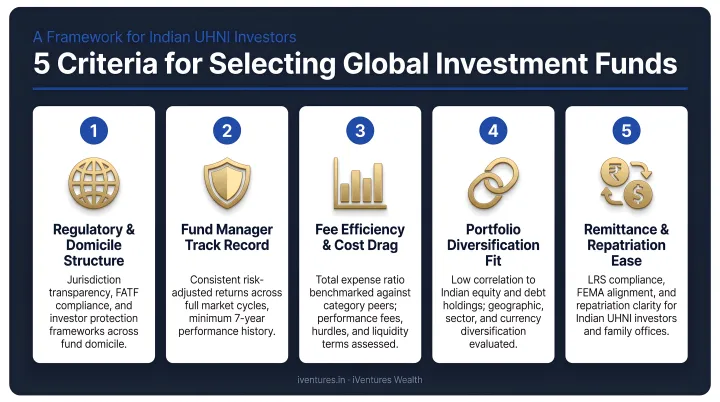
For Indian UHNIs, selecting global funds is rarely a standalone decision. It requires alignment across overall asset allocation, INR-USD currency exposure, estate planning structures, and succession goals.
The right allocation depends on what you already hold. iVentures Wealth's CFA-led advisory team typically recommends 10–30% global exposure within a diversified UHNI portfolio — structured around each client's existing holdings, risk profile, and cross-border planning requirements.
Key Risks Indian Investors Must Understand
Currency Risk
Global funds denominated in USD or EUR generate returns in foreign currency. When repatriated to INR, a strengthening rupee erodes real returns; INR depreciation enhances them. This is a two-way risk that compounds significantly over long holding periods.
Hedged fund variants reduce this exposure but add cost — so the choice isn't free. Unhedged allocations retain the currency diversification benefit. For NRIs tracking wealth in USD, the currency dynamic often works in their favour; resident Indians, however, need to factor it explicitly into return expectations.
Geopolitical and Regulatory Risk
Unlike currency risk — which investors can partially manage through hedging — geopolitical and regulatory risk operates entirely outside any single investor's control. US semiconductor export restrictions — targeting 140 Chinese companies in December 2024 — directly affected Asia-heavy global funds with technology exposure. Reuters reported net outflows of USD 7.82 billion from global equity funds in the week ending August 6, 2025, driven by tariff and economic concerns. Geopolitical risk is not theoretical — it moves fund flows in real time.
Indian Tax Considerations
Tax treatment varies significantly by access route:
- Direct overseas securities via LRS: US stocks held for more than 24 months qualify as long-term assets taxed at 12.5% without indexation; short-term gains are taxed at applicable slab rates
- Overseas FOFs: Treatment depends on whether the scheme qualifies as a "Specified Mutual Fund" under Section 50AA of the Income Tax Act — defined as a fund investing more than 65% in debt/money-market instruments. The Finance (No. 2) Act 2024 amended this definition; equity-oriented overseas FOFs may not fall under Section 50AA
- GIFT City structures: IFSC-domiciled funds carry specific tax treatment — consult a tax adviser before investing
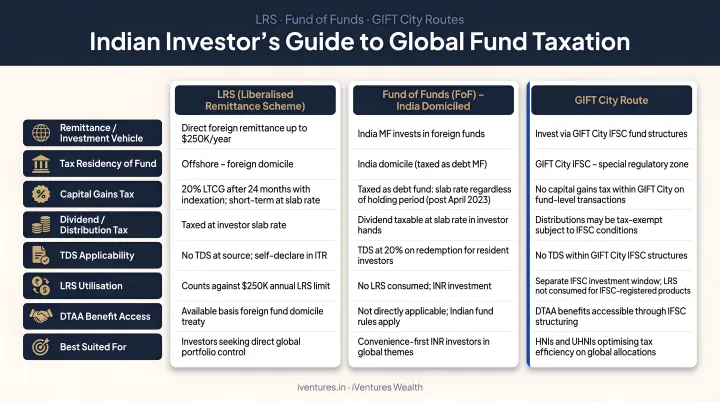
A single wrong assumption about your fund's tax category can materially alter net returns — get the classification confirmed before you invest, not after.
Conclusion
The five funds highlighted here cover the full spectrum — from VT's 0.06% passive breadth to SGENX's gold-hedged defensive value. None is universally "best." The right choice depends on your risk tolerance, existing portfolio composition, access route, and how the allocation interacts with your tax and currency exposure.
For Indian investors — particularly UHNIs, NRIs, and family offices — global diversification is a structural part of preserving and growing wealth across decades and jurisdictions. The funds reviewed here each serve a distinct role within that allocation.
If you're evaluating how global funds fit into your overall financial plan, iVentures Wealth's CFA-led team is available for a personalised portfolio strategy consultation aligned with your goals, risk profile, and cross-border tax situation.
Frequently Asked Questions
What is a global investment fund?
A global investment fund is a pooled vehicle that allocates capital across securities in multiple countries — including the investor's home country. It provides diversification across geographies, currencies, and economic cycles, reducing dependence on any single market's performance.
Which is the best global investment fund?
The right fund depends on your risk tolerance, investment horizon, and tax situation. For passive developed-market exposure, iShares MSCI World ETF (URTH/SWDA) is widely respected; for active management with a long track record, American Funds New Perspective Fund (ANWPX) is a strong candidate.
What is the difference between a global fund and an international fund?
A global fund invests worldwide including the investor's home country; an international fund excludes the home country. For Indian investors, a global fund may hold Indian equities alongside foreign ones, while an international fund invests only in overseas markets.
How can Indian investors invest in global funds?
The three main routes are overseas Fund of Funds (FOFs) via Indian AMCs, direct investment through the LRS route (up to USD 250,000 per year), and GIFT City-registered fund structures. Each carries different tax, compliance, and cost implications — the right route matters as much as the right fund.
Are global funds riskier than domestic mutual funds?
Global funds carry additional risks — currency swings, geopolitical events, and cross-border regulatory exposure — beyond those of domestic funds. However, international diversification can actually reduce overall portfolio volatility over long horizons by spreading exposure across uncorrelated markets.
How are global fund gains taxed for Indian investors?
Tax treatment varies by access route. Via LRS, direct overseas securities held over 24 months attract 12.5% LTCG (no indexation); short-term gains are taxed at slab rates. For overseas FOFs, Section 50AA classification (post Finance Act 2024) governs the rate. Consult a tax adviser for treatment specific to your fund and route.