
Introduction
Meera works in Dubai, earns in AED, and has spent a decade sending money home to India for her parents, a small property, and a growing mutual fund SIP. Every year, she notices the same thing: the rupee she gets for her dirhams buys a little less than it did the year before.
This concern is becoming common among NRIs earning in USD, AED, or GBP. The rupee has slid from about ₹45 per dollar in 2010 to nearly ₹83 today, a decline of over 45%.
GIFT City's rise as an international financial centre has opened up USD investment options that didn't exist a few years ago.
This article breaks down what dollar-denominated investments actually are and why they matter for your India-linked goals. It also covers the main product types available and how to choose based on your residency, tax situation, and timeline.
Key Takeaways
- USD-denominated investments protect a portion of your portfolio from rupee depreciation
- Options span FCNR deposits, GIFT City FDs, GIFT City funds/AIFs, and US equities or ETFs
- Tax treatment varies by residency; an India tax-free product may still be taxed abroad
- Choose products based on liquidity needs and repatriation plans, not just the rate
What Are Dollar-Denominated Investments and Why Do They Matter for NRIs?
Dollar-denominated investments are financial products, deposits, funds, bonds, or equities, priced and settled in USD rather than INR. Your invested amount stays in dollar terms throughout, so it doesn't lose value simply because the rupee weakens against the dollar.
NRIs typically access these products through three routes:
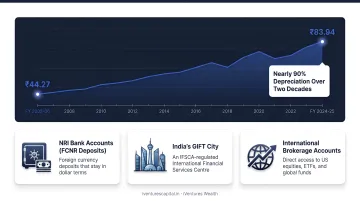
- NRI bank accounts, primarily FCNR deposits held in foreign currency
- India's GIFT City, an International Financial Services Centre regulated by the IFSCA
- International brokerage accounts, for direct US equities, ETFs, and global funds
Why this matters right now: the rupee has moved from roughly ₹44.27 against the dollar in FY 2005-06 to around ₹83.94 by FY 2024-25, based on historical exchange rate data tracked since 1947. That's a depreciation of nearly 90% over two decades.
For an NRI holding pure INR assets, that decline steadily erodes purchasing power every time savings eventually get converted back to a foreign currency.
Currency Risk Cuts Both Ways
Dollar investments aren't a blanket replacement for INR assets, though. If your future expenses, retirement, or dependents are actually rupee-based, shifting everything to USD just moves the currency risk elsewhere rather than removing it.
The better approach is matching currency exposure to currency-denominated goals:
- Funding a child's US or UK education? Dollar assets make sense.
- Building a retirement corpus to spend abroad? Same logic applies.
- Supporting parents' day-to-day expenses in India? INR assets are the natural fit.
For NRIs who want dollar exposure without moving entirely offshore, GIFT City has changed the equation since 2020. Before its expansion, NRIs had limited USD options beyond FCNR deposits and offshore brokerage accounts. IFSCA-regulated banks and fund managers have since built out FDs, mutual funds, and AIFs, all with fully repatriable USD, giving NRIs a genuinely India-linked but dollar-denominated middle ground.
Types of Dollar-Denominated Investment Options for NRIs
"Dollar investment" isn't one product. It's a category covering several structurally different instruments, each with its own regulator, minimum ticket size, and liquidity profile. Picking based on the name, or the headline rate, alone is a mistake.
| Product | Tenure/Lock-in | Deposit Insurance | Tax Treatment |
|---|---|---|---|
| FCNR Deposit | 1-5 years | DICGC, up to ₹5 lakh | Tax-free, Section 10(15)(iv)(fa) |
| GIFT City FD | 7 days to 10 years | None | Tax-free, no 15CA/CB needed |
| GIFT City MF/AIF | Open-ended / 3-5 yr lock-in | None | Tax-free for non-residents, Section 10(4D) |
| US Stocks/ETFs | No lock-in | Varies by broker/country | Governed by your residence country's rules |
FCNR (Foreign Currency Non-Resident) Deposits
FCNR deposits let NRIs park foreign currency, including USD, GBP, and AED, with a domestic Indian bank branch for a tenure of one to five years. Both principal and interest stay in the foreign currency, and the entire amount is fully repatriable. Interest is covered under DICGC deposit insurance up to ₹5 lakh per depositor per bank.
Best for: NRIs who want simple, insured, predictable returns without market risk.
The trade-off: withdraw before completing one year, and you forfeit all interest. Unsuitable if you might need the money within 12 months.
GIFT City USD Fixed Deposits
GIFT City FDs are held with IFSC Banking Units, operated by major banks like SBI, ICICI, HDFC, and Axis, inside India's GIFT City. Deposits stay in USD from start to finish, interest is tax-free, and there's no Form 15CA/15CB paperwork.
Compared with FCNR, these deposits offer:
- Shorter minimum tenures, starting from as little as seven days
- Easier premature withdrawal terms in most cases
- Some banks extend tenures out to 10 years
Best for: NRIs wanting bank-grade safety with more flexible access than FCNR allows.
The trade-off: GIFT City deposits fall outside DICGC's insurance cover. Your safety net is the strength of the parent bank, not a government guarantee scheme.
GIFT City Mutual Funds & AIFs
Beyond fixed deposits, GIFT City also offers a route to market-linked growth. Fund Management Entities regulated by the IFSCA run two broad categories: open-ended, market-linked mutual funds, and Alternative Investment Funds covering private equity, credit, and real estate strategies, usually with three-to-five-year lock-ins. Capital gains here are tax-free for non-residents under Section 10(4D).
Best for: NRIs seeking equity-like growth or alternative-asset diversification in USD. AIFs suit larger, patient-capital portfolios given the longer lock-ins.
The trade-off: the fund universe is young, a fraction of the choices available in mainland India's mutual fund industry, and returns are market-linked rather than guaranteed. Tax-free treatment holds only as long as you maintain non-resident status.
GIFT City's growth trajectory backs this up: fund commitments at the IFSC are projected to cross USD 100 billion by 2030, a sharp jump from where they stood five years ago.
US Stocks, ETFs and Global Funds
For exposure entirely outside the India-linked ecosystem, NRIs can open international brokerage accounts to invest directly in US-listed companies, ETFs, and mutual funds, gaining exposure to global sectors simply unavailable on Indian exchanges.
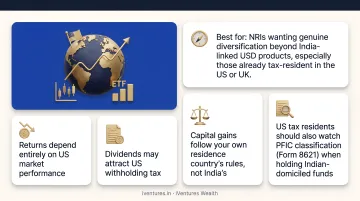
Best for: NRIs wanting genuine diversification beyond India-linked USD products, especially those already tax-resident in the US or UK.
The trade-off:
- Returns depend entirely on US market performance
- Dividends may attract US withholding tax
- Capital gains follow your own residence country's rules, not India's
- US tax residents should also watch PFIC classification (Form 8621) when holding Indian-domiciled funds
How to Choose the Right Dollar-Denominated Investment for Your Profile
The "right" product isn't whichever one currently advertises the highest rate. It depends on where you live, how soon you need the money, and where you see yourself in five years.
Country of Residence and Tax Treatment
The same GIFT City fund behaves differently depending on where you pay tax:
- UAE-based NRIs benefit from a favourable India-UAE tax treaty rate of 5% on interest income, often seeing close to zero effective tax
- UK or US residents could owe tax at home on the same gains, even though India treats them as exempt
A DTAA-aware review is essential before committing meaningful capital.
Investment Horizon and Liquidity Needs
Match tenure to when you'll actually need the money:
- Near-term (under 2 years): avoid FCNR and AIF lock-ins
- Medium-term (2-5 years): GIFT City FDs or FCNR work well
- Long-term (5+ years): GIFT City funds, AIFs, or US equities have room to compound
Repatriation and Future Plans
Planning to move back to India soon? Factor in how residency changes affect existing investments. Once you return, you may pass through RNOR (Resident but Not Ordinarily Resident) status, and tax treatment on your dollar investments can shift the moment your residency status does.
Risk Appetite and Goal Type
- Capital preservation: FCNR, GIFT City FDs, fixed returns, no market risk
- Balanced approach: a mix of FCNR/GIFT City FDs and GIFT City AIFs, moderate risk with steadier compounding
- Long-term growth: GIFT City mutual funds/AIFs, US equities, market-linked, higher upside potential
Because residency, DTAA benefits, and repatriation rules interact differently for every NRI, this isn't really a spreadsheet exercise. A SEBI-registered advisory team focused specifically on NRI and OCI portfolios, such as iVentures Wealth, can help structure a tax-optimised allocation across FCNR, GIFT City, and global equity products. This beats picking each one in isolation. That cross-border view matters more than most people expect, especially once the numbers involved cross a few crore.
Checklist: What to Verify Before You Invest
Before committing money to any "dollar investment," run through this checklist.
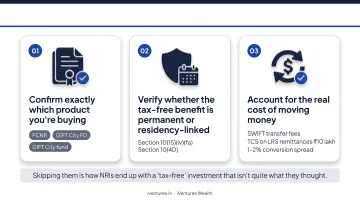
Confirm exactly which product you're buying. FCNR, GIFT City FD, and GIFT City fund aren't interchangeable. Insurance cover, liquidity, and lock-in terms differ, despite all being marketed as "dollar investments."
Verify whether the tax-free benefit is permanent or residency-linked. Section 10(15)(iv)(fa) and Section 10(4D) exemptions apply while you hold non-resident status. For larger investments, get this confirmed in writing rather than relying on a sales brochure.
Account for the real cost of moving money. SWIFT transfer fees, currency conversion spreads, and TCS on LRS remittances above ₹10 lakh can erode a year's interest. A 1-2% conversion spread often costs more than the tax savings you were chasing.
None of these checks are complicated on their own. Skipping them, though, is how NRIs end up with a "tax-free" investment that isn't quite what they thought.
Conclusion
Dollar-denominated investments give NRIs a genuine way to protect India-linked wealth from rupee depreciation, without giving up on India as a market. Options now range from simple, insured FCNR deposits to flexible GIFT City FDs, growth-oriented GIFT City funds, and direct US equities.
None of these is universally "best." The right mix depends on where you live, how soon you need the money, and whether you're planning to return to India. It also depends on what your goals actually require in dollar terms versus rupee terms.
If you're sitting on significant NRI savings and unsure how to structure them, talk to an experienced, research-led wealth advisory team. Understanding DTAA rules and cross-border tax treatment can save you from expensive guesswork. iVentures Wealth's NRI advisory team works with exactly this kind of cross-border portfolio structuring.
Frequently Asked Questions
Can I invest in dollar-denominated assets in India?
Yes. You can access FCNR deposits, GIFT City FDs, GIFT City mutual funds and AIFs, and international brokerage accounts for US equities. Each route has its own regulator and eligibility rules, so check which applies to your residency status.
Can an NRI hold a USD account in India?
Yes, through FCNR deposits or GIFT City IBU accounts. Both let your balance stay in foreign currency rather than converting to rupees, protecting you from exchange rate swings while the money sits in India.
What is the safest USD investment option for NRIs?
FCNR deposits are the safer choice on paper, insured by DICGC up to ₹5 lakh per depositor per bank. GIFT City FDs offer no deposit insurance, so their safety depends entirely on the strength of the parent bank.
Is interest earned on FCNR deposits taxable in India?
No. FCNR interest is tax-free in India under Section 10(15)(iv)(fa), for as long as you maintain NRI status. It may still be taxable in your country of residence, so check local rules before assuming it's tax-free everywhere.
Can NRIs invest in US stocks directly from India?
Yes, via international brokerage accounts that let you buy US-listed stocks, ETFs, and mutual funds. Dividends usually attract US withholding tax, and capital gains treatment depends on your country of residence's tax rules.
What is GIFT City and why is it relevant for USD investments?
GIFT City is India's IFSCA-regulated international financial centre, offering tax-efficient, fully repatriable USD products, including fixed deposits, mutual funds, and AIFs, built specifically for NRIs and global investors.