

Here's the paradox: many wealthy investors read headlines like this as validation, when they should be reading them as a warning.
Most HNIs believe owning multiple properties equals diversification. In reality, it often means concentrated exposure to one asset class, one city, and one liquidity profile. This guide helps you self-diagnose over-allocation, understand its hidden costs, benchmark the right real estate percentage, and rebalance without triggering a fire sale.
Key Takeaways
- Owning several flats or offices isn't diversification if they're in the same city or asset type
- Cap real estate at 10-20% of net worth, excluding your primary home
- Concentration steadily erodes wealth through illiquidity, tax drag, and missed returns elsewhere
- Fixing the imbalance needs a phased, documented plan, not a panic sale
Why Real Estate Dominates HNI Portfolios in India
Property in India carries weight that goes beyond spreadsheets. It's tangible. You can walk into it, show it to family, and point to it as proof of arrival.
Generations of Indian households have treated land and buildings as the "safest" store of value, often ahead of anything traded on a screen. Social status still gets measured in square feet.
That belief system shows up clearly in the data. Kotak's Top of the Pyramid 2024 survey of 150 Ultra-HNIs across 12 Indian cities found real estate makes up 29% of the average portfolio - second only to equity.
| Asset class | Average allocation |
|---|---|
| Equity | 32% |
| Real estate | 29% |
| Debt | 21% |
| Alternate assets | 18% |

Source: Kotak Top of the Pyramid 2024
The Promoter Blind Spot
Business owners and promoters often inflate this number without realising it. A factory building, a warehouse, or an office floor gets purchased as a natural extension of running the business, not as a deliberate investment call.
Over the years, this adds up:
- Operating premises bought instead of leased "to save rent"
- A second warehouse acquired during expansion, financed from business surplus
- Personal capital parked into company-owned property for tax or control reasons
None of these decisions feel like "investing in real estate." Collectively, they often are the single largest line item on a promoter's balance sheet.
7 Warning Signs You're Over-Allocated to Real Estate
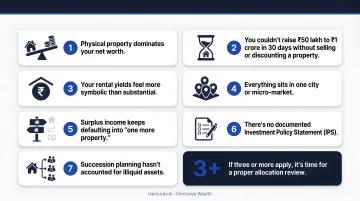
Ask yourself these questions honestly. If three or more apply, it's time for a proper allocation review.
Physical property dominates your net worth. If real estate (excluding your primary home) accounts for more than 40-50% of what you own, you're carrying concentration risk most equity investors would never accept in a single stock.
You couldn't raise ₹50 lakh to ₹1 crore in 30 days without selling or discounting a property. True liquidity means access to capital on short notice. Property rarely offers that without a haircut.
Your rental yields feel more symbolic than substantial. When rental income barely covers maintenance and taxes, your return depends entirely on price appreciation, not on the property actually paying you. Commercial spaces typically outperform residential holdings on this front.
Everything sits in one city or micro-market. A single local slowdown, an infrastructure project delay, or an oversupply cycle can hit your entire real estate book at once.
Surplus income keeps defaulting into "one more property." No comparison against equities, AIFs, or debt instruments happens before the decision is made.
There's no documented Investment Policy Statement (IPS). Without a written target allocation, decisions get driven by builder pitches, family pressure, or plain FOMO rather than a strategy you'd defend on paper.
Succession planning hasn't accounted for illiquid assets. Dividing a single large property among multiple heirs without a plan is a common trigger for family disputes and forced, distressed sales.
The Hidden Costs of Being Real-Estate Heavy
Concentrated real estate holdings carry costs that rarely show up in the "return on property" conversation at family gatherings.
Liquidity and Structural Risk
Unlike equity or debt, you cannot partially sell a flat. Broad market data illustrates just how sticky property markets can get: primary-market inventory overhang stood at roughly 13 months in Bengaluru, 21 months in Mumbai Metropolitan Region, and 23 months in Delhi NCR during a recent measured period.
That figure means a family selling a flat in Gurugram or Noida may need years, not months, to convert that equity into cash for other opportunities, whether that's funding a business expansion or rebalancing into equities. Capital trapped in an oversupplied micro-market can stay stuck for years, unlike a listed portfolio you can rebalance in minutes.
Tax Inefficiency
Rental income gets added to your total income and taxed at your applicable slab rate, plus surcharge and a 4% health and education cess. For top-bracket HNIs, this combination pushes the effective tax bite meaningfully higher than most people assume.
On the sale side, the Income Tax Department's capital gains framework sets long-term capital gains on property (held over 24 months) at 12.5% without indexation for transfers after 23 July 2024. Property bought before that date qualifies for a grandfathering option: taxpayers compare this against the older 20%-with-indexation calculation and apply whichever is lower.
Carrying Costs and Anchoring Bias
Costs that erode net returns without ever entering the mental math:
- Property tax and society maintenance charges
- Vacancy periods between tenants
- Title disputes or litigation risk on older properties
- Brokerage and legal fees on every transaction
Many HNIs also value property based on what they originally paid rather than its current opportunity cost. That anchoring bias is exactly what delays a rational rebalancing decision for years.
What's the Right Real Estate Allocation? Benchmarks for HNIs
Start with a foundation before layering property on top. The 12-20-80 framework offers a reasonable starting point: roughly 12 months of expenses held in liquid or emergency funds, about 20% in gold, and the remaining 80% split across growth and stability assets.
Real estate should sit as a distinct satellite allocation layered onto this core, not a substitute for it.
Indicative Allocation Ranges
| HNI profile | Suggested real estate share |
|---|---|
| Conservative HNI | 20-25% |
| Balanced HNI | ~15% |
| Growth-focused / younger HNI | 10% or less |
These ranges exclude your primary residence, which serves a lifestyle purpose, not a wealth-generation one. They also need tailoring to your actual liquidity needs and income sources.
Life-stage matters. HNIs in their 40s, still in wealth-accumulation mode, can typically justify a smaller real estate share and a larger growth allocation. Those approaching retirement should look to convert illiquid holdings into income-generating instruments instead of adding more bricks and mortar.
REITs as a Middle Path
Whichever life stage you're in, direct ownership isn't the only route to real estate exposure. REITs and InvITs offer real estate-like exposure with dramatically better liquidity than direct property. Kotak's Ultra-HNI survey found 38% preference for REITs and 21% for InvITs among respondents when discussing real estate exposure. This signals that sophisticated investors increasingly see listed real estate as a legitimate alternative to direct ownership.
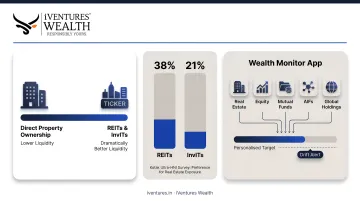
Getting your personal number right requires seeing your whole balance sheet in one place, not guessing at percentages. This is where a tool like iVentures Wealth's Wealth Monitor App earns its keep.
It consolidates real estate, equity, mutual funds, AIFs, and global holdings into a single dashboard, then benchmarks your actual allocation against a personalised target, flagging drift before it becomes a problem.
How to Rebalance Without a Fire Sale
Fixing concentration doesn't require selling everything tomorrow. It requires discipline applied consistently over time.
Redirect new inflows first: channel fresh business profits or salary surplus into underweight asset classes such as equity, debt, or AIFs, rather than the next property purchase. This avoids triggering capital gains on existing holdings while gradually shifting the balance.
Monetize without selling: lease out underutilised property, explore REIT conversion routes, or consider fractional ownership platforms. Each generates income while reducing net concentration without an outright exit.
Plan phased exits where selling is unavoidable: stagger transactions across financial years to manage the capital gains impact and avoid distress pricing in a slow-moving market.
Work with a product-neutral advisor: real estate brokers, developers, and even many bank relationship managers carry an inherent incentive to keep you invested in property. iVentures Wealth's SEBI-registered, fiduciary advisory model delivers unbiased rebalancing guidance instead of another property recommendation.
A documented plan, executed patiently, beats a rushed decision made under pressure almost every time.
Frequently Asked Questions
How much net worth is considered HNI in India?
Definitions vary by institution. Kotak's research uses a ₹25 crore household net worth threshold for Ultra-HNIs, while global reports like Knight Frank use US$1 million (roughly ₹8 crore) for HNWIs and US$30 million (roughly ₹250 crore) for UHNWIs. Always check which basis a source is using.
What is the 12-20-80 asset allocation rule?
It's a starting framework: roughly 12 months of expenses in an emergency fund, 20% in gold, and the remaining 80% across growth and stability assets. Real estate gets layered on top of this core as a separate, deliberate allocation.
What percentage of my portfolio should be in real estate?
Most benchmarks suggest 10-25%, depending on your life stage and liquidity needs. Younger, growth-focused HNIs typically sit at the lower end; conservative or retired HNIs may sit higher.
Are REITs a good substitute for owning physical property?
REITs offer similar sector exposure with far better liquidity than direct ownership, though you give up direct control and the return profile differs slightly. Many HNIs now use REITs to complement, rather than replace, physical holdings.
How can I get liquidity from real estate without selling it?
Options include a loan against property, leasing out unused space, or converting a portion of your holdings into REIT units. Each provides intermediate liquidity without an outright sale.
Should I sell my current properties to correct over-allocation?
Not necessarily, and rarely all at once. A phased, advisor-guided approach that accounts for your specific tax position and liquidity needs works far better than a rushed, panic-driven sale.