
Many affluent investors are curious about SIFs but stuck on the basics: how do they differ from mutual funds and PMS? Do they fit an existing portfolio? Are the risks worth the upside?
This article breaks down what a SIF actually is, how it works, the strategies available, and the benefits and risks involved. We'll also cover eligibility, taxation, and how personalised advisory can help you decide if a SIF belongs in your portfolio.
Key Takeaways
- SIFs are SEBI-regulated since April 2025, with a ₹10 lakh minimum per PAN
- They bridge mutual funds and PMS, enabling long-short equity, sector rotation, and dynamic allocation
- Benefits include multi-asset diversification and sophisticated fund management under SEBI oversight
- Risks include limited liquidity, redemption notices up to 15 working days, and manager-dependent outcomes
- Best suited for HNIs, UHNIs, and family offices with surplus capital and long horizons
What is a Specialised Investment Fund? (SIF Meaning)
A Specialised Investment Fund is a new investment product regulated under Chapter VI-C of the SEBI (Mutual Funds) Regulations, 1996. SEBI doesn't hand it a neat glossary definition. Instead, it builds SIFs inside the mutual fund framework, but gives asset management companies (AMCs) far greater flexibility to take risk and construct portfolios than a standard equity or debt scheme allows.
SIFs function as strategy-driven vehicles. AMCs can launch SIF strategies that behave more like hedge fund or PMS-style products, including limited unhedged short positions through derivatives, something regular mutual funds simply cannot do.
Where SIFs sit in the investment hierarchy:
| Product | SEBI minimum investment |
|---|---|
| SIF | ₹10 lakh (aggregated at PAN level, per AMC) |
| PMS | ₹50 lakh |
| AIF | ₹1 crore (₹25 lakh for eligible employees/directors) |
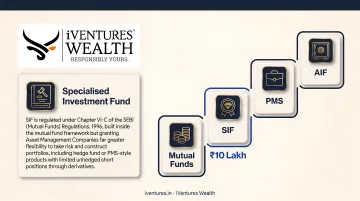
This ₹10 lakh threshold makes SIFs a genuine middle ground, accessible to a much wider set of sophisticated investors than PMS or AIF ever were.
Why Did SEBI Introduce SIFs?
The regulator was solving a specific problem. Investors with ₹10 lakh to ₹50 lakh in investable assets found mutual funds too restrictive, but they weren't large enough (or willing) to meet PMS or AIF minimums. Unregistered products often filled that gap badly, marketed with vague promises and no oversight.
SIFs close that gap with a regulated alternative. The framework comes from SEBI's regulatory circular dated 27 February 2025, which also lays out eligibility norms for AMCs wanting to launch these products.
Adoption has been swift. AMFI data shows SIF assets under management reached ₹17,857.77 crore by June 2026, up 29% from May, according to Business Standard's July 2026 coverage of AMFI data.
That growth now spans 27 schemes and over 75,000 investor folios, with net inflows for June alone at ₹3,781.96 crore. For a product category barely a year old, those numbers point to real, sustained investor demand.
Features of a Specialised Investment Fund & How It Works
SIFs combine mutual fund-like accessibility with PMS-style flexibility. Here's what defines the structure.
Core features:
- Minimum ₹10 lakh investment, aggregated at PAN level across all SIF strategies of one AMC (regular mutual fund holdings don't count toward this)
- Professional, active management under SEBI's disclosure regime
- Multi-asset capability spanning equities, debt, REITs/InvITs, and commodity derivatives
- SIP, SWP, and STP all permitted, subject to the minimum-investment rule
Short Exposure and Redemption Flexibility
Unlike ordinary mutual funds, a SIF strategy can take unhedged short positions through derivatives, up to 25% of net assets, for reasons beyond simple hedging or rebalancing. This lets fund managers potentially profit in falling markets, not just rising ones.
Total gross exposure across permitted assets still can't exceed 100% of net assets.
Redemption isn't uniform across SIFs. Some strategies offer daily redemption; others are interval-based, opening only weekly or twice-weekly. AMCs can impose a notice period, but SEBI caps it at 15 working days.
The Active vs Passive Breach Rule
Because the ₹10 lakh threshold is monitored daily, SEBI distinguishes between two scenarios:
- Active breach — an investor-initiated withdrawal that would push holdings below ₹10 lakh. AMCs must block this, except for a full redemption of the entire balance.
- Passive breach — a market-driven fall in NAV that pushes the value below ₹10 lakh. This is permitted; no top-up is required.
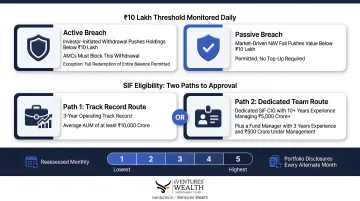
Not every AMC can launch a SIF. SEBI requires one of two eligibility paths before granting approval:
- A three-year operating track record with average AUM of at least ₹10,000 crore
- A dedicated SIF CIO with 10+ years of experience managing at least ₹5,000 crore, plus a fund manager with three years' experience and ₹500 crore under management
Every SIF also carries a mandatory risk-band label from 1 (lowest) to 5 (highest), reassessed monthly, with detailed portfolio disclosures every alternate month.
Types of SIF Investment Strategies
SEBI's framework permits seven distinct SIF strategies, grouped into three broad categories.
Equity-Oriented Strategies
- Equity Long-Short Fund — at least 80% in listed equity, with short exposure via derivatives
- Equity Ex-Top 100 Long-Short Fund — at least 65% in stocks outside the top 100 by market cap, targeting mid and small-cap opportunities
- Sector Rotation Long-Short Fund — at least 80% equity exposure concentrated across a maximum of four sectors, rotated based on market cycles
Debt-Oriented Strategies
- Debt Long-Short Fund — an interval strategy across debt instruments of varying durations, redeemable weekly or less often
- Sectoral Debt Long-Short Fund — debt spread across at least two sectors, capped at 75% in any single sector
Hybrid Strategies
- Active Asset Allocator Long-Short Fund — dynamically shifts across equity, debt, derivatives, REITs (Real Estate Investment Trusts) and InvITs (Infrastructure Investment Trusts), and commodities with no fixed allocation band
- Hybrid Long-Short Fund — a minimum 25% in both equity and debt instruments, redeemable twice weekly or less often
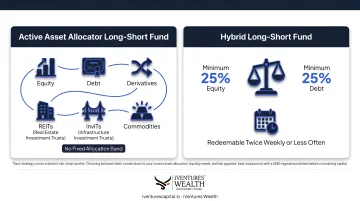
Each strategy carries a distinct risk-return profile. Choosing between them comes down to your current asset allocation, liquidity needs, and risk appetite, best mapped out with a SEBI-registered adviser before committing capital.
Benefits & Risks of Investing in SIFs
Every new product category comes with trade-offs. SIFs are no exception.
Key Benefits
- Access to differentiated strategies: long-short, sector rotation, and dynamic allocation approaches unavailable in standard mutual funds
- Cross-asset diversification: a single regulated structure spanning equities, debt, REITs/InvITs, and commodities
- Potential for alpha: active rebalancing and short-selling can generate returns beyond what long-only funds capture, though this comes paired with higher volatility
- SEBI oversight: disclosure norms, risk-band labelling, and governance standards protect investor interests in ways unregulated products never could
Key Risks
- Limited accessibility: the ₹10 lakh threshold, while lower than PMS or AIF, still excludes smaller retail investors
- Liquidity constraints: redemption windows range from daily to twice-weekly, with notice periods stretching up to 15 working days and possible exit loads
- Manager and market dependency: returns aren't guaranteed. A short-selling call gone wrong, a sector rotation mistimed, or a credit event in a debt-oriented strategy can all hurt performance
SIFs demand a genuine understanding of what you're buying. This isn't a "set it and forget it" mutual fund SIP.
Eligibility, Taxation & Who Should Invest in a SIF
Eligibility is straightforward on paper: you need ₹10 lakh minimum, aggregated at the PAN level, across all SIF strategies offered by one AMC. Accredited investors, those meeting SEBI's net worth or income thresholds, are exempt from this minimum entirely.
Taxation depends heavily on the underlying portfolio. Per Mint's October 2025 analysis of SIF tax treatment, tax treatment varies by equity exposure and holding period:
| SIF Category | Holding Period | Tax Treatment |
|---|---|---|
| Equity-oriented (65%+ equity) | Up to 12 months | 20% short-term capital gains tax |
| Equity-oriented (65%+ equity) | Over 12 months | 12.5% long-term capital gains tax (₹1.25 lakh exempt annually) |
| Hybrid (35–65% equity) | Under 24 months | Slab-rate tax |
| Debt-oriented (65%+ debt) | Any holding period | Slab-rate tax |
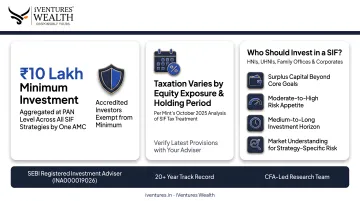
Tax rules shift often, so verify the latest provisions with your adviser before acting.
Who should invest? SIFs suit HNIs, UHNIs, family offices, and corporates with:
- Surplus capital beyond core financial goals
- A moderate-to-high risk appetite
- A medium-to-long investment horizon
- Enough market understanding to evaluate strategy-specific risk
This is precisely the segment iVentures Wealth works with daily. As a SEBI Registered Investment Adviser (INA000019026) with a 20+ year track record and a CFA-led research team, the firm helps UHNI and family office clients assess whether a SIF strategy genuinely complements their broader portfolio and long-term goals, rather than just chasing a new category because it's trending.
If you're weighing a SIF allocation against your existing PMS, AIF, or mutual fund holdings, a fiduciary-first conversation is worth having before you commit capital.
Frequently Asked Questions
What is a specialised investment fund?
A SIF is a SEBI-regulated investment category, effective April 2025, that bridges the gap between mutual funds and PMS. It requires a ₹10 lakh minimum investment and allows more sophisticated strategies than standard mutual funds.
Who is eligible to invest in a specialised investment fund?
Investors need ₹10 lakh aggregated at the PAN level across all SIF strategies offered by one AMC. Accredited investors meeting SEBI's net worth or income criteria are exempt from this minimum.
What is the difference between a mutual fund and a specialised investment fund?
Mutual funds have no minimum ticket size and offer limited strategy flexibility. SIFs require ₹10 lakh and permit long-short strategies, sector concentration, and unhedged derivative exposure, along with longer redemption notice periods.
Is a specialised investment fund a good investment?
It depends on your risk appetite, investment horizon, and financial goals. SIFs suit investors comfortable with volatility and limited liquidity; consulting a SEBI-registered adviser before investing is strongly recommended.
What is the minimum investment required for a SIF?
The threshold is ₹10 lakh per investor, calculated at the PAN level across all SIF strategies of a single AMC. This excludes any regular mutual fund holdings you may already have.
Are Specialised Investment Funds regulated by SEBI?
Yes. SIFs operate under SEBI's Mutual Fund Regulations, with defined disclosure norms, mandatory risk-band labelling, and governance standards enforced through SEBI's February 2025 circular.