
Here's the paradox: the instincts that built a successful company often work against you once it's sold. Running a business rewards concentration, speed, and conviction. Managing a large personal payout rewards diversification, patience, and process. Founders are frequently first-time investors handling sums far larger than anything they've personally managed before.
This article breaks down the mistakes Indian founders repeatedly make after a business sale, ESOP exit, or IPO, and lays out a practical, phased framework for the first 100 days that keeps your options open while you figure out the right long-term structure.
Key Takeaways
- Liquidity events unfold over years, not months, and the first few months set the trajectory for decades
- Lifestyle inflation and rushed reinvestment cause more damage than market swings ever do
- SEBI-registered fiduciary advisors, unlike commission-driven relationship managers, materially change long-term outcomes
- A phased 100-day plan reduces irreversible decisions and preserves optionality
Why Liquidity Events Are a Uniquely Risky Moment for Founders
Most founders spend years with net worth locked in a single asset: their company. A liquidity event flips that overnight. One day your wealth sits in illiquid equity you understand intimately; the next, it's a number in a bank account you've never had to manage at this scale.
That's the practical problem. Layer on three psychological pressures, and the risk compounds:
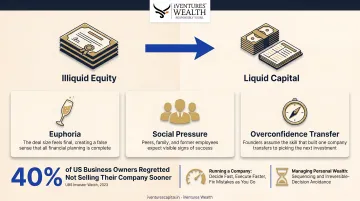
- Euphoria: the deal size feels "final," creating a false sense that all financial planning is now complete
- Social pressure: peers, family, and former employees expect visible signs of success
- Overconfidence transfer: founders assume the skill that built one company automatically translates into picking the next investment or venture
For multi-generational family businesses, the pressure compounds further. A sale disrupts a family's identity and income structure built around the operating company. Cousins, in-laws, and next-gen members all develop opinions about what should happen to the proceeds, often before the founder has finished the transaction paperwork.
That pattern shows up in the data: a 2023 UBS Investor Watch survey found that 40% of US business owners regretted not selling their company sooner. That's a reminder that decision regret shadows the entire ownership-to-exit journey, not just what happens after the money lands.
No reliable India-specific data yet exists on how many founders regret their post-exit financial choices within a year. What is documented, repeatedly, is the pattern: founders who diligenced term sheets for months make seven-figure personal decisions within weeks.
Running a company rewards speed: decide fast, execute faster, fix mistakes as you go. Personal wealth management rewards the opposite: sequencing and irreversible-decision avoidance. A bad quarter in a business can often be reversed. A rushed real estate purchase or a wrong tax assumption on a nine-figure exit frequently cannot.
The 6 Costly Mistakes Founders Make After a Liquidity Event
These mistakes repeat across founder exits regardless of deal size, whether it's ₹20 crore or ₹2,000 crore. Recognising the pattern early is the fastest way to avoid it.
Mistake 1: Treating the Entire Payout as Spendable Money
The gross number on the term sheet isn't the number to plan around. Between capital gains tax, TDS, advance tax instalments, and deal-related costs, usable proceeds are often 20 to 30% lower than the headline figure.
Founders who skip this step tend to fund a lifestyle jump, a bigger house, a second home, upgraded cars, based on gross proceeds rather than net capital. Once core capital gets spent on depreciating or illiquid lifestyle assets, it stops compounding entirely.
Split proceeds into three buckets before spending anything:
- Tax reserve: what you owe the government, set aside immediately
- Core capital: the corpus meant to compound for decades
- Lifestyle capital: a defined, capped amount you're free to spend
Mistake 2: Delaying Tax Planning Until After the Deal Closes
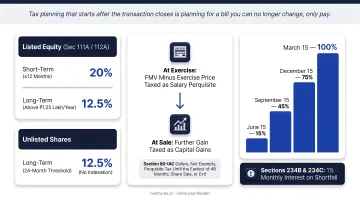
Tax planning that starts after the transaction closes is planning for a bill you can no longer change, only pay. For listed equity meeting Section 111A/112A conditions, short-term gains (held 12 months or less) attract 20% tax, while long-term gains above ₹1.25 lakh a year attract 12.5%. Unlisted shares carry a longer 24-month long-term threshold, with LTCG taxed at 12.5% without indexation.
Founder-employees holding ESOPs face a double tax point. The spread between fair market value and exercise price gets taxed as a salary perquisite at exercise, and any further gain gets taxed as capital gains at sale. Section 80-IAC lets eligible startups defer the perquisite tax, not exempt it, until the earliest of 48 months, share sale, or leaving the company.
Then there's advance tax. Once estimated liability crosses ₹10,000, quarterly instalments fall due:
- 15% by June 15
- 45% by September 15
- 75% by December 15
- 100% by March 15
Miss a deadline, and Sections 234B and 234C apply 1% monthly interest on the shortfall.
Mistake 3: Rushing Into New Ventures or Angel Investments
Within months of an exit, founders get flooded with pitches from old colleagues, fellow founders, and their own restless instinct to build again. Writing a handful of angel cheques into unvetted startups feels productive. It's actually the fastest way to recreate the concentration risk a liquidity event just let you escape.
A diversified portfolio built over years of company-building shouldn't get replaced with five new illiquid, single-founder bets in the first six months. If new ventures matter to you, cap the allocation, many advisors suggest no more than 10 to 15% of net proceeds, and treat it as venture risk capital, not core wealth.
Mistake 4: Relying on Commission-Driven Advisors Instead of Fiduciaries
A mutual fund distributor earns commissions from the products they sell you. A SEBI-registered Investment Adviser (RIA) is legally required under Regulation 15 to act in a fiduciary capacity, disclose conflicts, and cannot take payment from product manufacturers for advice given to you.
The distinction isn't academic. SEBI's Investor Survey 2025 found that 61% of mutual fund investors were fully dependent on intermediaries for advice and execution, while 41% of intermediaries themselves flagged mis-selling or lack of product suitability as a predominant investor complaint.
For a founder sitting on a one-time, irreplaceable corpus, that conflict of interest matters more than it ever did during the accumulation years. A relationship manager paid on product sales has a built-in incentive to recommend whatever pays them.
Mistake 5: Neglecting Estate Planning and Family Governance
Estate planning tends to get pushed to "someday," until a health scare or a family disagreement forces the issue years too late. A 2025 Julius Baer-EY study of more than 25 Indian family offices found that while 59% had wills or family agreements in place, 11% hadn't even discussed succession among family members.
India's business pages carry enough examples of what happens when this gets left too late: multi-generational disputes over wills, codicils, and verbal family understandings have played out publicly in prominent Indian business families over recent years, tying up assets and relationships in litigation.
For founders exiting multi-generational family businesses, a fresh liquidity event is the natural moment to formalise a will, consider trust structures, and put a family governance framework in writing, while everyone is still aligned and the capital is still liquid enough to structure cleanly.
Mistake 6: No Consolidated View Across Entities and Accounts
Post-exit wealth rarely sits in one place. Proceeds get split across multiple demat accounts, a holding company, real estate bought under a spouse's name, and mutual fund folios opened years ago by three different relationship managers.
The result: nobody, including the founder, can answer a simple question, "What's my actual asset allocation right now?" Without a consolidated view, it's impossible to know if you're overexposed to equity, underexposed to fixed income, or unknowingly holding five funds that all own the same twenty stocks.
The Founder's Post-Exit Playbook: What to Do in the First 100 Days
The next hundred days set the tone for everything that follows, whether that means a decade of compounding gains or years spent correcting early missteps. Here's how to sequence the work.
Days 1-30: Stabilise
Park proceeds in secure, interest-bearing instruments while you get organised:
- Move funds into liquid funds, sweep-in fixed deposits, or treasury bills, not left idle or locked into anything illiquid
- Avoid major purchases, investment commitments, or "quick" angel cheques during this window
- Gather every deal document, TDS certificate, and payout schedule you'll need for tax reconciliation
Days 30-60: Assess
Bring your chartered accountant and SEBI-registered advisor into the same conversation:
- Estimate actual tax liability, including capital gains, ESOP perquisite tax, and advance tax instalments due
- Reconcile TDS already deducted at source against what you'll actually owe
- Confirm real net proceeds versus the gross deal value everyone's been congratulating you on
Days 60-90: Structure
With tax liability confirmed, build the actual portfolio:
- Complete a formal risk-profiling exercise, not a five-minute questionnaire
- Design an initial diversified allocation across equity, debt, real estate, and alternates
- Size each allocation to specific short and long-term goals, not to whatever felt exciting last quarter
Days 90-100: Formalise
With the portfolio structured, shift focus to protecting it for the long run:
- Start estate planning conversations: wills, trust structures, or a family governance framework
- Set up a system for consolidated tracking across every demat account, entity, and family member's holdings
- Revisit the plan, since earn-outs, lock-ins, and staggered ESOP vesting can shift this calendar considerably
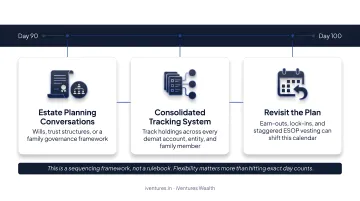
This is a sequencing framework, not a rulebook. Flexibility matters more than hitting exact day counts.
Building the Right Post-Exit Advisory Team
Three professionals, working together, cover ground a founder can't cover alone:
- A SEBI-registered investment adviser: portfolio construction, asset allocation, and ongoing risk-profiled reviews
- A chartered accountant: tax structuring, advance tax calculations, and return filing
- An estate planning attorney: wills, trust deeds, and family governance documentation
None should operate in isolation. A tax structure that ignores investment strategy creates inefficiency, and an investment plan that ignores estate structuring creates future disputes. Coordination between the three matters more than the brand name of any single expert.
The investment adviser's role deserves particular scrutiny here, since this is where most of the corpus sits. For a corpus this size, ad-hoc stock tips from a relationship manager aren't a strategy. A research-driven approach, ideally led by a CFA charterholder running structured processes (data collection, performance analysis, risk assessment, allocation review), gives you a defensible reason for every position in your portfolio.
When evaluating advisers, three questions matter more than pedigree:
- Are they a fiduciary? Check SEBI RIA registration directly; it's a legal status, not a marketing claim
- Is their fee structure transparent? You should know exactly what you're paying and why, with no hidden product commissions
- Do they have a track record with liquidity events specifically? Business sales, ESOP exits, and IPO lock-ins each carry sequencing challenges that general HNI advisory doesn't always cover
How iVentures Wealth Helps Founders Navigate Life After Exit
This is exactly the gap iVentures Wealth was built to close. Founded in 2005 and registered with SEBI as an Investment Adviser (INA000019026), the firm has spent 20+ years working as a fiduciary for founders, CEOs, and family offices across India. Today, it manages ₹1,200+ crore in assets for 150+ affluent families.
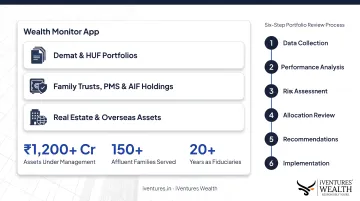
The "no consolidated view" mistake, Mistake 6 above, is one iVentures built a specific tool to solve. The Wealth Monitor App consolidates a founder's full asset picture into a single dashboard:
- Demat accounts and HUF portfolios
- Family trusts, PMS, and AIF holdings
- Real estate and overseas assets
The app updates valuations in real time, with monthly and quarterly reports for deeper tax and performance review. For a founder juggling personal holdings, a holding company, and family accounts, that single view replaces a spreadsheet nobody trusts.
For founders relocating abroad after an exit, or structuring wealth across generations, iVentures' family office and NRI/OCI advisory services cover cross-border tax coordination, currency management, and succession structuring. The firm works alongside external chartered accountants and estate attorneys rather than replacing them.
Krishna Makhariya, the firm's CFA-charterholder Head of Research, leads a structured six-step portfolio review process:
- Data collection
- Performance analysis
- Risk assessment
- Allocation review
- Recommendations
- Implementation
This process-driven approach suits a large, one-time corpus better than a series of individual stock tips.
Frequently Asked Questions
What is a liquidity event in wealth management?
A liquidity event is any occasion where illiquid wealth, business equity, ESOPs, or property converts into cash or tradeable assets. Common examples include a business sale, an IPO, or an acquisition.
How much of my liquidity event proceeds should I keep liquid versus invest?
This depends on your tax liability, near-term goals, and risk profile. A portion should always be reserved for estimated tax payments before any investing begins.
Do I need a financial advisor after selling my business or exiting via IPO?
A fiduciary advisor helps coordinate tax and investment decisions alongside estate planning, sequencing that's genuinely difficult to get right alone, especially for a first large liquidity event.
How should founders handle taxes after a liquidity event in India?
Estimate your capital gains and ESOP tax liability early, set aside funds for advance tax, and work with a chartered accountant before assuming TDS covers your full bill.
What is the biggest mistake founders make with their exit proceeds?
Rushing into new investments or ventures without a diversification and tax plan is the most common and costly mistake, often recreating the same concentration risk founders just exited from.
How soon after a liquidity event should I start investing?
Secure cash and confirm your tax liability first, typically within 30 to 60 days. Then build a diversified allocation over the following weeks rather than investing everything at once.