

Introduction
India's equity markets have rewarded patient investors more consistently than almost any other asset class over the past two decades. The question isn't whether Indian equities can create wealth — the data on that is clear. The harder question is which stocks to hold, and for how long.
Many investors struggle here. They pick stocks based on recent momentum, panic during corrections, and end up with portfolios that underperform even simple index funds.
In 2025, with India's GDP projected to grow at 6.6% in FY2025-26 according to the IMF's 2025 Article IV consultation, the structural case for long-term equity investing is compelling — but only if you're selecting the right businesses.
This guide walks through what defines a long-term stock, which Indian companies stand out in 2025, the criteria to evaluate them, and the key considerations before building a position — so you can make decisions grounded in fundamentals, not noise.
Key Takeaways
- Long-term stocks are held for 3+ years, chosen for business quality and earnings durability — not price momentum
- India's 2025 macro tailwinds — domestic consumption, digital infrastructure, and defence capex — support a strong equity outlook
- RIL, HDFC Bank, TCS, ICICI Bank, and BEL each anchor a sector with durable, structural growth potential
- Position sizing and time horizon matter as much as stock selection — match each holding to your risk capacity
- This content is educational only; consult a SEBI-registered adviser before making investment decisions
What Are Long-Term Stocks and Why Do They Matter in 2025?
Long-term stocks are equity investments held for 3–10+ years in companies with strong fundamentals, proven earnings growth, and the pricing power or market position to sustain both. The distinction from speculative trading goes beyond holding period. Long-term investors are acquiring a stake in a business and its future cash flows — not betting on short-term price movement.
The Compounding Argument
The most compelling case for long-term equity investing in India comes from the Nifty 50's own track record. NSE's analysis of 25 years of Nifty 50 Total Returns found positive CAGR in 99.9% of daily five-year rolling windows and 100% of daily ten-year rolling windows measured through December 2021. In nearly half of all ten-year periods, returns exceeded 15% CAGR annually.
Past performance doesn't guarantee future results. But for a sophisticated investor, the data makes one thing clear: the longer the holding period, the narrower the range of bad outcomes.
Why 2025 Specifically Matters
Several structural drivers make 2025 a relevant year to review and build long-term equity positions:
- Government capex: The Union Budget FY2025-26 allocated ₹11.21 lakh crore (3.1% of GDP) toward infrastructure and capital expenditure
- Digital payments: India recorded 96.96 crore internet connections in 2024, and UPI processed ₹24.77 lakh crore worth of transactions in April 2025 alone
- Defence indigenisation: The Ministry of Defence's FY2025-26 budget allocated ₹1.11 lakh crore specifically for domestic-industry procurement
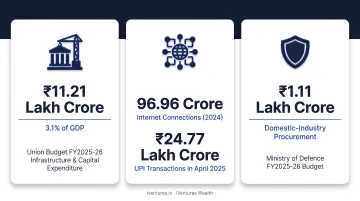
Each of these trends unfolds over years, not quarters. The companies best positioned to benefit are the focus of the analysis that follows.
Best Long-Term Stocks to Invest in India in 2025
The stocks below are drawn from India's largest companies by market capitalisation and evaluated on consistent profit growth, sectoral leadership, and resilience across market cycles. This list is for educational purposes only and is not investment advice. Market cap, P/E ratio, and five-year return figures should be verified from BSE/NSE at the time of reading, as these change daily.
Reliance Industries Limited (RIL)
RIL is India's largest conglomerate by market capitalisation, with four distinct business engines: Jio (telecom and digital services), Reliance Retail (consumer), O2C (oil-to-chemicals), and an emerging Green Energy vertical. This diversification is precisely what makes it a cornerstone holding — no single sector downturn can derail the whole enterprise.
What sets RIL apart for long-term investors:
- Jio had 488.2 million subscribers at 31 March 2025, with 191 million True 5G subscribers — pan-India 5G rollout complete
- FY2025 consolidated gross revenue reached ₹10,71,174 crore, with PAT of ₹81,309 crore
- Green energy commitment of ₹75,000 crore, targeting 100 GW renewable capacity by 2030 and net carbon zero by 2035
- Retail expansion continues aggressively across tier-2 and tier-3 India
| Metric | Detail |
|---|---|
| Sector | Conglomerate (Telecom, Retail, Energy, O2C) |
| Key Investment Thesis | Diversified revenue streams; India's consumer and digital growth story |
| Market Cap / P/E / 5Y Return | Verify at BSE/NSE before investing |
HDFC Bank Limited
HDFC Bank is India's largest private sector bank by market cap and one of the most consistent compounders in Indian equities. Decades of superior asset quality, consistent earnings growth, and a retail-dominated loan book have made it a benchmark holding in most institutional and HNI portfolios.
Key metrics from FY2025 annual report:
- Net NPA ratio: 0.43% — one of the lowest among large Indian private banks
- NIM: 3.48% for FY2025
- ROE: 14.6% for FY2025
- CASA ratio: 34.8% — reflecting a strong, low-cost deposit franchise
- 9,455 branches, with over 51% in semi-urban and rural India
That rural and semi-urban branch network signals a growth runway that extends well beyond India's metros — a meaningful differentiator for investors with a long time horizon.
| Metric | Detail |
|---|---|
| Sector | Private Sector Banking |
| Key Investment Thesis | Best-in-class asset quality; financialisation of savings tailwind; consistent compounder |
| Market Cap / P/E / 5Y Return | Verify at BSE/NSE before investing |
Tata Consultancy Services (TCS)
TCS is India's largest IT services company and one of the most cash-generative businesses in the country. Its global client base spans BFSI, retail, manufacturing, and government — providing revenue resilience that narrower IT peers simply can't match.
What makes TCS a long-term holding:
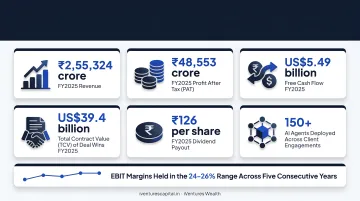
- FY2025 revenue: ₹2,55,324 crore; PAT: ₹48,553 crore
- Free cash flow of US$5.49 billion in FY2025
- FY2025 dividend payout: ₹126 per share
- Total Contract Value (TCV) of deal wins: US$39.4 billion in FY2025
- EBIT margins have held in the 24–26% range across five consecutive years
- Active AI investment: TCS WisdomNext platform with 150+ AI agents deployed across client engagements
| Metric | Detail |
|---|---|
| Sector | IT Services and Consulting |
| Key Investment Thesis | Global digital transformation beneficiary; high cash generation; dividend compounder |
| Market Cap / P/E / 5Y Return | Verify at BSE/NSE before investing |
ICICI Bank Limited
ICICI Bank's turnaround over the past five years stands out in Indian banking. Once weighed down by asset quality concerns, the bank has rebuilt its balance sheet, scaled its digital infrastructure, and delivered consistent profit growth — with retail lending expanding in parallel throughout.
FY2025 operating highlights:
- Net NPA ratio: 0.39% — the lowest in the bank's history at 31 March 2025
- ROE: 18.0% (consolidated) for FY2025 — materially ahead of HDFC Bank on this metric
- NIM: 4.41% in Q4 FY2025; 4.32% for the full year
- Retail advances grew 8.9% year-on-year to ₹7,172 billion
- iMobile processed 558 million transactions worth ₹11,238 billion in FY2025
- FII/FPI ownership at 37.3% — reflecting strong institutional confidence
| Metric | Detail |
|---|---|
| Sector | Private Sector Banking |
| Key Investment Thesis | Profit and asset quality turnaround; digital banking scale; broad financial services presence |
| Market Cap / P/E / 5Y Return | Verify at BSE/NSE before investing |
Bharat Electronics Limited (BEL)
BEL is a Navratna PSU and India's dominant defence electronics manufacturer. Once considered a slow-moving government entity, BEL has been transformed by India's defence indigenisation push into a consistently growing business with an expanding order book and improving margins.
The BEL investment case in numbers:
- Order book of approximately ₹74,000 crore as of 1 April 2026 (up from ₹71,650 crore a year earlier)
- PAT grew from ₹2,065 crore in FY2021 to ₹5,288 crore in FY2025
- Net profit margin of 23% in FY2025
- Export turnover reached US$141.9 million in FY2026, with an export order book of US$495 million
- The Defence Acquisition Procedure (DAP) 2020 mandates at least 50% indigenous content in defence procurement — a structural policy tailwind for BEL
| Metric | Detail |
|---|---|
| Sector | Defence Electronics / Government PSU |
| Key Investment Thesis | Defence indigenisation play; growing order book; strong margins in a consistently growing sector |
| Market Cap / P/E / 5Y Return | Verify at BSE/NSE before investing |
How We Selected These Long-Term Stocks
The Evaluation Framework
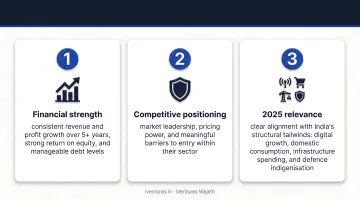
Each stock was assessed against three core pillars:
- Financial strength — consistent revenue and profit growth over 5+ years, strong return on equity, and manageable debt levels
- Competitive positioning — market leadership, pricing power, and meaningful barriers to entry within their sector
- 2025 relevance — clear alignment with India's structural tailwinds: digital growth, domestic consumption, infrastructure spending, and defence indigenisation
Common Mistakes to Avoid
SEBI's July 2024 study found that 7 in 10 individual intraday traders in the equity cash segment made losses. The pattern is consistent: investors who chase price movements rather than business quality tend to underperform over time.
Specific pitfalls to avoid when building a long-term portfolio:
- Chasing momentum — buying because a stock has already run up
- Ignoring valuation — even great businesses can be poor investments at the wrong price
- Overlooking governance — management's track record of capital allocation matters as much as reported financials
- Sector concentration — NSE data shows the median direct-equity investor held just three stocks as of August 2025, a level of concentration that creates significant uncompensated risk
Where Professional Guidance Adds Value
For affluent investors and HNIs, selecting and monitoring a long-term equity portfolio requires more than a curated list — it requires a personalised strategy that accounts for:
- Tax efficiency across holding structures and jurisdictions
- Risk tolerance relative to existing assets and income profile
- Asset allocation gaps or concentrations in the current portfolio
- Long-term financial goals, from wealth preservation to generational transfer
iVentures Wealth's CFA-led research team (SEBI Registration: INA000019026) operates as a fiduciary adviser — researching equities with the same discipline applied to overall portfolio construction. With ₹1,200+ crore in assets under advisory and 150+ affluent client relationships built over 20 years, the firm brings institutional rigour to individual portfolios.
Conclusion
Long-term wealth creation in Indian equities is less about finding the perfect entry point and more about selecting fundamentally strong businesses and holding them through market cycles. The companies covered above — RIL, HDFC Bank, TCS, ICICI Bank, and BEL — represent some of India's most resilient and structurally positioned enterprises across five distinct sectors.
That said, no stock is right for every investor. Before building a position in any of these, assess the holding against your personal risk profile, investment horizon, liquidity requirements, and existing portfolio composition. Revisiting equity holdings at least once a year is a sound discipline — watch for shifts in earnings quality, management changes, and sector-level headwinds that can alter a company's long-term thesis.
For investors who want a research-backed, personalised approach to building or reviewing a long-term equity portfolio, iVentures Wealth provides SEBI-registered advisory — tailored to HNIs, family offices, founders, and senior professionals — with open-architecture recommendations and no product conflicts. To schedule a consultation, reach out on WhatsApp at +91 99999 85119 or email wealth@iventures.in.
Frequently Asked Questions
Which is the best stock to buy in 2025?
No single stock is universally "best" — the right choice depends on your risk profile, time horizon, and sectoral preferences. Fundamentally strong large-cap stocks with consistent earnings growth and clear sectoral tailwinds are generally considered solid long-term candidates, but suitability varies by investor.
What are the key criteria for selecting long-term stocks in India?
The most important criteria are consistent revenue and profit growth over 5+ years, strong return on equity, a durable competitive moat, and management with a credible capital allocation track record. Valuation matters too — paying any price for quality is still a risk.
How long should I hold a long-term stock to see meaningful returns?
The typical long-term horizon is 5–10 years, which gives compounding sufficient time to work and allows businesses to navigate short-term volatility. NSE data shows that 100% of ten-year rolling Nifty 50 periods through December 2021 delivered positive returns. Time in the market is the one variable most investors consistently underestimate.
What sectors in India offer the best long-term investment opportunities in 2025?
Several sectors carry strong structural tailwinds heading into 2025:
- Private banking and financial services — driven by the financialisation of household savings
- IT and digital services — global enterprise transformation continues to generate offshore demand
- Defence electronics — government indigenisation mandates are redirecting significant capital
- Consumption — India's expanding middle class supports durable demand across categories
How much of my portfolio should be allocated to long-term equities?
The right allocation depends on age, income, risk tolerance, and financial goals. One common starting point is the "100 minus age" rule for debt allocation — but HNIs with longer horizons or higher risk capacity often skew meaningfully higher toward equities. A SEBI-registered financial adviser can provide personalised guidance based on your full financial picture.
Is it better to invest directly in stocks or through a SEBI-registered investment adviser?
Direct investing requires time, research capability, and emotional discipline — and SEBI's own data shows most individual traders underperform. A SEBI-registered adviser provides personalised strategy, professional research, and fiduciary obligation — making professional advisory especially valuable for busy professionals, CXOs, and HNIs where both capital and time are at a premium.