

The trouble is, the answers you'll find are all over the place. Some advisors say 5%. Others swear by 10-15%. A few aggressive voices push 20% or even 50% as protection against currency debasement. None of this helps if you don't know which number applies to you.
This guide breaks down the proven allocation frameworks, the personal factors that should override any generic rule, and the best instruments available to Indian investors looking to add gold to their portfolio.
Key Takeaways
- 10-15% gold allocation is the balanced sweet spot most most institutional research recommends
- Gold's low correlation with equities makes it a portfolio stabiliser rather than a growth driver
- Your ideal percentage hinges on risk tolerance, time horizon, and existing asset mix
- Allocation frameworks span conservative (5-10%) to aggressive hedging (30-50%)
- Rebalance periodically, especially after sharp rallies, to avoid drifting overweight
Why Gold Deserves a Strategic Place in Your Portfolio
Gold's biggest strategic advantage isn't price appreciation. It's what it doesn't do: move in lockstep with your other assets.
World Gold Council research puts gold's average correlation with equities and bonds at just 0.1, with its long-run correlation to global equities as low as 0.03 using monthly data going back to 1975. That's about as close to independent as any major asset class gets.
Gold as an Inflation and Currency Hedge
Indian investors have direct evidence of this at home. INR gold returned an average of 10% a year between 1981 and 2021, comfortably ahead of the 7.3% average CPI inflation over the same stretch.
The pattern holds during monetary tightening too. During five separate Indian rate-hiking cycles since 2004, gold averaged 19.5% annualised returns — including a 45.7% run from April to July 2008 alone.
Safe-Haven Behaviour During Crises
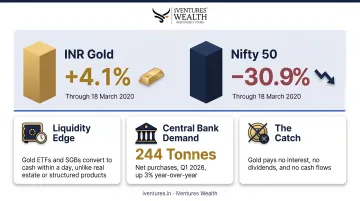
Gold's crisis performance is where it earns its keep. Through 18 March 2020, as COVID-19 panic gripped markets, INR gold gained 4.1% while the Nifty 50 fell 30.9%. This is the diversification benefit doing exactly what it's supposed to do when equities sell off hard.
A few other factors to weigh:
- Liquidity edge: Unlike real estate or structured products, gold (especially in ETF or SGB form) can be converted to cash within a day
- Central bank demand: Global central banks bought 244 tonnes net in Q1 2026 alone, 3% more than a year earlier, reinforcing gold's role as a reserve asset
- The catch: Gold pays no interest, no dividends, and no cash flows. Over-allocate, and you're sacrificing long-term compounding potential for stability you may not need
How Much Gold Should You Allocate? Common Rules & Frameworks
Expert recommendations typically range from 5% to 25% of a portfolio, with 10-15% being the most frequently cited band. A World Gold Council backtest on Indian portfolios found that adding 7.5-15% gold to a standard 70:30 equity-debt mix improved risk-adjusted returns and reduced drawdowns between December 2006 and December 2025.
The Conservative Approach (5-10%)
This suits investors who are broadly optimistic about economic growth and equity markets but want light insurance against unforeseen shocks. It's a "just in case" allocation rather than a core conviction position: enough to smooth volatility without meaningfully capping upside.
The Moderate Approach (10-20%)
This is where most balanced portfolios land, offering meaningful downside protection with a limited growth trade-off. MSCI's backtesting illustrates the effect:
| Portfolio Mix | Volatility | Max Drawdown |
|---|---|---|
| 60% equity / 40% bonds | 10.7% | 33% |
| 55% equity / 40% bonds / 5% gold | 9.9% | 30% |
A separate MSCI comparison found that a 60% equity / 30% bonds / 10% gold mix outperformed the benchmark by roughly 400 basis points over a one-year period.
Even a modest 5% sleeve moved the needle on both volatility and drawdown. A 10% allocation pushed that benefit further.
The Higher-Allocation / Hedge-Heavy Approach (25-50%)
This range suits investors who are genuinely bearish on the broader economy or currency outlook, a defensive stance well beyond what the typical wealth-building investor takes on. The trade-off is real volatility risk: gold can see interim pullbacks of 15-25% even within a broader bull run, as it did during 2008-09. Anyone running this heavy an allocation needs annual rebalancing to lock in gains rather than let the position ride unchecked.
The Emerging 60/20/20 Institutional Model
A notable shift is happening at the institutional level. In September 2025, Morgan Stanley CIO Mike Wilson publicly favoured a 60% equities, 20% fixed income, 20% gold model, effectively replacing half the traditional bond sleeve with gold as a "real asset" hedge against fiscal deterioration and currency debasement.
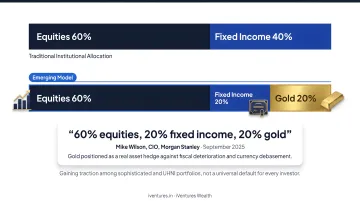
This model is gaining traction among sophisticated and UHNI portfolios, but it reflects a specific macro conviction — not a universal default for every investor.
Determining Your Ideal Gold Allocation: Key Factors to Consider
There's no single correct number. The right allocation depends on where you sit on a handful of variables:
- Risk tolerance: Conservative investors often lean toward 15-20% gold for stability, while aggressive, growth-focused investors may cap it at 5-10% to avoid diluting equity returns.
- Investment horizon and life stage: Younger investors need lower gold and higher equity exposure to ride out volatility. Those nearing retirement or a major goal, such as a child's education or business exit, benefit from a higher gold weighting for capital preservation.
- Existing portfolio composition: If you already hold real estate, structured products, or private equity (common in HNI and UHNI portfolios), check for overlap first. Piling gold onto an already illiquid, alternative-heavy balance sheet can concentrate risk rather than diversify it.
- Purpose of the allocation: Is gold meant as permanent insurance, or a tactical position riding the current rally? This distinction shapes both the sizing and rebalancing frequency.
Because the right gold allocation depends on your complete balance sheet, tax position, and goals rather than gold in isolation, this is exactly where a SEBI-registered fiduciary advisor earns their fee. A firm like iVentures Wealth, which takes a holistic, CFA-led research approach across a client's entire portfolio rather than treating gold as a standalone decision, can help determine the right starting allocation and rebalance it periodically as markets and goals evolve.
Best Ways to Invest in Gold in India
Once you've settled on a target percentage, the instrument matters almost as much as the allocation itself.
| Instrument | Key Advantage | Key Trade-off |
|---|---|---|
| Sovereign Gold Bonds (existing) | 2.5% annual interest + tax-free capital gains at maturity | No fresh issuance since February 2024; tax exemption rules under review |
| Gold ETFs | Exchange-traded, tracks spot price closely, high liquidity | Requires a demat and trading account |
| Gold Mutual Funds (FoFs) | No demat needed, SIP-friendly | Second layer of expense on top of the underlying ETF |
| Physical Gold | Tangible ownership, cultural utility | Making charges, storage costs, purity verification hassles |
| Digital Gold | Convenient, small-ticket entry | 2-3% buy-sell spread; sits outside SEBI's securities framework |
Sovereign Gold Bonds remain attractive for existing holders thanks to their interest coupon and tax-free maturity gains. Fresh issuance ended in February 2024 and the scheme was formally discontinued in the 2025 Union Budget, so this route is now limited to secondary-market purchases with evolving tax treatment.
Gold ETFs and gold mutual funds are the cleanest paper-gold route for most investors — regulated, liquid, and closely tracking spot prices without the storage headaches of physical gold.
Physical and digital gold still have a place for cultural or gifting purposes, but they carry costs, including GST, making charges, and spreads, that paper-gold instruments largely avoid.
Common Mistakes to Avoid When Allocating to Gold
A few recurring errors show up across investor portfolios:
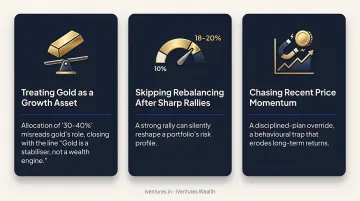
- Treating gold as a growth asset. Gold doesn't compound like equities. Allocating 30-40% expecting equity-like long-term returns misunderstands its role entirely: gold is a stabiliser, not a wealth engine.
- Skipping rebalancing after sharp rallies. A strong run-up (like gold's recent surge) can silently push your allocation from a target 10% to 18-20% without you noticing. Left unchecked, this reshapes your entire risk profile.
- Chasing recent price momentum. Buying more gold simply because prices are rising, rather than following a disciplined, macro-driven allocation plan, is a classic behavioural trap that erodes long-term returns.
Frequently Asked Questions
What are common rules for gold allocation in a portfolio (such as 60/20/20 or 80/50)?
Common frameworks range from 5-10% conservative, 10-15% moderate, and 15-25% hedge-heavy, alongside the emerging institutional 60/20/20 model. "80/50" isn't a standard rule — it reflects extreme, unusual hedge-heavy positioning.
Is 10% gold allocation in a portfolio too much?
No. A 10% allocation is balanced, not excessive. It adds meaningful diversification and stability without materially dragging down long-term portfolio growth.
What does Warren Buffett say about gold?
Buffett has long been sceptical, once describing gold as having "two significant shortcomings, being neither of much use nor procreative." Gold's recent rally has challenged this view somewhat, but his core scepticism toward unproductive assets remains well known.
Is gold a good hedge against inflation?
Gold works as an inflation hedge, and Indian data supports this over long horizons. However, it historically reacts more strongly to geopolitical uncertainty and currency movements than to inflation alone in the short term.
How often should you rebalance your gold allocation?
Annual rebalancing, or trigger-based rebalancing when your allocation drifts 5% or more from target, is the general recommendation. This locks in gains after rallies and keeps your risk profile intact.
Should young investors invest in gold?
Young investors can hold a smaller gold allocation, around 5-10%, for diversification while prioritising equities for long-term wealth creation. Gold's role here is stability, not growth.