

In Q1 2026, investment demand for gold in India overtook jewellery demand for the first time, according to World Gold Council data — 82 tonnes of investment buying against 66 tonnes of jewellery purchases. That's not a seasonal blip. It's a mindset shift among India's wealthy, from consumption to allocation.
For HNIs, the stakes of getting this wrong cut both ways. Too little gold, and a portfolio loses its hedge against rupee depreciation and market shocks. Too much, and you're parking capital in a low-yield asset that quietly erodes long-term wealth creation.
This article skips the "should I buy gold" debate. The real question for HNIs is sharper: how much, in which instrument, and why.
Key Takeaways
- Gold has evolved from a tactical trade into a core, strategic allocation for advisors
- The right percentage depends on net worth tier, alternative exposure, and wealth goals
- With SGBs closed to new investors, ETFs and staggered entry are the default HNI route
- A SEBI-registered advisor converts generic allocation ranges into a portfolio-specific number
What Is Gold as an Investment for HNIs?
For a retail saver, gold is often a small-ticket habit: a monthly SIP into a gold fund, or coins bought around a festival. For an HNI, gold plays a different role entirely.
It's a portfolio stabiliser and inflation/currency hedge, not a primary engine of wealth creation. Its real job is cushioning the impact when equities, real estate, and business income all move in the same direction at once.
Instruments HNIs Actually Use
Three broad routes exist, but they aren't equally relevant to a large portfolio:
- Physical gold (bars/coins): Rarely used for investment purposes due to storage, insurance, and resale friction at scale. It suits gifting or cultural holdings better than core allocation.
- Sovereign Gold Bonds (SGBs): Historically the most tax-efficient option, combining 2.5% annual interest with capital-gains exemption at maturity. No fresh tranche has been issued since February 2024, so fresh HNI capital can only access outstanding bonds through exchange trading, not primary issuance.
- Gold ETFs and gold mutual funds: Now the default for HNIs. They offer market-linked pricing, exchange-level liquidity, staggered entry, and none of the storage headaches of physical gold.
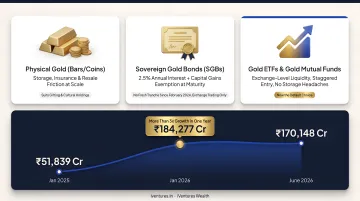
The numbers back this shift. AMFI data shows gold ETF AUM growing from roughly ₹51,839 crore in January 2025 to ₹184,277 crore by January 2026, a more than threefold jump in a year, before easing slightly to ₹170,148 crore by June 2026 as prices corrected.
Why HNIs Are Increasing Gold Exposure
Four forces are converging here:
- Demand crossover. Q1 2026 investment demand rose 54% year-on-year to 82 tonnes, while jewellery fell 19% to 66 tonnes, a clear signal that wealthier buyers are allocating, not just consuming.
- Low correlation with existing wealth. For promoters and CXOs whose net worth is already concentrated in one company or sector, gold offers genuine diversification: it doesn't move in lockstep with equities, debt, or business income.
- A maturing wealth ecosystem. India's ultra-high-net-worth population is projected to grow from 19,877 in 2026 to 25,217 by 2031, per Knight Frank's Wealth Report, a 27% rise. More family offices, more capital, and less room for casual, undisciplined allocation.
- Elevated prices, elevated conviction. Even at record price levels, advisors are increasingly vocal about treating gold as core, not tactical, precisely because global uncertainty hasn't gone away.
How Much Gold Should HNIs Actually Allocate? A Decision Framework
There's no single "right" number here. Anyone quoting a flat percentage without asking about your net worth, liquidity needs, or existing holdings is giving you a rule of thumb, not advice.
That said, two broad ranges show up repeatedly among Indian wealth advisors:
| Advisor View | Recommended Range | Rationale |
|---|---|---|
| Arijit Sen, Merry Mind | 5-10% (ETFs) | Tactical flexibility and hedging |
| Dev Ashish, Stable Investor | 7-10% | Diversifier, not a return driver |
| Riya Singh, Emkay Global | 5-15% | Split between physical and market-linked gold |
| Chirag Mehta, Quantum MF | 10-15% | Core hedge via ETFs/gold FoFs |
The 5-15% spread doesn't mean advisors disagree with each other. It reflects genuinely different client situations, and several specific factors drive where you land.
Portfolio Size and Net Worth Tier
A ₹50 lakh portfolio and a ₹50 crore-plus portfolio don't need the same gold weighting.
- Smaller portfolios often lean toward a higher gold percentage for capital protection, since there's less room to absorb drawdowns.
- Larger portfolios with existing exposure to private credit, AIFs, and structured products already have built-in diversification. The marginal need for gold shrinks.
The KPI that matters here: gold as a percentage of investable surplus, not as a percentage of your entire net worth including operating business assets.
Wealth Objective: Preservation vs Growth
A family office or trust focused on legacy planning behaves differently from a founder still compounding a business.
- Preservation-focused clients (retirees, family trusts) typically sit at the higher end of the range, around 10-15%
- Growth-focused entrepreneurs keep gold as a smaller ballast, closer to 5-8%, to avoid diluting long-term compounding
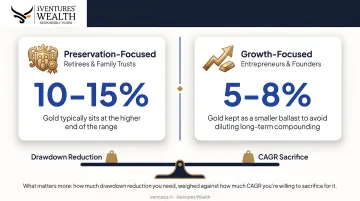
What matters more here is the drawdown reduction you need, weighed against how much CAGR you're willing to sacrifice for it.
Existing Exposure to Alternative and Correlated Assets
If you already hold real estate, commodity-linked structured products, or private credit with inflation-linked returns, stacking a large gold position on top risks over-concentration in "hard asset" categories. For instance, a portfolio already heavy in commodity-linked structured notes may not need an additional 10-15% in gold layered on top.
Check the correlation coefficient across your existing holdings before adding gold, not just the label on each asset class.
Liquidity Needs and Entry Timing
With SGBs off the table and gold prices at elevated levels, most advisors now recommend staggered ETF entry over lump-sum buying. This also caps exposure to less-liquid instruments if you have near-term goals or cyclical business cash flow needs.
Weigh your time horizon to the next liquidity event against the average cost of staggered entry versus a lump-sum purchase at today's price.
Currency, Geopolitical, and Inflation Hedge Requirements
HNIs with rupee depreciation exposure, cross-border business interests, or genuine concern about geopolitical shocks tend to lean toward the higher end of the range, using gold deliberately as a hedge rather than a return bet. A promoter with significant export revenue exposed to global currency swings, for example, may hold gold at 12-15% specifically to offset rupee volatility.
Here, the KPI is your portfolio's sensitivity to INR depreciation, measured against your inflation-adjusted return target.
How iVentures Wealth Helps HNIs Get Gold Allocation Right
Most gold advice online stops at a percentage. iVentures Wealth starts with your entire balance sheet before it goes anywhere near a number.
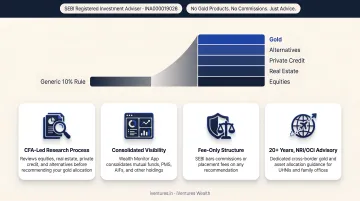
As a SEBI-registered investment adviser (INA000019026), the firm doesn't sell gold products, or any products at all. That distinction matters more than it sounds:
- CFA-led research process: Headed by Krishna Makhariya, the team reviews your equities, real estate, private credit, and alternatives before recommending an instrument mix built for you, not a copied 10% rule.
- Consolidated visibility: The Wealth Monitor App consolidates holdings across mutual funds, PMS, AIFs, and other instruments, showing exactly where gold adds diversification instead of duplicating it.
- Fee-only structure: SEBI's regulations bar iVentures from accepting commissions or placement fees, so an ETF recommendation is never swayed by which fund pays a higher trail, unlike jewellers or bank-led gold schemes.
- 20+ years advising UHNIs and family offices, with dedicated advisory for NRI/OCI clients navigating cross-border gold and asset allocation decisions.
If you're unsure whether your current gold exposure fits your broader portfolio, a direct consultation is a more useful starting point than another generic percentage from the internet.
Conclusion
Chasing a popular allocation percentage you saw in an article — including parts of this one — isn't a strategy. The right number for you depends on your net worth tier, your objective, your liquidity runway, and what's already sitting in your portfolio.
Gold allocation also isn't a one-time decision. Revisit it as your net worth grows, as new alternative assets enter your portfolio, and as instruments like SGBs disappear while new ones take their place.
Broad market commentary can tell you the range. A fiduciary advisor, like the team at iVentures Wealth, can tell you exactly where you sit within it.
Frequently Asked Questions
Is it good to invest in gold in India in 2026?
Gold remains a relevant hedge given inflation and global uncertainty, but it works best as a defined allocation within a diversified portfolio, not a standalone bet. Staggered entry is preferable to a lump-sum purchase at current elevated prices.
How high will gold prices go in India by 2030?
Long-term price forecasts are speculative and shouldn't drive your allocation decision. Even major institutions like J.P. Morgan only forecast one to two years out with confidence. Treat past price appreciation as context, not a guarantee.
How much would a ₹10,00,000 investment in gold 20 years ago be worth today?
Gold in India delivered an annualised return of roughly 11.7% over the 15 years to end-2021, per World Gold Council data, with separate industry estimates placing 20-year rupee returns even higher. This underscores gold's long-term wealth-preservation role, though your exact returns depend on entry timing and market cycles.
What percentage of my portfolio should be in gold if I am an HNI?
Advisor ranges typically span 5-15%, depending on your net worth, existing alternative asset exposure, and whether you're using gold tactically or as a core hedge. There's no single figure that fits every HNI.
Are Sovereign Gold Bonds still available for new investors in 2026?
No fresh SGB tranche has been issued since February 2024, and no new subscription window is currently open. Gold ETFs and gold mutual funds have become the primary market-linked alternatives for fresh HNI investment.
Should HNIs invest in gold ETFs or physical gold?
ETFs are generally preferred by HNIs for their liquidity, transparency, and ease of staggered entry. Physical gold is better suited to gifting or cultural holdings rather than core portfolio allocation.