
Both are legal, both are legitimate, and both solve the same underlying problem: how does an Indian resident build real exposure to US equities, global bonds, or international funds? The difference lies in cost, compliance, and how much paperwork you're willing to take on.
This comparison matters more than ever. FY2025-26 saw $28.98 billion move out of India under the Liberalised Remittance Scheme, and within that, equity and debt investment remittances jumped 56.10% to $2.65 billion. Meanwhile, GIFT City's fund ecosystem is expanding fast on the domestic front.
This article breaks down both routes: what they are, their costs, their tax treatment, and a real-world scenario to help you pick the right one.
Key Takeaways
- LRS lets residents remit up to $250,000/year abroad; GIFT City offers onshore, rupee-friendly access to the same markets.
- Tax treatment on foreign capital gains and dividends is nearly identical either way; cost and convenience are the real differentiators.
- TCS at 20% applies above ₹10 lakh on LRS remittances, regardless of broker or GIFT City account.
- Your ideal route depends on investment size, product needs, and comfort with foreign paperwork.
- A SEBI-registered adviser can blend both routes instead of forcing an either/or choice.
What is LRS (Liberalised Remittance Scheme)?
LRS is the RBI's framework letting resident individuals remit up to $250,000 per financial year, per person (PAN is mandatory for identification), for permitted current and capital account transactions, including overseas investing. For Indian investors chasing global equity or bond exposure, this is still the most direct route available.
Its biggest strength? Breadth. LRS opens the door to virtually the entire global securities universe:
- Individual US and international stocks
- Foreign-listed bonds and REITs
- Options and derivatives on foreign exchanges
- Fractional shares through established brokerage platforms
How LRS Actually Works
An Authorised Dealer (AD Category-I) bank handles the remittance, checks FEMA compliance, and reports the transaction to the RBI. Your funds are wired abroad into a foreign brokerage account, where you invest directly in dollar-denominated securities.
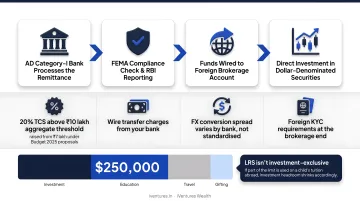
The cost layers add up:
- 20% TCS above the ₹10 lakh aggregate threshold (raised from ₹7 lakh under Budget 2025 proposals)
- Wire transfer charges from your bank
- FX conversion spread, which varies by bank and isn't standardised
- Foreign KYC requirements at the brokerage end
One planning trap: LRS isn't investment-exclusive. The same $250,000 cap covers education spending, travel, and gifting too. If you've already used part of the limit on a child's tuition abroad, your investment headroom shrinks accordingly.
Use Cases of LRS
LRS fits best when you need specific, named securities that GIFT-listed exchanges simply don't offer — a particular US tech stock, a niche ETF, or exchange-traded options strategies.
Typical LRS users:
- Tech professionals and entrepreneurs who already hold foreign brokerage accounts
- NRIs maintaining existing overseas relationships
- Investors wanting direct market access rather than a wrapped product
Given that equity/debt remittances under LRS rose over 56% in FY26, direct global investing through this route is gaining traction among Indian residents, not shrinking.
What is GIFT City (IFSC Route)?
GIFT City, short for Gujarat International Finance Tec-City, is India's first International Financial Services Centre, regulated by the IFSCA. It's designed to let international investing happen within India's own regulatory perimeter, which matters a lot if you want onshore comfort and simpler estate planning.
Core benefits include:
- Potential INR funding for certain products, avoiding a SWIFT wire altogether
- No STT or stamp duty on trades executed on IFSC exchanges like NSE IX and India INX
- A growing shelf of global funds, ETFs, unsponsored depository receipts (UDRs), and AIFs
The Nuance Most People Miss
Not every GIFT City investment works the same way, and this distinction matters for preserving your remittance limit:
- LRS-funded GIFT IFSC brokerage accounts: these still consume your $250,000 annual cap and attract TCS exactly like direct overseas investing.
- Domestic mutual fund or ETF wrappers that invest in GIFT-listed international instruments: these don't touch LRS at all, since you're subscribing in rupees to a SEBI-regulated domestic scheme.
Confusing these two can reduce your remittance headroom for the year without warning.
IFSCA also acts as a single-window regulator covering banking, capital markets, insurance, and fund management inside GIFT City, a real simplification compared to juggling RBI, SEBI, and foreign regulators under the direct LRS route.
Use Cases of GIFT City
GIFT City serves two very different investor types:
- UHNIs and family offices seeking exposure beyond retail amounts through AIFs: restricted non-retail schemes require a $150,000 minimum, while venture-capital schemes require $250,000
- Retail investors wanting curated global index exposure without opening a foreign account, through NSE IX/India INX-listed UDRs on US stocks, or domestic AMC funds tracking indices like the S&P 500 or Nasdaq 100
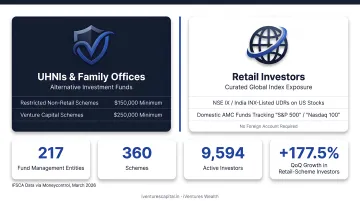
The ecosystem is genuinely growing. IFSCA data reported by Moneycontrol shows 217 fund management entities, 360 schemes, and 9,594 active investors as of March 2026, with retail-scheme investors up 177.5% quarter-on-quarter. This growth shows GIFT City has moved well past a niche product shelf and into the mainstream.
GIFT City vs LRS: Quick Comparison and Which Route to Choose
Quick Comparison Table
| Factor | LRS (Direct Overseas) | GIFT City (IFSC Route) |
|---|---|---|
| Cost | 20% TCS above ₹10 lakh, wire charges, FX spread | No STT/stamp duty on IFSC trades; broker fees vary by provider |
| LRS Limit Impact | Always consumes the $250,000 cap | LRS-funded IFSC accounts consume it too; domestic wrapper funds don't |
| Product Access | Broadest: individual stocks, bonds, options, REITs | Smaller but expanding: UDRs, curated funds, ETFs, AIFs |
| Compliance | Foreign KYC, Schedule FA reporting | Often via Indian brokers' IFSC arms, simpler onshore paperwork |
| Tax Treatment | Slab rate for short-term; 12.5% LTCG after the applicable holding period | Same capital gains framework, with no rate advantage either way |
Neither route offers a tax rate edge over the other. The gains treatment on foreign securities is governed by the same Income Tax provisions regardless of which door you walked through.
Which Route Should You Choose
Base your decision on four factors:
- Investment size relative to the $250,000 ceiling: larger allocations may fit better through GIFT AIFs than repeated LRS remittances
- Need for specific or niche securities: direct LRS wins if you need a named stock or bond unavailable on GIFT exchanges
- Comfort with foreign account paperwork. GIFT City reduces this burden considerably
- Estate and succession preference: onshore GIFT assets can simplify inheritance versus foreign-domiciled holdings
Choose LRS if you already hold a foreign brokerage relationship or need instruments GIFT exchanges don't list.
Choose GIFT City if you'd rather avoid TCS-heavy wire transfers, want onshore convenience, or are investing near the LRS ceiling through structured AIFs.
For UHNIs and family offices juggling multiple entities and jurisdictions, a SEBI-registered fiduciary adviser such as iVentures Wealth can combine LRS, GIFT City, and domestic wrapper routes into one coherent global allocation strategy. This approach is backed by tax optimisation guidance and consolidated tracking through tools like the firm's Wealth Monitor App.
Real-World Example: Choosing the Right Route
Consider a composite scenario reflecting patterns common among Indian HNI families: a Gurugram-based entrepreneur with $600,000 earmarked for global diversification over three years.
The challenge: Remitting the full amount via LRS alone meant crossing the ₹10 lakh TCS threshold every single year. This tied up 20% of each large transfer as tax collected upfront — a real cash-flow drag, even though it's adjustable against final tax liability at ITR filing.
On top of that, holdings were split across a foreign broker and an Indian demat account, making year-end reporting genuinely messy.
The trigger: After the second year of repeated TCS deductions and fragmented Schedule FA paperwork, the family reassessed their approach with their adviser.
The revised structure:
- Continued using LRS for specific US stock positions the family wanted to hold directly
- Shifted a meaningful portion of new allocations into GIFT City-listed AIF and fund structures for broader index exposure
- Consolidated reporting across both routes into a single dashboard
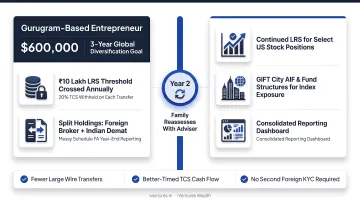
The outcome: fewer large one-off wire transfers, better-timed TCS cash-flow planning, and a portfolio that stayed diversified without requiring a second full foreign KYC process.
This is precisely the kind of situation where blending routes beats picking just one. If you're facing a similar decision, iVentures Wealth's SEBI-registered advisers can build a personalized global investing and tax optimization strategy around your specific numbers.
Conclusion
There's no universal winner between LRS and GIFT City. LRS suits investors who need the widest, most direct global market access. GIFT City suits those prioritising onshore convenience and cost efficiency at scale, alongside simpler estate planning. Many sophisticated investors end up using both, not one or the other.
Getting this right translates into real, practical outcomes: lower transaction costs, simpler compliance, and a portfolio built for the long term. Working with a fiduciary advisor like iVentures Wealth helps structure this efficiently across decades, not just a single financial year.
Frequently Asked Questions
GIFT City vs LRS: Which is better for investing in global securities?
Neither is universally better. LRS offers broader product access while GIFT City offers onshore convenience and potential cost savings. The right choice depends on your investment size and product needs.
Is it worth investing in GIFT City?
Yes, for investors wanting curated global fund or ETF exposure without foreign account hassles. Its product shelf is smaller than a full-service foreign broker but growing quickly.
Can residents invest in GIFT City?
Residents can invest, subject to LRS rules for direct dollar-denominated products. Certain domestic wrapper funds allow rupee-denominated access without using LRS at all.
Does investing through GIFT City consume my LRS limit?
LRS-funded GIFT IFSC brokerage accounts do consume the $250,000 limit. Specific domestic mutual fund or ETF structures wrapping GIFT-listed instruments do not.
What is the TCS applicable on LRS remittances for GIFT City vs foreign brokers?
The same 20% TCS rate above ₹10 lakh applies regardless of destination. It's adjustable against your final tax liability when you file your ITR.
What is the minimum investment required to invest through GIFT City?
Restricted non-retail AIF schemes require around $150,000, while venture-capital schemes require $250,000. Retail fund minimums are scheme-specific and disclosed in each offer document.