
Introduction
Indian investors are moving money abroad like never before. US stocks, global ETFs, and dollar-denominated assets have become a regular part of many portfolios, not a curiosity reserved for the ultra-wealthy.
Every rupee that leaves India for these investments, though, has to travel through one legal gateway: the RBI's Liberalised Remittance Scheme (LRS).
Most investors run into the same three questions. How much can you send abroad under the USD 250,000 LRS limit? Why is tax getting deducted before you've even earned a return? Should you go with a direct international broker or a GIFT City platform?
This guide answers all three. We'll walk through LRS rules, TCS implications, a step-by-step investing process, and where professional wealth advisory fits in when you're structuring remittances across family members, banks, and platforms.
Key Takeaways
- LRS allows residents to remit up to USD 250,000 yearly for global ETFs and stocks
- TCS above the exemption threshold is refundable against your final tax liability, not extra cost
- International brokers and GIFT City platforms share the same LRS cap but differ in oversight
- Tracking LRS usage across banks and structuring family remittances needs careful, professional planning
What is the Liberalised Remittance Scheme (LRS)?
The Liberalised Remittance Scheme is the RBI's framework, operating under the Foreign Exchange Management Act (FEMA), 1999, that lets resident Indians send money abroad without seeking approval for each individual transaction. The RBI introduced it in February 2004, largely to simplify outward remittances that earlier needed case-by-case clearance, according to the RBI's Liberalised Remittance Scheme FAQ.
Who Can Use LRS
LRS is available only to resident individuals, including minors, provided a natural guardian countersigns the minor's declaration.
It is not available to corporates, partnership firms, HUFs, or trusts. NRIs are also excluded, since the scheme is restricted to residents.
If your residential status changes to NRI, your LRS eligibility ends that day, regardless of how much of your annual limit was unused.
Current Account vs Capital Account Transactions
LRS covers two broad categories:
- Current account transactions: travel, overseas education, medical treatment, gifts, and maintenance of relatives abroad
- Capital account transactions: buying equity shares, ETFs, debt instruments, real estate, or opening foreign bank accounts
Global ETF and dollar-stock investing sits squarely in the capital account bucket. This is also where TCS rates and RBI scrutiny tend to be strictest, making the rules below essential reading before you invest.
LRS Limit Rules Every Indian Investor Must Know
The headline number is simple: USD 250,000 per resident individual per financial year (April to March). The limit resets every April 1, and unused amounts never carry forward. Send only USD 50,000 last year, and you still get a fresh USD 250,000 this year, not USD 450,000.
One Combined Limit, Not Separate Buckets
This trips up a lot of first-time investors. The USD 250,000 cap is an aggregate ceiling across everything you remit in a financial year, not a separate allowance per purpose.
Send USD 100,000 for a child's education and USD 80,000 for medical treatment, and you're left with only USD 70,000 for global ETFs and stocks that year.
Family Remittances and PAN-Level Tracking
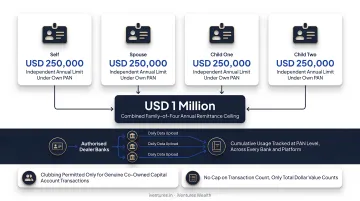
- Each adult family member gets an independent USD 250,000 limit under their own PAN
- A family of four can collectively remit up to USD 1 million in a single year
- Clubbing limits for a joint investment account is permitted only for capital account transactions where every account holder is a genuine co-owner of the underlying asset
PAN is mandatory for every LRS transaction, and authorised dealer banks upload transaction data daily. Your cumulative usage gets tracked at the PAN level across every bank and platform you use, not just one relationship. There's no cap on the number of transactions; only the total dollar value counts.
Exceptions: Exceeding the Cap and Prohibited Uses
A few situations permit remittances beyond USD 250,000, with documentary evidence:
- Education: AD banks can release more based on the institution's fee estimate
- Medical treatment: higher amounts allowed against a hospital or doctor's estimate
- Emigration: up to the amount specified by the destination country, though this can't be used to buy immigration-linked bonds or property
Certain uses, on the other hand, are explicitly prohibited regardless of documentation:
- Margin or margin-call payments to overseas exchanges
- Purchase of Foreign Currency Convertible Bonds (FCCBs) in the secondary market
- Lottery tickets, sweepstakes, and banned publications
- Remittances to countries on FATF's non-cooperative list
TCS on LRS Remittances: Rules and Ways to Reduce the Impact
Tax Collected at Source (TCS) under Section 206C(1G) of the Income Tax Act gets collected by your bank at the time of remittance. This is advance tax, not an extra cost, since you can claim it back as credit against your final tax liability when filing your ITR.
Current TCS Rates on LRS
| Remittance purpose | Exemption threshold | TCS rate above threshold |
|---|---|---|
| Investments (global ETFs, US stocks, etc.) | ₹10 lakh per FY | 20% |
| Education / medical treatment | ₹10 lakh per FY | 2% |
| Education funded by a qualifying loan | No threshold | Nil |
These figures reflect the current position, as per the Income Tax Department's TCS guidance. Remit ₹25 lakh in one shot for stock investing, and your bank will collect 20% TCS on the ₹15 lakh above the threshold, roughly ₹3 lakh withheld upfront.
PAN-Linked Thresholds and Aadhaar Rules
This catches people off guard: remit ₹6 lakh through one bank and another ₹6 lakh through a different platform in the same financial year, and both amounts get aggregated against your PAN. The exemption doesn't reset per bank, and your PAN's operative status matters just as much.
An inoperative PAN (one not linked to Aadhaar) triggers TCS at the higher of twice the normal rate or 5%. For investment remittances already at 20%, this makes little difference, but education and medical remittances jump from 2% to 5%. Check this before initiating any large transfer.
Managing the Cash Flow Impact
TCS doesn't have to derail your investment timing:
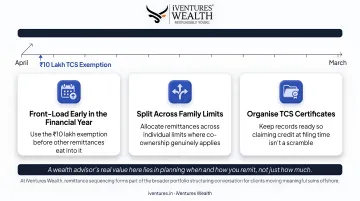
- Front-load large investments early in the financial year so the ₹10 lakh exemption gets used before other remittances eat into it
- Split remittances across family members' individual limits where the investment structure genuinely allows co-ownership
- Keep TCS certificates and remittance records organised so claiming credit at tax filing time isn't a scramble
A wealth advisor's real value here lies in planning when and how you remit, not just how much. Getting the timing right across a financial year can be the difference between a smooth lump-sum investment and an unpleasant surprise on your bank statement. At iVentures Wealth, this kind of remittance sequencing forms part of the broader portfolio structuring conversation we have with clients moving meaningful sums offshore.
How to Invest in Global ETFs and Dollar Assets Using LRS
Investing abroad follows a fairly linear sequence once you understand each step.
Step 1: Choose Your Platform
Compare a GIFT City IFSC-registered platform against a direct international broker:
- GIFT City platforms operate under India-based IFSCA regulation, often with simpler onboarding for residents
- Direct international brokers offer a wider stock and ETF universe but sit under foreign regulators like the SEC and FINRA
Step 2: Complete KYC
You'll typically need:
- PAN and Aadhaar for identity verification
- Passport as residency proof
- Form W-8BEN, declaring your non-US tax residency to the broker (held by the broker, not filed with the IRS directly)
Step 3: Initiate the LRS Remittance
Your Indian bank processes the transfer against purpose code S0001 (equity investment abroad) once you submit the LRS declaration. A few practical points:
- Wire fees, forex markup, and SWIFT charges add up, sometimes 0.5%–2% of the transferred amount depending on your bank
- Transfers usually settle within 2 to 5 working days
Step 4: Choose Your Investments
Once funds land in your brokerage account, options include:
- Direct US stocks and fractional shares
- Broad-market ETFs tracking the S&P 500 or Nasdaq 100
- Sector or thematic ETFs covering clean energy, semiconductors, or healthcare innovation
This is where diversification actually happens. You gain exposure to companies simply unavailable on Indian exchanges, plus a hedge against rupee depreciation.
Over the past two decades, the rupee has weakened from roughly ₹44 to the dollar in 2005 to about ₹87 in 2025, close to a 50% decline in value, according to World Bank exchange rate data. A dollar-denominated portfolio partially offsets that long-term slide.
Step 5: Stay Compliant Every Year
Owning foreign assets brings annual disclosure obligations:
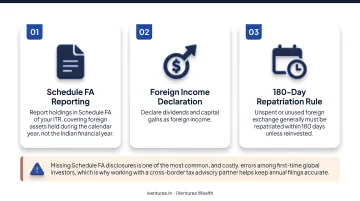
- Report holdings in Schedule FA of your ITR, covering foreign assets held during the calendar year, not the Indian financial year
- Declare dividends and capital gains as foreign income
- Follow the 180-day repatriation rule: unspent or unused foreign exchange generally must be repatriated within 180 days unless reinvested
Missing Schedule FA disclosures is one of the most common, and costly, errors among first-time global investors, which is why many work with cross-border tax advisors like iVentures Wealth to keep annual filings accurate.
Direct LRS Route vs GIFT City Route: Which Should You Choose?
Both paths use the identical USD 250,000 LRS cap and the same TCS rules. The real differences lie in regulation, market access, and investor experience.
| Factor | Direct International Broker | GIFT City (IFSC) Platform |
|---|---|---|
| Regulator | SEC/FINRA (US) | IFSCA (India) |
| Stock/ETF universe | Broadest, full US exchange access | Growing, expanding list of US stocks and ETFs |
| Account opening | Foreign KYC process, can take longer | India-based onboarding, generally faster |
| Investor comfort | Requires trust in a foreign-regulated entity | India-regulated framework, familiar grievance process |
| Best suited for | Investors wanting the complete US market | First-time global investors preferring local oversight |
Which Route Fits Your Profile?
- First-time global investors often prefer GIFT City platforms since onboarding sits within an India-regulated framework, and grievance redressal feels closer to home
- Experienced investors chasing specific stocks or niche ETFs beyond GIFT City's current listings tend to lean toward a direct broker account
- Family offices and CXOs we work with at iVentures Wealth often use both, allocating core index exposure through one platform and thematic bets through the other
Neither route is objectively better. It comes down to how much market breadth you need versus how much regulatory familiarity you want.
Common LRS Mistakes and Why Professional Guidance Matters
Even careful investors slip up on LRS compliance. The most frequent mistakes we see:
- Losing track of cumulative usage across multiple banks, since each AD bank only sees its own transactions unless you check the aggregate yourself
- Skipping Schedule FA disclosures, often because investors don't realise foreign ETF holdings count as reportable foreign assets
- Ignoring the 180-day repatriation rule on unused foreign exchange after selling a position
- Inadvertently breaching family limits on joint remittances where co-ownership documentation wasn't properly established
Why This Gets Harder for UHNIs and Family Offices
Complexity multiplies once you're managing assets across multiple currencies, brokers, and jurisdictions. A family with members investing through different banks and platforms needs consolidated visibility, not four separate spreadsheets that never quite agree with each other.
This is where a structured advisory relationship earns its keep. iVentures Wealth brings over 20 years of experience as a fiduciary investment advisory firm, SEBI-registered since 2010 (INA000019026), working with affluent families, NRIs, and family offices.
We help clients plan remittance timing, structure global allocations within the LRS framework, and maintain a consolidated view of domestic and international holdings through tools like the Wealth Monitor App. For families juggling global assets across jurisdictions, that single-pane view often matters more than any individual investment decision.
Frequently Asked Questions
What is the maximum LRS limit for overseas investments?
The current limit is USD 250,000 per resident individual per financial year, covering all current and capital account transactions combined, including global ETF and stock investments.
Who can remit up to USD 250,000 under LRS?
All resident individuals, including minors through a guardian, are eligible. Corporates, HUFs, partnership firms, trusts, and NRIs are excluded from the scheme.
How do I avoid the 20% TCS on foreign remittance?
You can't avoid it entirely above the ₹10 lakh exemption threshold. However, you can manage the impact by timing remittances, linking PAN to Aadhaar, and claiming it back as credit while filing your ITR.
Can I invest directly in US stocks and ETFs from India under LRS?
Direct investment is permitted as a capital account transaction. It requires KYC, an LRS remittance under the equity-investment purpose code, and either a direct international broker or a GIFT City-registered platform.
What is the difference between investing via GIFT City and the direct LRS route?
Both use the same LRS cap and TCS rules. They differ in regulatory authority, IFSCA versus SEC/FINRA, stock universe breadth, and how comfortable you are with a foreign versus India-based platform.
Is PAN mandatory for LRS remittances?
Yes. PAN is mandatory for every LRS transaction and is used to track your cumulative remittances across all banks against the annual USD 250,000 limit.