

Many HNIs in India, business owners, CXOs, NRIs, family offices, struggle with the same conflict: growth, tax efficiency, liquidity, and legacy transfer all pulling in different directions. Retail investment frameworks simply weren't built for this.
This guide covers HNI classification in India, the core asset buckets that actually work at this wealth level, model allocations by risk and life stage, rebalancing discipline, and how to pick an advisor who's on your side of the table.
Key Takeaways
- HNI allocation differs from retail investing due to tax surcharges, concentration risk, and succession needs
- The 3-bucket structure (Growth, Stability, Alternatives) outperforms rigid equity/debt splits
- Common rules (60-30-10, 70-15-15, 70-20-10) are starting points, not prescriptions
- Annual rebalancing with a 5-10% drift threshold protects returns from tax drag
- SEBI-registered, fee-only fiduciaries remove conflicts baked into commission-driven advice
What Is Asset Allocation and Why HNIs Need a Different Approach
Asset allocation is the deliberate split of your capital across equity, debt, real estate, gold, and alternatives, calibrated to your goals, risk appetite, and liquidity needs. Simple in theory. Considerably harder once your balance sheet includes a business, a PMS mandate, and property in three cities.
Who Qualifies as an HNI in India
Indian wealth managers commonly use ₹5 crore in investable assets (excluding your primary residence) as the entry point for HNI classification. Beyond that, firms apply their own internal bands for Very High and Ultra HNI tiers, and these thresholds vary by institution.
At iVentures Wealth, for instance, the internal segmentation looks like this:
- HNI: ₹5 crore–₹50 crore, focused on goal-based planning and AIF/PMS access
- UHNI: ₹50 crore+, adding ESOP diversification, private equity, and family governance
- NRIs/OCIs: ₹5 crore+ threshold, given cross-border tax complexity
- CXOs and professionals: ₹10 crore+, given concentrated equity/ESOP exposure
- Corporates and family offices: ₹50 crore and ₹100 crore respectively
The exact number matters less than the underlying logic: complexity, not just wealth, drives the advisory need.
Why the Standard Playbook Fails HNIs
Four structural issues break the retail framework:
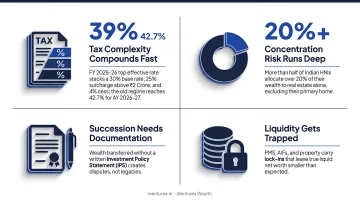
Tax complexity compounds fast. For FY 2025-26, the top marginal rate under the new regime reaches roughly 39% effective, once you stack the 30% base rate, 25% surcharge above ₹2 crore, and 4% cess. Under the old regime, that figure climbs to nearly 42.7%, according to the Income Tax Department's official slabs for AY 2026-27.
Every fund switch, every rebalancing trade, is now a tax decision first and an investment decision second.
Concentration risk runs deep. A 2025 survey found that more than half of Indian HNIs allocate over 20% of their wealth to real estate, excluding the home they live in, according to reporting on HNI investment struggles. Add a promoter's stake in his own company, and diversification often exists on paper only.
Succession needs documentation. Wealth that moves across generations without a written Investment Policy Statement (IPS) tends to create disputes, not legacies. An IPS forces clarity on goals, risk limits, and who decides what, before a crisis forces it for you.
Liquidity gets trapped. PMS, AIFs, and property carry lock-ins. Without planning, HNIs discover their "liquid" net worth is smaller than they thought, usually at the worst possible moment.
Core Asset Classes and the 3-Bucket Framework
Instead of a single equity-debt ratio, HNI portfolios work better structured around three buckets, each tied to a distinct time horizon and job.
Growth Bucket (7+ Year Horizon)
This is your wealth engine, built for compounding, not comfort.
- Equity mutual funds for diversified, professionally managed exposure
- Direct equity for concentrated, high-conviction positions
- PMS for portfolios above ₹50 lakh (SEBI's mandated minimum), with customisation retail funds can't offer
- Category II AIFs (₹1 crore minimum) for private equity, structured credit, and unlisted opportunities
Stability and Income Bucket (3-7 Year Horizon)
This bucket cushions volatility and funds near-term goals.
- Debt mutual funds and high-quality corporate bonds/G-Secs for capital preservation
- REITs for rental-style income without owning physical property or managing tenants
- Gold as a hedge that behaves differently from equity during stress
A quick real-world contrast: one iVentures client, a Gurugram-based investor, put ₹2 crore into a commercial property in Cyber City and saw it grow to ₹3.2 crore in two years with a 12% rental yield. Strong outcome, but the capital was locked for years with no easy exit.
REITs solve for the same rental-income thesis with daily liquidity on the exchange, and SEBI mandates that REITs distribute at least 90% of net cash flows to unit holders.
Alternative and Hedge Bucket (Flexible Horizon)
This is where HNIs access what retail investors typically can't.
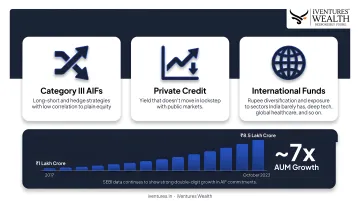
- Category III AIFs for long-short and hedge strategies with low correlation to plain equity
- Private credit for yield that doesn't move in lockstep with public markets
- International funds for rupee diversification and exposure to sectors India barely has, deep tech, global healthcare, and so on
Adoption is accelerating. Indian AIF AUM grew roughly sevenfold, from ₹1 lakh crore in 2017 to ₹8.5 lakh crore by October 2023, according to PwC's analysis of wealthtech and alternative investments. That trajectory hasn't slowed, with subsequent SEBI data continuing to show strong double-digit growth in AIF commitments.
Ideal HNI Asset Allocation Models
No single allocation is "correct." But some starting frameworks are worth understanding before customising your own.
Popular Asset Allocation Rules HNIs Use
| Rule | Split | Best suited for |
|---|---|---|
| 60-30-10 | Equity 60%, Debt 30%, Gold 10% | Investors prioritising growth with a meaningful debt cushion |
| 70-15-15 | Equity 70%, Debt 15%, Gold 15% | Long-horizon investors comfortable with higher volatility |
| 70-20-10 | Equity 70%, Debt 20%, Alternatives 10% | Investors ready to add AIFs/PMS for diversification beyond traditional assets |
Even prominent Indian investors deviate sharply from these templates. Zerodha's Nikhil Kamath, for one, has publicly shared a far more defensive personal mix, roughly 40% equity, 40% debt, 15% gold, and 5% alternatives, reflecting his own valuation concerns rather than any universal rule.
Allocation by Risk Profile
| Profile | Equity | Debt | Real Estate/REITs | Gold | Alternatives |
|---|---|---|---|---|---|
| Conservative | 35-40% | 35-40% | 10% | 10% | 5-10% |
| Balanced | 50-55% | 25-30% | 10% | 5-10% | 10-15% |
| Aggressive | 60-65% | 10-15% | 10% | 5% | 15-20% |
Allocation by Life Stage
- 40s (accumulation): Maximum SIP, PMS, and AIF exposure; growth bucket dominates
- 50s (consolidation): Shift toward REITs, reduce concentrated single-stock risk, begin estate documentation
- 60s and beyond (preservation): Prioritise income generation through SWPs and lower-volatility instruments
For illustration only, consider a retired professional with an ₹8-10 crore corpus. Splitting it across debt funds and REITs, then running a systematic withdrawal plan (SWP) at a conservative 6-7% annual rate, could generate a monthly income stream while preserving most of the principal.
This is a structural example, not a recommendation. Actual numbers depend heavily on your tax bracket, other income, and inflation assumptions.
The larger point: your "ideal" allocation depends on your liquidity needs, your tax position, and where you are in life. A SEBI-registered advisor, like the team at iVentures Wealth, can help translate these templates into an allocation that actually fits your circumstances.
Strategies, Rebalancing and Mistakes to Avoid
Choosing the Right Allocation Strategy
Each framework fits a different temperament and involvement level.
- Strategic: A fixed long-term target mix, rarely adjusted. Suits investors who prefer discipline over market timing.
- Tactical: Short-term tilts away from target weights to exploit market conditions. Ideal for hands-on investors with strong conviction.
- Dynamic: Continuous adjustment based on valuation signals or volatility. Works well for investors who want active management without daily involvement.
- Core-Satellite: A stable core (index funds, debt) surrounded by smaller satellite bets (PMS, AIFs, direct equity). Suits most HNIs, balancing discipline with opportunity.
Rebalancing Without Triggering Tax Drag
Rebalancing protects your target risk level, but careless execution creates unnecessary tax bills.
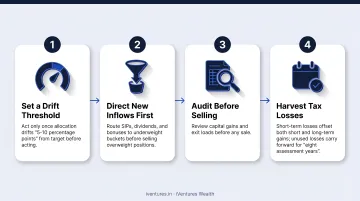
- Set a drift threshold, typically 5-10 percentage points from target, before acting
- Direct new inflows (SIPs, dividends, bonuses) to underweight buckets first, rather than selling overweight positions
- Audit capital gains and exit loads before any sale
- Harvest tax losses where available; short-term losses offset both short and long-term gains, and unused losses carry forward for eight assessment years
Common Mistakes HNIs Make in India
These recurring errors erode long-term returns for many Indian HNI portfolios:
- Over-concentration in real estate, often unintentional, built up over decades of "safe" property purchases
- No documented IPS, leaving allocation decisions ad hoc and vulnerable to emotional swings
- Ignoring alternatives at scale, missing the diversification AIFs and private credit can offer
- Mixing insurance with investment, ULIPs and endowment plans bundle protection and returns, usually diluting both
Why Partner with a SEBI-Registered Fiduciary Advisor
Commission-driven distribution creates a structural conflict: the person recommending your investments earns more when you buy certain products. A SEBI-registered Investment Adviser operating on a fee-only basis has no such incentive. Their compensation doesn't change based on which fund, AIF, or PMS you choose.
iVentures Wealth has operated as a SEBI-registered RIA (INA000019026) since 2010, building on a fiduciary model established in 2005.
The firm's CFA-led research team, headed by Krishna Makhariya, builds documented, goal-based allocation frameworks for UHNIs, family offices, and corporates managing over ₹1,200 crore in assets across 150+ affluent relationships.
For HNIs juggling multiple entities, family members, and asset classes, tracking everything in one place is its own challenge. iVentures' Wealth Monitor App was built for exactly this: consolidated portfolio visibility instead of scattered statements across PMS providers, AIFs, and demat accounts.
The firm also brings specialized depth in areas most generalist advisors don't touch:
- NRI/OCI tax-efficient investing across jurisdictions
- Product-neutral treasury advisory for corporates
- Family office and succession structuring for multi-generational wealth
If your portfolio has outgrown the standard 60/40 approach, a structured allocation review is a reasonable next step. Book a portfolio review with iVentures Wealth's advisory team to see where your current allocation stands against your goals.
Frequently Asked Questions
What are common asset allocation rules for HNIs (e.g., 70-20-10, 15-15-15)?
These are indicative equity-debt-alternatives splits meant as starting frameworks, not fixed formulas. Every rule needs customisation based on your actual risk capacity, tax bracket, and goals.
What is the minimum net worth for an HNI client?
Most Indian wealth managers use ₹5 crore in investable assets (excluding primary residence) as the HNI threshold, though exact figures vary by institution and service segment.
What is a high net worth allocation?
It is a diversified mix across equity, debt, real estate, gold, and alternatives, structured for growth, tax efficiency, and multi-generational legacy planning rather than just returns.
How often should HNIs review and rebalance their portfolio?
At least annually for straightforward portfolios. Semi-annual reviews make sense if you hold PMS, AIFs, or real estate alongside listed investments, given the added complexity.
Is PMS better than mutual funds for HNI asset allocation?
PMS suits larger equity allocations (₹50 lakh+) where customisation matters. Mutual funds remain useful for smaller allocations and asset classes PMS providers typically don't cover.
How much should HNIs allocate to alternative investments like AIFs?
A common range is 5-15% of a ₹2 crore+ corpus, rising as overall wealth grows. Given AIF lock-in periods, seek professional guidance before committing.