That changed in February 2026 when NSE IX soft-launched its Global Access platform, giving Indian resident investors direct access to US equities and ETFs through a GIFT City-based, IFSCA-regulated infrastructure. No foreign demat account required. Fully digital onboarding. And a roadmap to expand to 30+ global markets within months.
This isn't a workaround or grey-zone solution. It's a structural development in how Indian investors can access global wealth creation — built on familiar regulatory rails.
Key Takeaways
- NSE IX Global Access is an IFSCA-regulated platform operating from GIFT City, covering US equities and ETFs with a 30+ market expansion roadmap
- All investments are routed under RBI's LRS framework, with a ₹250,000 annual per-individual limit
- No foreign demat account needed — account opens digitally using Aadhaar/PAN
- Fractional investing is available, letting investors build positions in high-priced global stocks without buying full shares
- GIFT City transactions carry no STT, CTT, or stamp duty, though Indian capital gains and dividend taxes still apply
What Is NSE IX Global Access?
The Platform and Its Regulator
NSE International Exchange (NSE IX) is a wholly-owned subsidiary of the National Stock Exchange of India, operating from GIFT City, Gujarat (India's International Financial Services Centre). GIFT City is a special economic zone regulated by the International Financial Services Centres Authority (IFSCA), giving it a distinct legal and tax framework from mainland India.
The Global Access platform , operated by NSEIX Global Access IFSC Limited , carries IFSCA's Global Access Provider (GAP) registration IFSCA/GAP/SE/2025-26/001. This places it firmly within India's regulated financial ecosystem, not outside it.
The platform soft-launched on February 25, 2026 with initial access to US equities, debt, and ETFs. Trade execution and settlement on the US side is facilitated through ViewTrade, which became the first global broker to secure a GAP licence from IFSCA at GIFT City in November 2025.
How It Evolved: From Receipts to Global Access
settlement.
Roadmap
Phase 1 covers US markets. The Hindu BusinessLine reported that NSE IX plans to expand to 30 international markets within 3–6 months of launch, covering G7 economies and markets representing 50–60% of global GDP. A secondary market update from May 2026 indicated expansion to Europe, Asia, Australia, Canada, Mexico, and parts of South America by FY27 — though NSE IX had not officially confirmed this at the time of writing. Check the latest expansion status before making allocation decisions.
LRS, GIFT City Tax Treatment, and What Actually Applies to You
LRS: The Framework That Makes This Possible
All investments through NSE IX Global Access are made under the Reserve Bank of India's Liberalised Remittance Scheme (LRS). Per RBI's LRS framework, resident individuals may remit up to USD 250,000 per financial year for overseas investments.
A critical point: GIFT City routing does not bypass this limit. IFSCA has confirmed that funds remitted to IFSC under LRS for foreign securities still count toward the USD 250,000 annual cap.
If you're already using LRS for overseas property, education, or other investments, your remaining capacity for NSE IX Global Access is reduced accordingly.
iVentures Wealth helps HNI and UHNI clients actively manage LRS utilisation across financial years — coordinating LRS declarations, TCS compliance, and documentation across multiple investment positions.
GIFT City Tax Benefits: Platform-Level, Not Investor-Level
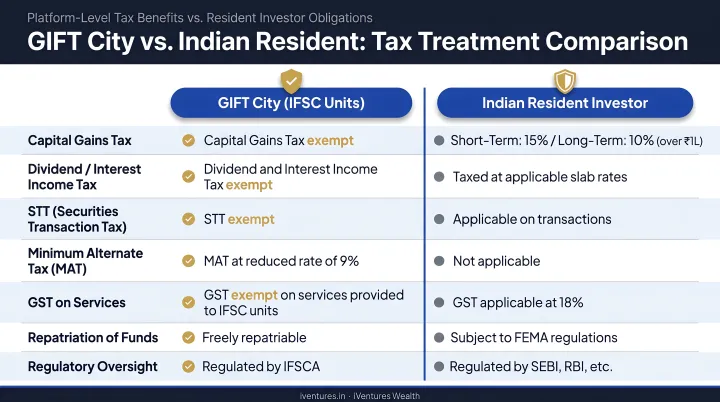
The tax benefits of GIFT City apply at the platform/exchange level — not automatically to the resident investor's tax liability.
What GIFT City IFSC transactions benefit from:
- No Securities Transaction Tax (STT)
- No Commodity Transaction Tax (CTT)
- No stamp duty on foreign-currency trades
- No GST on transactions carried out on GIFT IFSC exchanges
- Section 80LA provides qualifying IFSC units a 100% tax deduction for any 10 consecutive assessment years out of 15
What still applies to you as an Indian resident investor:
- Capital gains from US equities are taxable in India (long-term gains currently at 12.5% without indexation; short-term at applicable slab rates — confirm current rates with a tax adviser)
- Dividend income is taxable at your slab rate
- US withholding tax on dividends may apply under the India-US DTAA; foreign tax credit can potentially be claimed against Indian tax liability
TCS: A Practical Concern for Larger Remittances
Beyond capital gains and dividends, there's a third tax-layer consideration that HNI investors frequently overlook: TCS at the point of remittance.
Under Finance Act 2023 amendments to Section 206C(1G), LRS remittances for overseas investment attract 20% TCS above ₹7 lakh (from October 1, 2023 onwards). No specific exemption for GIFT City routing is confirmed in published sources.
Key points to factor into your planning:
- TCS is not a final tax — claim it as credit when filing your income tax return
- For larger remittances, it creates a meaningful temporary cash flow drag
- Factor this into liquidity planning before initiating transfers
Permitted vs. Restricted Instruments
Under IFSCA's August 2025 Global Access circular, GAPs are permitted to offer access to financial products listed on foreign exchanges. What is explicitly prohibited:
- Crypto-assets
- Derivatives already available on recognised IFSC exchanges
- Speculative instruments
Equities and ETFs are permitted. Investors expecting access to US options, futures, or crypto through this route should note these restrictions.
Key Features of the NSE IX Global Access Platform
Fractional Investing
One of the most practically useful features: you don't need to buy a full share. Retail investors can buy a fractional position in stocks like Apple or Nvidia — allowing genuine diversification across multiple global names without large per-position capital outlay. This matters most when building a global sleeve within a broader portfolio, where high per-share prices would otherwise limit how many names you can hold.
For HNIs and UHNIs allocating across geographies, fractional access means:
- Entry into high-priced US stocks without committing a full share's capital
- Genuine multi-stock diversification within a defined overseas allocation
- Flexibility to rebalance positions in smaller increments as the portfolio evolves
Digital Onboarding
Account opening is fully online and paperless. The app uses Aadhaar and banking APIs for KYC, with verification reported to take 30 seconds to two minutes — a significant improvement over traditional overseas broker onboarding, which historically involved extensive paperwork and multi-week timelines. Once onboarded, resident Indians fund their GIFT City brokerage accounts directly from their Indian bank accounts under the LRS framework, with INR-to-foreign currency remittance handled within the same structure.
Trading Hours
US market access means US trading hours. Investors will be trading during US Eastern time — which translates to evening IST hours (verify current IST hours including Daylight Saving Time adjustments directly with the platform). This applies to all live US market platforms, not just NSE IX. Factor it into your workflow before opening an account.
Cost Structure
No official fee schedule, brokerage rates, currency conversion spreads, or platform charges have been published by NSE IX Global Access at the time of writing. The platform is positioned as cost-efficient relative to setting up accounts with foreign brokers, but directional comparisons should be made once official fee disclosures are available. Check the NSEIX Global Access website for the latest published fee information before proceeding.
How to Get Started: Step-by-Step
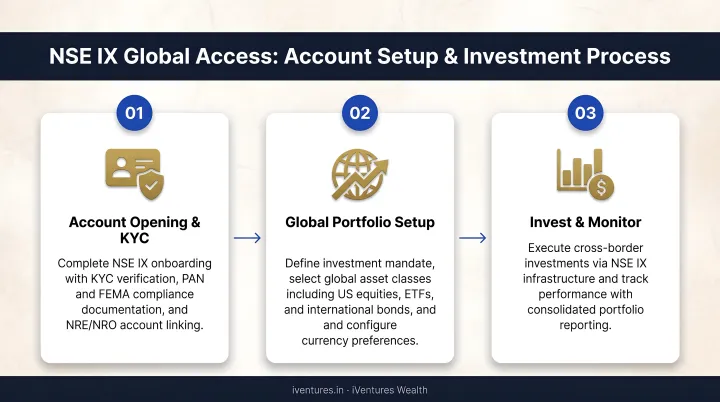
Open a GIFT City brokerage account. This must be with a broker registered under NSE IFSC, separate from your existing Indian demat account. Visit the NSE IX or IFSCA website to find brokers registered under the Global Access framework.
Fund your account through LRS. Transfer from your Indian bank to your GIFT City brokerage account. This counts toward your USD 250,000 annual LRS limit, and your bank will require LRS declaration and TCS compliance paperwork (PAN, purpose of remittance). Timelines vary by bank, so confirm before initiating the transfer.
Place trades and monitor your portfolio. Once funds are credited, you can browse US stocks and ETFs, place fractional or full-value orders during US market hours, and track holdings within the GIFT City infrastructure. No separate overseas demat account is required.
The mechanics are straightforward, but how global equities fit within your broader portfolio — across LRS limits, currency exposure, and tax treatment — is where thoughtful planning matters. An advisor familiar with cross-border structuring can help you get this right from the start.
What HNI and UHNI Investors Should Weigh Before Investing
The Diversification Case
India's domestic equity market is significant — NSE domestic market capitalisation stood at approximately USD 5.4 trillion as of June 2025 per World Federation of Exchanges data — yet it represents a relatively small share of global investable assets.
Indian investors who hold the majority of their portfolio in Nifty 50 stocks and Indian real estate carry concentrated exposure to a single economic cycle and a single currency. The domestic market also lacks meaningful depth in several high-growth sectors: advanced semiconductors, large-cap global consumer brands, global healthcare, and AI infrastructure.
iVentures Wealth's research, led by Krishna Makhariya (CFA, Head of Research), documents this home bias problem clearly. Their analysis shows India has been the top-performing equity market only twice in the last 10 years — a data point that reinforces why global allocation matters even for investors who are bullish on India's long-term growth story. The firm typically recommends 10–30% global allocation depending on a client's risk profile, existing concentration, and goals.
US equities also provide structural USD exposure, which serves as a meaningful hedge given the long-term INR depreciation trend against the dollar. That said, currency movement cuts both ways — which is why understanding the risks upfront matters.
Risk Factors Worth Stating Clearly
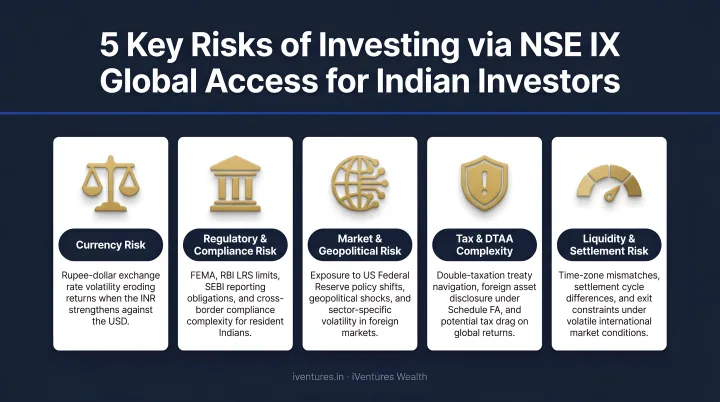
- Currency risk: USD/INR movements directly affect INR-denominated returns. A weakening rupee amplifies gains; a strengthening rupee reduces them. iVentures builds currency-aware portfolios and explains FX impact in INR terms — rather than treating it as an unmanageable risk.
- LRS cap: At USD 250,000 per individual per year, the LRS limit constrains scale for very large portfolios. Family members each have their own LRS limit, which provides some flexibility.
- Trading hours: Evening IST trading hours may not suit all investors' lifestyle or liquidity preferences.
- Platform maturity: NSE IX Global Access is newly launched. Liquidity, stock breadth, and operational depth are still developing relative to established global brokers.
- Regulatory risk: LRS policy changes remain a background risk for any LRS-dependent investment route.
A SEBI-registered fiduciary adviser like iVentures Wealth (registration INA000019026) can help navigate these considerations without any conflict of interest from platform commissions. That means modelling currency impact in INR terms, assessing how NSE IX Global Access fits your annual LRS utilisation, and evaluating how a global equity sleeve integrates with your existing Indian equity, debt, and real estate positions.
NRI and OCI Eligibility
The NSE IX Global Access app is positioned specifically for Resident Indians under LRS. Published IFSCA and NSE IX sources do not confirm NRI or OCI eligibility under this LRS route as of writing. NRIs and OCIs have separate investment pathways — including NRE/NRO repatriation routes and GIFT City-domiciled USD-denominated funds — which iVentures Wealth advises on as part of its cross-border wealth management service.
Frequently Asked Questions
How do I invest via NSE International Exchange?
Open a trading and demat account with an NSE IFSC-registered broker (separate from your standard Indian demat account), transfer funds from your Indian bank under the LRS framework, and place orders in US stocks or ETFs during US market hours through the Global Access platform — no foreign demat account needed.
Can I invest in Indian stocks from abroad as an NRI?
Yes, but through a different route. NRIs and OCIs invest in Indian listed stocks via NRE/NRO accounts with SEBI-registered brokers under repatriation rules — separate from NSE IX Global Access, which is designed for resident Indians investing outward. A qualified wealth adviser can help NRI clients navigate both inbound Indian market investments and outbound global allocation.
What is the minimum investment on NSE IX Global Access?
There is no fixed minimum. Fractional trading lets investors build positions in global stocks without buying full shares, making global portfolios accessible at most capital levels.
Is NSE IX Global Access regulated and safe?
NSE IX operates under IFSCA regulation within GIFT City, carrying GAP registration IFSCA/GAP/SE/2025-26/001. Investments are made through LRS-compliant channels with regulatory oversight — a more transparent route than many unregulated or offshore international investing platforms available to Indian investors.
What are the tax implications?
GIFT City transactions carry no STT, CTT, or stamp duty at the platform level. However, capital gains and dividend income from global stocks remain taxable in India, and residents must report foreign assets in Schedule FA of their ITR. The interaction between US withholding tax, DTAA credits, and Indian tax liability warrants advice from a qualified tax adviser.
How is NSE IX Global Access different from other global investing platforms?
Most competing platforms hold assets outside India under foreign regulation. NSE IX Global Access operates within GIFT City under IFSCA oversight, which means:
- Regulatory familiarity with Indian exchange infrastructure
- GIFT City transaction-tax benefits (no STT, CTT, or stamp duty)
- Direct exposure to US and global markets without moving assets offshore