

Introduction
More Indians are investing than ever before. India crossed 19.24 crore demat accounts by March 2025 — a 27% jump in a single year — and SIP collections hit ₹2.89 lakh crore in FY2024-25, up 45% year-on-year. The access is real. The momentum is real. So is the confusion.
For someone just starting out, choosing between SIPs, PPF, ELSS, NPS, FDs, and gold bonds — while also navigating the old vs. new tax regime — can feel overwhelming. Most beginner content either oversimplifies ("just do SIP!") or buries you in jargon.
This guide cuts through both. It covers six beginner-friendly investment options in India for 2026 — with honest context on risk, realistic returns, lock-in periods, and how each fits into a broader financial plan.
Key Takeaways
- The best beginner investments balance accessibility, simplicity, and long-term growth — not just headline returns
- SIP in index funds, PPF, ELSS, FDs, NPS, and Sovereign Gold Bonds are the top picks for 2026
- Starting early and staying consistent matters far more than chasing the ideal instrument
- Your tax regime choice (old vs. new) directly affects which instruments make sense for you
- Matching instruments to your income, goals, and tax profile matters as much as picking the right asset class
What Makes an Investment "Beginner-Friendly" in India in 2026?
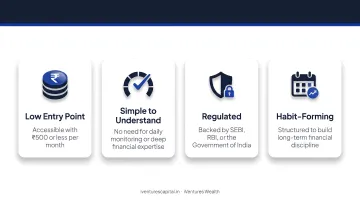
A beginner-friendly investment meets four practical criteria:
- Low entry point — accessible with ₹500 or less per month
- Simple to understand — no need for daily monitoring or deep financial expertise
- Regulated — backed by SEBI, RBI, or the Government of India
- Habit-forming — structured to build long-term financial discipline
The 2026 Landscape
Retail participation has climbed sharply. AMFI recorded 6.80 crore new SIP registrations in FY2024-25 versus 4.28 crore the year before — a 59% jump. Platforms have become easier, minimums have dropped, and KYC can be completed entirely online.
That accessibility, though, comes with one important wrinkle: the tax regime you're on changes which investments actually make sense for you. PIB data shows that for AY2024-25, approximately 72% of ITR filers chose the new regime and 28% chose the old.
This matters because instruments like ELSS and PPF carry significant Section 80C benefits — but only under the old regime. If you're on the new regime, the return profile of these instruments shifts considerably.
That's why the options below are worth evaluating in combination — two or three instruments, chosen around your tax regime and timeline, tend to outperform any single all-in bet.
Best Investments for Beginners in India 2026
Six instruments. Different risk levels, time horizons, and tax treatments — each serving a distinct role in a first-time investor's portfolio. Here's what each one actually does for you.
SIP in Equity Mutual Funds (Index Funds)
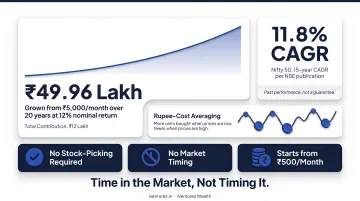
A Systematic Investment Plan in an index fund automatically invests a fixed amount each month into a fund tracking an index like the Nifty 50 or Sensex. No stock-picking required. No timing the market. Starts from ₹500/month.
The core advantage is rupee-cost averaging: you buy more units when prices fall and fewer when they rise, smoothing out volatility across market cycles. An NSE publication reports an 11.8% CAGR over 15 years for the Nifty 50 (past performance, not a guarantee).
To make the compounding effect concrete: ₹5,000 invested monthly at a 12% nominal annual return over 20 years grows to approximately ₹49.96 lakh on a total contribution of ₹12 lakh. Time in the market — not timing it — drives the outcome.
Why it works for beginners: The "set it and forget it" structure removes emotional decision-making. When markets fall, the SIP keeps running — which is exactly when rupee-cost averaging works in your favour.
Public Provident Fund (PPF)
PPF is one of the most straightforward instruments in India: government-backed, zero market risk, and structured with EEE (Exempt-Exempt-Exempt) tax status under the old tax regime. Contributions qualify for Section 80C deduction, interest earned is tax-free, and maturity proceeds are fully exempt.
Key parameters:
- Interest rate: Currently 7.1% per annum (unchanged for multiple quarters; verify the latest DEA quarterly notification before investing)
- Annual investment: ₹500 minimum, ₹1.5 lakh maximum
- Tenure: 15 years
- Partial withdrawals: Permitted from the 7th financial year onward, subject to scheme limits
PPF enforces the long-term saving discipline that most new investors struggle with. It's the natural "safe" pillar alongside equity exposure — ideal for risk-averse beginners or anyone building a serious savings habit for the first time.
ELSS (Equity Linked Savings Scheme)
ELSS is the only mutual fund category eligible for Section 80C deduction (up to ₹1.5 lakh under the old regime), with the shortest lock-in among all 80C options at just three years. It combines tax saving with equity market exposure.
Historical category averages (approximate, from Value Research; verify dated figures before citing):
- ~12% annualised over 5 years
- ~13.5% annualised over 10 years
For young earners under the old tax regime, ELSS offers a clear dual benefit: tax savings now and potential wealth creation over time. The 3-year lock-in also serves a practical purpose — it keeps investors from panic-selling during short-term market dips, which is the single most common mistake first-time equity investors make. One structural detail worth knowing: each SIP instalment carries its own independent 3-year lock-in clock.
Fixed Deposits (FDs)
FDs are the most universally accessible investment in India — predictable returns, no market risk, and available at every bank and post office. Bank FDs up to ₹5 lakh per depositor per bank are insured by DICGC.
Current indicative rates (as per SBI's December 2025 schedule):
- 1-year FD: ~6.25%
- 3-year FD: ~6.30%
- 5-year FD: ~6.05%
Note: FD interest is taxable at your income slab rate — not a flat rate. Over the long run, post-tax FD returns often struggle to beat inflation.
Role in a beginner's portfolio: FDs are not a wealth creation tool. They are a stability tool. Use them for:
- Emergency funds (3–6 months of expenses)
- Short-term goals with 1–3 year horizons
- Providing psychological comfort while building equity positions
National Pension System (NPS)
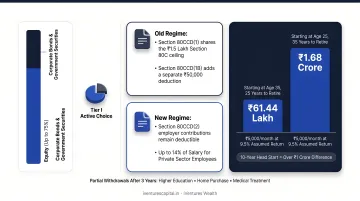
NPS is a government-regulated retirement savings scheme with market-linked returns. Under Tier I Active Choice, you can allocate up to 75% in equity, with the remainder in corporate bonds and government securities.
Tax advantages:
- Old regime: Section 80CCD(1) contribution shares the ₹1.5 lakh Section 80C ceiling; Section 80CCD(1B) adds a separate ₹50,000 deduction
- New regime: Employer contributions under Section 80CCD(2) remain deductible — up to 14% of salary for private sector employees
Why opening NPS early matters: The compounding gap between starting at 25 vs. 35 is significant. At ₹5,000/month with a 9.5% assumed nominal return:
- Starting at age 25 (35 years to retire at 60): corpus of approximately ₹1.68 crore
- Starting at age 35 (25 years to retire at 60): corpus of approximately ₹61.44 lakh
That's a difference of over ₹1 crore — from a 10-year head start. NPS also allows partial withdrawals after 3 years for specific needs like higher education, home purchase, or medical treatment.
Sovereign Gold Bonds (SGBs)
SGBs are RBI-issued bonds benchmarked to the domestic gold price. They offer two simultaneous return streams:
- Capital appreciation linked to gold price movement
- Fixed coupon of 2.5% per annum, paid semi-annually on the nominal value
The critical tax advantage: capital gains on redemption at maturity (8 years) are completely exempt for individuals who redeem through the RBI — making SGBs more tax-efficient than physical gold or Gold ETFs, which carry indexation-adjusted LTCG implications.
One important caveat for 2026: No FY2025-26 primary issuance schedule has been officially announced as of the time of writing. The last confirmed tranche was SGB 2023-24 Series IV. Beginners interested in SGBs should monitor RBI announcements and apply through their bank or broker when a new tranche opens.
Gold provides inflation hedging and diversification without the cost or security risk of storing physical gold. In a beginner's portfolio, a 5–10% allocation to SGBs is a defensible position — you get the coupon income while the underlying gold exposure works as a portfolio buffer in volatile markets.
Quick Comparison – Top Beginner Investments at a Glance
Use this table as a quick reference — not every option suits every goal, and your ideal mix depends on your timeline, risk appetite, and tax situation.
| Investment | Minimum Investment | Lock-in Period | Approx. Returns | Risk Level | Tax Benefit (Old Regime) | Best Suited For |
|---|---|---|---|---|---|---|
| Index Fund SIP | ₹500/month | None | Market-linked (historically ~11–12% CAGR long-term) | Medium-High | None | Long-term wealth creation |
| PPF | ₹500/year | 15 years | 7.1% p.a. (current, verify quarterly) | Very Low | Section 80C + EEE | Safe savings pillar |
| ELSS | ₹500/month | 3 years per instalment | ~12–13.5% (historical category avg.) | Medium-High | Section 80C | Tax saving + equity growth |
| Bank FD | Bank-specific | Flexible | ~6.05–6.30% (SBI rates; verify current rates before investing) | Very Low | Only 5-yr tax-saving FD | Emergency fund, short-term goals |
| NPS Tier I | ₹500 to open; ₹1,000/year | Till retirement (age 60) | Market-linked (allocation-dependent) | Low-Medium | 80CCD(1) + 80CCD(1B) | Retirement planning |
| Sovereign Gold Bonds | 1 gram of gold | 8 years (RBI exit after yr 5) | Gold price appreciation + 2.5% coupon | Medium | No 80C; RBI-redemption gains exempt | Diversification, inflation hedge |
How to Start Investing as a Beginner in India – Practical First Steps
Step 1: Build Your Financial Foundation
Before investing a single rupee in equity or long-term instruments, make sure:
- You have an active PAN card and completed Aadhaar-linked KYC
- A savings account is operational
- An emergency fund covering 3–6 months of expenses is parked in a bank FD or liquid mutual fund
Skipping this step is the most common beginner mistake. An equity SIP is not an emergency fund.
Step 2: Open the Right Accounts
- Demat account — for equity mutual funds (if using exchange route), ETFs, and SGBs
- Mutual fund KYC registration — required for SIPs and ELSS through fund houses or platforms like MFCentral
- PPF account — available at any bank or post office; can often be opened online in under 30 minutes
- NPS Tier I account — opened via eNPS portal or your bank
Most of these can be completed entirely online today — no branch visits required.
Step 3: Start Small and Scale Systematically
- Start a SIP in an index fund — even ₹500 to ₹1,000/month builds the habit
- Add a PPF or FD contribution alongside for stability
- Review and increase your SIP amount annually as your income grows
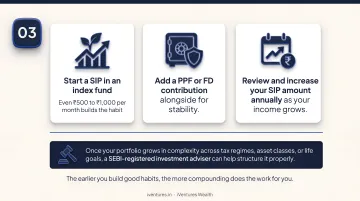
Once your portfolio grows in complexity — across tax regimes, asset classes, or life goals — a SEBI-registered investment adviser can help structure it properly. The earlier you build good habits, the more compounding does the work for you.
Conclusion
The best investments for beginners in 2026 are not about chasing the highest possible returns. They're about building consistent habits, maintaining diversification across safe and growth-oriented instruments, and choosing options that genuinely align with your goals and time horizon.
Start with what you can sustain. An index fund SIP of ₹1,000/month beats waiting for the "right time" with ₹50,000. PPF contributions you maintain for 15 years beat a one-time lump sum you forget about. Discipline and time are the real compounding engines.
As your portfolio grows, having a structured, conflict-free advisory relationship becomes increasingly valuable. iVentures Wealth is a SEBI-registered investment adviser (INA000019026) that has guided affluent investors, HNIs, and family offices across India since 2005, with over ₹1,146 Crore in assets under advice. Book a complimentary 30-minute call to explore how professional advisory can support your financial journey.
Frequently Asked Questions
What should I be investing in in 2026?
Beginners in 2026 should prioritise equity SIPs for long-term growth alongside safe instruments like PPF or FDs for stability. The right balance depends on your age, income, goals, and tax regime.
How much money do I need to start investing as a beginner in India?
The entry barrier is very low — SIPs start from ₹500/month, PPF from ₹500/year, and bank FDs from amounts that vary by bank. Starting small consistently beats waiting until you have a large lump sum to invest.
What is the safest investment option for beginners in India in 2026?
PPF (government-backed, EEE tax status) and bank FDs (DICGC-insured up to ₹5 lakh) are the safest options for beginners. Sovereign Gold Bonds and NPS with a government securities allocation also offer strong capital safety.
Should beginners choose mutual funds or fixed deposits in 2026?
Both serve different purposes and are not mutually exclusive. FDs are ideal for short-term goals and emergency reserves, while mutual fund SIPs — especially index funds — are better suited for wealth creation over 7–10+ year horizons.
How do I choose the right investment based on my risk profile?
Assess three factors: your time horizon, income stability, and comfort with portfolio value fluctuations. Those with 10+ year horizons and stable income can lean toward higher equity exposure; shorter goals call for capital protection instruments.
Is SIP a good investment option for beginners in India in 2026?
Yes — SIP is one of the most beginner-friendly methods available. It automates discipline, benefits from rupee-cost averaging during market dips, and index fund SIPs especially offer low-cost, diversified equity exposure without requiring active stock selection skills.