
Introduction
A promoter with a decade of market experience holds onto a losing stock for three years, waiting to "break even." A doctor earning ₹80 lakh a year sells her best-performing mutual fund the moment it dips 8%. Neither lacks knowledge. Both are reacting to psychology, not analysis.
Behavioural finance research confirms this isn't rare. Dalbar's decades-long Quantitative Analysis of Investor Behavior study shows a persistent gap between what funds return and what investors actually earn, largely due to panic selling and poor timing. It's the default setting for most investors, regardless of net worth or education. Left unmanaged, these mental shortcuts steadily erode decades of compounding.
This article breaks down the major behavioural biases that shape investment decisions, the measurable damage they cause to portfolios and markets, and practical ways to counter them.
Key Takeaways
- Behavioural biases are unconscious mental shortcuts that pull investors away from data-driven decisions
- Six common culprits: overconfidence, loss aversion, anchoring, herd mentality, confirmation bias, and familiarity bias
- These biases create a measurable "behaviour gap" between fund returns and what investors actually earn
- Structured, advisor-led processes help investors recognise and manage bias over time
What Are Behavioural Biases in Investing?
A behavioural bias is a systematic, often unconscious tendency to deviate from logical, data-based decision-making because of psychological or emotional factors. It isn't a one-off mistake. It's a pattern that repeats across market cycles, often without the investor noticing.
Behavioural finance studies exactly this: how psychological tendencies drive real market anomalies. Economist Robert Shiller has documented how efficient-markets theory, once dominant in academic finance, lost ground as anomalies and excess volatility exposed gaps in the "rational investor" assumption behind the Efficient Market Hypothesis.
Prices don't just reflect information. They reflect fear, confidence, and crowd behaviour too.
Biases generally split into two categories:
- Cognitive biases – errors in processing information, such as anchoring on a stock's purchase price
- Emotional biases – feelings-driven decisions, such as panic-selling during a downturn
Understanding which category a bias falls into is the first step toward managing it. The next section breaks down six of the most damaging ones in detail.
Types of Behavioural Biases in Investing and Their Effects
Biases show up differently depending on personality, market experience, and current conditions. A first-time investor and a 25-year market veteran can fall prey to the same bias in completely different ways. Understanding each one's real-world effect is what makes it manageable.
Overconfidence Bias
Overconfident investors overestimate their own knowledge, skill, or ability to time markets. This typically leads to excessive trading and concentrated, high-risk positions.
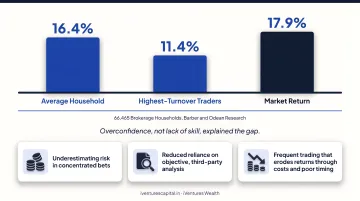
A landmark study of 66,465 brokerage households found that the average household earned 16.4% annually, according to research by Barber and Odean. The highest-turnover group, the most confident traders, earned just 11.4% against a market return of 17.9% during the same period. Overconfidence, not lack of skill, explained the gap.
Effects on decisions include:
- Underestimating risk in concentrated bets
- Reduced reliance on objective, third-party analysis
- Frequent trading that erodes returns through costs and poor timing
Loss Aversion
Behavioural economists Kahneman and Tversky formalised this asymmetry in prospect theory: the psychological pain of a loss is felt more intensely than the pleasure of an equivalent gain.
In practice, loss aversion produces the disposition effect: investors hold losing investments too long hoping to break even, while selling winners prematurely to "lock in" gains. This directly hurts long-term portfolio returns, since winners often continue outperforming while retained losers keep dragging the portfolio down.
Anchoring Bias
Anchoring is the over-reliance on an initial reference point, such as a stock's purchase price or a past index high, when evaluating an investment today.
This bias prevents timely re-evaluation of holdings based on current fundamentals. An investor who bought a stock at ₹500 may refuse to sell at ₹350, not because the fundamentals justify holding, but because ₹500 has become a fixed mental benchmark. It delays both exit and entry decisions during changing market conditions.
Herd Mentality
Herd mentality means making investment decisions based on the crowd rather than independent analysis, usually driven by fear of missing out.
The concept of information cascades explains this pattern: early movers in a market can disproportionately shape the decisions of everyone who follows, even when those later investors hold contradicting private information of their own. This fuels bubbles during euphoria and panic-selling during crashes, with investors buying high and selling low without due diligence.
Effects on decisions include:
- Buying into "hot" themes without independent research
- Selling in panic during broad market corrections
- Ignoring valuation fundamentals in favour of momentum
Confirmation Bias
Confirmation bias means seeking and favouring information that supports an existing belief while dismissing evidence that contradicts it.
An investor convinced a particular stock is a "sure winner" will read only the bullish analyst notes and skip the cautionary ones. This creates false confidence, causes investors to miss warning signs, and results in over-concentration in already-favoured assets.
Familiarity (Home) Bias
Familiarity bias means preferring investments that feel known, such as domestic markets, well-known companies, or family-run businesses, over unfamiliar alternatives.
An IMF study comparing actual cross-border holdings against a global-market benchmark found striking gaps. Malaysian investors held 96.61% of their portfolios domestically, versus a 0.44% benchmark weight; UK investors held 69.37% domestically against an 11.43% benchmark, according to IMF research on international portfolio holdings. The result: portfolios that are poorly diversified and carry higher unsystematic risk than necessary.
We see this pattern regularly at iVentures Wealth too. One entrepreneur client's portfolio was almost entirely India-focused, built from years of domestic market familiarity, despite India representing only a small share of global market capitalisation. Others hold the bulk of their wealth in promoter equity and one or two properties, leaving personal finances tied directly to business cycles.
How Behavioural Biases Affect Investment Returns and Markets
Individually, these biases cause suboptimal decisions. Collectively, across millions of investors, they distort entire markets and create a persistent, measurable shortfall known as the behaviour gap.
The Behaviour Gap Is Real and Costly
The behaviour gap is the difference between a fund's stated returns and what investors actually earn, caused by poorly timed entries and exits driven by bias.
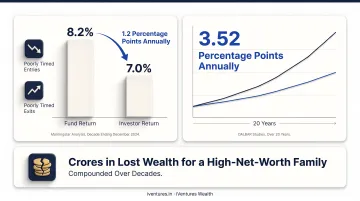
Morningstar's analysis of the decade ending December 2024 found investors earned 7.0% annually on a dollar-weighted basis, against 8.2% for the funds they invested in. That's a gap of 1.2 percentage points a year, according to Morningstar's research on investor returns.
Over 20 years, DALBAR's studies have shown gaps as wide as 3.52 percentage points annually. Compounded over decades, this shortfall can mean crores in lost wealth for a high-net-worth family.
Collective Bias Fuels Bubbles and Crashes
Herding and overconfidence don't just affect individuals. When enough investors act on the same impulse, markets overshoot in both directions:
- Rising prices attract more buyers, reinforcing overconfidence and feedback loops
- Corrections trigger panic-selling well below fair value
- Real estate cycles show the same pattern, with home price expectations often detached from fundamentals during boom phases
Compounding Damage Across Generations
Unmanaged biases don't stay contained to a single bad year. They compound across decades, materially impacting:
- Retirement corpus size at the point of withdrawal
- Generational wealth transfer and inheritance planning
- Family office asset allocation decisions made over multiple leadership generations
Corporate treasuries and family offices face the same risk. Overconfident CEOs tend to overinvest when internal cash is abundant, then pull back sharply when external financing is needed.
This is precisely why objective, research-backed, third-party advice adds measurable value, whether it's an individual investor or a corporate treasury team managing surplus funds.
How to Identify and Overcome Behavioural Biases
Investors cannot eliminate biases entirely. They're wired into how humans process risk and reward. But structured processes and objective oversight can keep them in check.
Build a Rules-Based Process
A written investment policy with predefined entry, exit, and rebalancing criteria removes the emotion from moment-to-moment decisions. For instance, a rule that caps any single stock at 10% of the portfolio forces a sale during a rally, well before overconfidence bias can take hold. When investors set the rules in advance, a market crash or a euphoric rally becomes far less likely to trigger an impulsive call.
Review Against Objective Benchmarks
Periodic portfolio reviews should compare performance against market benchmarks, not personal reference points like the original purchase price. At iVentures Wealth, advisors review portfolios at least quarterly, using benchmarks such as the Nifty 500 TRI.
This distinction matters. Even a well-performing diversified equity fund can underperform this benchmark up to 40% of the time over 1-5 year rolling periods. That variance helps investors distinguish real misalignment from normal short-term noise.
Work With a Fiduciary, Not a Product Seller
A SEBI-registered investment adviser has a legal obligation to act in the client's interest, not the product manufacturer's. iVentures Wealth operates under SEBI RIA registration INA000019026, meaning the firm earns no commissions from any product it recommends. This structural design directly counters herd mentality and familiarity bias:
- No incentive to push the "hot fund" of the moment
- Open-architecture access to the full universe of regulated products
- CFA-led research (led by Krishna Makhariya) assessing risk ratios and market data rather than short-term returns alone
Use Tools That Show Facts, Not Feelings
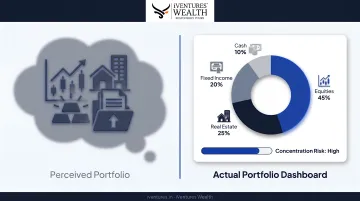
Consolidated, real-time portfolio tracking, such as iVentures' Wealth Monitor App, gives investors a factual view of holdings rather than a memory-based or anchored impression of what they think they own. Seeing true concentration and risk exposure in one dashboard makes it harder to ignore a bias-driven blind spot.
Common Mistakes to Avoid
Even investors who understand these biases intellectually still fall for them. Watch out for:
- Assuming awareness is enough – knowing about loss aversion doesn't stop the pain of a loss from clouding judgement in the moment
- Overcorrecting into paralysis – swinging from overconfidence to excessive caution after a past mistake, missing genuine opportunities
- Skipping external checks – relying purely on self-discipline during high-stress, volatile market events, when it matters least
Conclusion
Behavioural biases are a natural part of how humans make decisions under uncertainty. Their impact on investment outcomes, however, is measurable and compounding, often quietly eroding returns over successive market cycles.
Each investor experiences these biases differently, shaped by personality, wealth stage, and market exposure. Recognising your own tendencies, whether it's overconfidence, loss aversion, or a stubborn preference for familiar assets, is the starting point for better decisions. This is precisely where a SEBI-registered fiduciary advisor like iVentures Wealth adds value: structured processes and objective guidance that keep investors disciplined across market cycles, long after the initial motivation to "do better" fades.
Frequently Asked Questions
Does behavioural bias affect an investor's rationality?
Yes. Biases distort rational decision-making by causing investors to rely on emotion or mental shortcuts instead of objective data. This often leads to poorly timed trades and skewed risk assessments.
How do behavioural biases affect stock market prices?
Collective biases like herding and overconfidence drive bubbles during euphoria and sharp corrections during panic. This creates short-term mispricing that can persist well beyond what fundamentals justify.
What are the behavioural aspects of investing?
Behavioural aspects include emotional responses such as fear and greed, alongside cognitive shortcuts like anchoring and confirmation bias. Together, these influence buying, holding, and selling decisions at every stage of an investment.
What is the most common behavioural bias among investors?
Loss aversion and overconfidence are among the most widely documented biases across investor studies. Both appear across income levels, experience, and market conditions.
Can behavioural biases be completely eliminated?
No, biases cannot be fully eliminated since they are rooted in normal human psychology. They can, however, be managed through disciplined, rules-based processes and professional advisory support.
How can a financial advisor help reduce behavioural bias?
A fiduciary advisor provides an objective, data-driven perspective that counters emotionally driven decisions. Working with a SEBI-registered adviser like iVentures Wealth adds a structural check against impulses like herd mentality and overconfidence.