

The confusion usually starts once you dig into the details. Overlapping rules on PIS accounts, NRE versus NRO accounts, and taxation trip up even financially savvy NRIs, leading to compliance mistakes that can freeze transactions or trigger penalties.
This guide walks through eligibility, the accounts you actually need, what you can and can't invest in, taxation and repatriation, a step-by-step setup process, and where a SEBI-registered advisor fits into the picture.
Key Takeaways
- NRIs can legally invest in equities, mutual funds, IPOs, ETFs and equity F&O under FEMA/RBI rules
- NRE/NRO, PIS, and NRI Demat accounts are all mandatory for secondary market trading
- Intraday trading, short selling and currency derivatives are off-limits; delivery-based trades are the only route
- Capital gains and dividends attract tax in India, though DTAA treaties help avoid being taxed twice
- Specialised NRI wealth advisory, like iVentures Wealth, simplifies PIS compliance, cross-border tax planning and repatriation
Types of NRI Bank and Investment Accounts Required
Before any of this works, FEMA needs to classify you correctly. An NRI, under FEMA, is an Indian citizen who has gone abroad for employment, business, or an indefinite stay, or someone whose stay outside India signals they don't intend to settle back home permanently.
This status determines every account and investment right that follows.
NRE vs NRO Account: Which One Do You Need?
Your first decision is which bank account will anchor your investments.
| Feature | NRE Account | NRO Account |
|---|---|---|
| Source of funds | Foreign earnings | India-sourced income (rent, dividends, pension) |
| Repatriation | Fully repatriable | Capped at USD 1 million per financial year |
| Interest taxation | Tax-free in India | Taxable at applicable slab rate |
| Best suited for | Repatriable equity investments | Non-repatriable investments |
Most NRIs end up holding both. The NRE account funds fresh capital sent from abroad, while the NRO account handles income earned within India.
Portfolio Investment Scheme (PIS/PINS) Account
A PIS (or PINS) account, opened with a single authorised bank, is mandatory for routing secondary market equity trades on a repatriable basis. RBI monitors this account to track investment ceilings company by company.
There's a relaxation worth knowing: since RBI's 2016 notification, certain delivery-based equity purchases can also happen through a non-PIS NRO route, on a non-repatriation basis. This gives NRIs more flexibility, though repatriable trades still need the PIS route through your designated bank.
Demat and Trading Account Setup
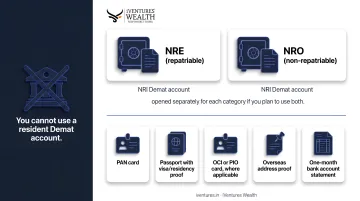
You cannot use a resident Demat account. NRIs need a dedicated NRI Demat account, linked to either the NRE (repatriable) or NRO (non-repatriable) account, and opened separately for each category if you plan to use both.
KYC documents typically required:
- PAN card
- Passport with visa/residency proof
- OCI or PIO card, where applicable
- Overseas address proof
- One-month bank account statement
What NRIs Can and Cannot Invest In
Here's where most confusion sits. NRIs get access to a decent range of instruments, but not everything on the Indian market is open to them.
Permitted investments:
- Delivery-based listed equities
- Mutual funds and ETFs (with some fund-house exceptions)
- Government and corporate bonds
- IPOs
- Equity and index F&O, funded through non-repatriable rupee balances
Not permitted:
- Intraday trading (only delivery-based trades are allowed)
- Short selling
- Currency derivatives
NRIs must take delivery on every purchase and give delivery on every sale. This makes trades that depend on same-day squaring off, such as BTST or STBT structures, impractical through the standard PIS route.
Sector restrictions also apply. RBI blocks foreign investment, including from NRIs, in atomic energy, lottery, gambling, chit funds and a handful of other sectors reserved for domestic or government control.
Ownership Ceilings You Should Know
A single NRI or OCI cannot hold more than 5% of a listed company's paid-up capital. Combined, all NRI/OCI holdings in one company are capped at 10%, though the company can raise this to 24% via a special resolution passed at a general body meeting. RBI has proposed doubling these thresholds to 10% and 24% respectively, but until a formal notification is issued, the older limits remain operative.
The US/Canada Mutual Fund Catch
If you're an NRI based in the USA or Canada, some Indian AMCs won't accept your investment because of FATCA/CRS compliance burdens. HSBC Mutual Fund, for instance, rejects US persons and Canada-resident investors outright. Others, like Aditya Birla Sun Life Mutual Fund, do accept US/Canada NRIs but require additional declarations for every transaction.
One more nuance: IPO investments don't need a PIS account and allow full repatriation of proceeds. However, individual issuers can choose to exclude NRI participation from a specific offer, so it's worth checking eligibility on each IPO before applying.
Taxation and Repatriation Rules for NRI Stock Investors
Tax treatment for NRIs mirrors what resident investors pay on listed equity, with a few added layers for cross-border compliance.
For transfers made on or after 23 July 2024, short-term capital gains on listed equity and equity mutual funds are taxed at 20%, while long-term gains attract 12.5% above an exemption threshold of ₹1.25 lakh per financial year. These are the current capital gains rates published by the Income Tax Department, before applicable surcharge and cess.

You pay tax on dividends at your applicable slab rate. TDS is also deducted at source on both dividends and capital gains, regardless of your final liability after filing a return.
How DTAA Helps
India has Double Taxation Avoidance Agreements with numerous countries, including the USA, UK, UAE and Canada. If you've already paid tax on the same income in your country of residence, DTAA lets you claim credit or exemption in India instead of paying twice on identical earnings.
Claiming this benefit requires the right forms and documentation, which is where most NRIs get stuck.
Repatriation Limits
Once your tax obligations are settled, moving funds abroad depends on which account route you used to invest:
- NRE-route investments: fully repatriable, no cap
- NRO-route investments: capped at USD 1 million per financial year, subject to CA certification via Form 15CA/15CB
Filing taxes across two jurisdictions, tracking TDS credits, and applying DTAA correctly is complicated. This is exactly the kind of cross-border complexity that iVentures Wealth's NRI/OCI tax advisory is built to handle, helping clients optimise DTAA benefits and stay compliant on both sides of the border.
Step-by-Step Process to Start Investing in Indian Stocks
Once you understand the accounts and rules, actually getting started follows a fairly linear path.
- Open an NRE and/or NRO account with an authorised Indian bank based on whether your funds are foreign or India-sourced
- Link a PIS/PINS account with the same bank for repatriable secondary market trades
- Open a Demat and trading account with a broker that supports NRI clients, matched to your repatriable or non-repatriable status
- Complete KYC with your PAN, passport, overseas address proof and bank statements
- Fund your account and start trading, keeping in mind that trades settle on a T+1 cycle, where funds and shares move between your PIS bank account and broker account the day after the trade
If managing this remotely isn't practical, you can appoint a Power of Attorney (POA) holder or use a Demat Debit and Pledge Instruction (DDPI) mandate to let someone execute trades on your behalf, without handing over full control of your accounts.
Why NRIs Should Consider Professional Wealth Advisory
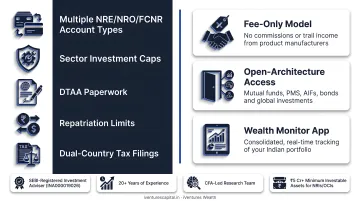
Managing Indian investments from abroad involves more moving parts than most NRIs expect: multiple account types, sector caps, DTAA paperwork, repatriation limits, and tax filings in two countries at once. Consolidating all of that into one coherent strategy is hard to do alone.
This is precisely the gap a dedicated NRI advisory practice is built to close. iVentures Wealth, for instance, is a SEBI-registered Investment Adviser (INA000019026) with over 20 years of experience and a dedicated NRI/OCI advisory practice, backed by a CFA-led research team.
A few things set this kind of advisory apart from a typical broker or bank PIS desk:
- Fee-only model: no commissions or trail income from product manufacturers, so recommendations aren't tied to what pays the advisor best
- Open-architecture access: mutual funds, PMS, AIFs, bonds and global investments, without a restricted product shelf
- Wealth Monitor App: consolidated, real-time tracking of your Indian portfolio, useful when you're managing wealth from a different time zone
For NRIs with investable assets above ₹5 crore, this structural independence matters more than proximity. You're not relying on a relationship manager who earns more when you buy a particular fund.
Frequently Asked Questions
How can USA NRIs invest in Indian stocks?
US-based NRIs use the same NRE/NRO-PIS and Demat account route as other NRIs. Mutual fund access is more limited due to FATCA rules at certain AMCs, since not all fund houses accept US-based investors.
Can NRIs invest in mutual funds in India?
Yes, NRIs can invest via NRE or NRO accounts through lumpsum or SIP routes. US and Canada-based NRIs face restrictions at some fund houses due to FATCA/CRS compliance requirements.
Can NRIs do intraday trading in the Indian stock market?
No. Intraday trading, BTST and STBT trades aren't permitted for NRIs under RBI rules. Only delivery-based equity trades are allowed through the PIS route.
What is the difference between NRE and NRO accounts for stock market investment?
NRE accounts hold foreign earnings and are fully repatriable, funding repatriable investments. NRO accounts hold India-sourced income, with repatriation capped at USD 1 million per financial year.
Can OCIs invest in the Indian stock market the same way as NRIs?
Yes. OCIs and PIOs have the same investment rights and restrictions as NRIs under FEMA's Non-Debt Instruments Rules, covering equities, mutual funds, IPOs and F&O.
Is there a limit on how much an NRI can invest in a single Indian company?
Yes. An individual NRI/OCI can hold up to 5% of a company's paid-up capital, with all NRIs/OCIs combined capped at 10%, extendable to 24% via special resolution.