Gujarat International Finance Tec-City is India's first International Financial Services Centre — a USD-denominated special economic zone where two international exchanges operate under a unified regulator, covering time zones from Tokyo to New York. For UHNIs, NRIs, family offices, and even resident Indians using the Liberalised Remittance Scheme, it opens access to Indian derivatives, US stocks, bonds, and commodity contracts from within India's borders.
This article covers what GIFT City exchanges are, how they differ from NSE/BSE, what you can trade, the tax treatment by investor type, and how to get started.
Key Takeaways
- GIFT City hosts two international exchanges — NSE IFSC and India INX — both regulated by the IFSCA, a unified regulator replacing the need for multiple separate authorities
- Transactions are USD-denominated; India INX operates for 22 hours daily, covering major global time zones
- Non-resident investors pay no STT, CTT, stamp duty, or GST; capital gains on specified securities are exempt under Section 47(viiab)
- Resident Indians can access GIFT City investments through the RBI's LRS, up to USD 250,000 per financial year
- A January 2024 amendment allowed public Indian companies to list directly on GIFT City exchanges, broadening the range of securities available
What Are GIFT City Stock Exchanges?
GIFT City — Gujarat International Finance Tec-City — sits between Ahmedabad and Gandhinagar in Gujarat. It is India's first International Financial Services Centre: a multi-services Special Economic Zone where financial transactions occur in foreign currency, primarily USD.
What makes it distinct isn't geography — it's jurisdiction. Entities and accounts operating inside GIFT City follow a separate regulatory framework, not the domestic rules that govern NSE or BSE.
The Regulator: IFSCA
The IFSCA (International Financial Services Centres Authority) was established on April 27, 2020 under the IFSCA Act, 2019. It consolidates the regulatory powers that would otherwise be split across RBI, SEBI, IRDAI, and PFRDA — all under one roof for IFSC activities. In practice: compliance for a GIFT City entity or account follows IFSCA rules, not the domestic regulatory stack.
The "Onshore the Offshore" Logic
Before July 2023, offshore investors seeking leveraged exposure to Indian equities largely traded SGX Nifty contracts in Singapore. That sent liquidity and fee revenue offshore — outside Indian regulatory reach.
The NSE IFSC–SGX Connect changed that. SGX Nifty formally became GIFT Nifty on July 3, 2023, with approximately USD 9.4 billion in open interest transferring over. That activity now sits within Indian jurisdiction while remaining globally accessible.
Who Can Participate?
- Foreign Portfolio Investors (FPIs) registered with SEBI
- Eligible Foreign Investors (EFIs) from FATF-compliant jurisdictions
- NRIs and OCIs through foreign currency accounts at IFSC Banking Units
- Resident Indians via the Liberalised Remittance Scheme (LRS), up to USD 250,000 per year
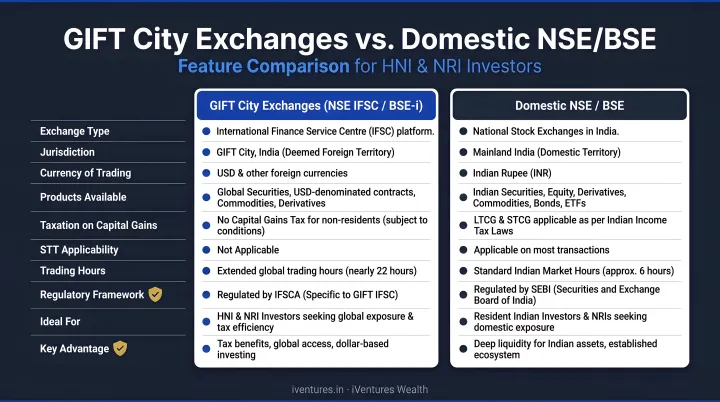
GIFT City Exchanges vs. Domestic NSE/BSE
| Feature | GIFT City (NSE IFSC / India INX) | Domestic NSE/BSE |
|---|---|---|
| Currency | USD | INR |
| Regulator | IFSCA | SEBI |
| Trading Hours | 22 hours (India INX) | ~6.25 hours |
| STT/CTT | None | Applicable |
| Stamp Duty | None | Applicable |
| GST on transactions | None | Applicable |
| PAN requirement | Exempted for eligible non-residents | Mandatory |
The Two Exchanges: NSE IFSC and India INX
NSE IFSC (NSE International Exchange)
NSE IFSC is a wholly owned subsidiary of the National Stock Exchange of India, incorporated on November 29, 2016 and located within GIFT City's SEZ. Its flagship instrument is GIFT Nifty — the successor to SGX Nifty — which tracks the Nifty 50 index through futures and options contracts.
By August 2024, NSE IFSC reported cumulative GIFT Nifty turnover of USD 1.08 trillion across 25.13 million contracts, with August 2024 monthly turnover hitting a record USD 100.13 billion. Average daily turnover of Nifty derivative contracts on NSE IFSC reached USD 3.70 billion in March 2024.
Product sessions run across extended windows — GIFT Nifty options slots run from 06:30 to 02:45 IST in multiple sessions — specifically to allow institutional investors to hedge Indian equity positions during US market hours or manage overnight risk across time zones.
India INX (India International Exchange)
India INX launched as India's first international stock exchange, inaugurated on January 9, 2017 as a BSE subsidiary, with operations starting January 16. It runs 22 hours daily and claims a turnaround time of 4 microseconds.
India INX's listing infrastructure spans a wide range of instruments available through its Global Securities Market (GSM) platform:
- Foreign currency bonds and Masala Bonds
- Green and sustainable (ESG-labelled) bonds
- Global Depositary Receipts (GDRs)
- Equity receipts, fund listings, and debt instruments for international capital access
As of March 2024, IFSCA reported total debt listings across IFSC exchanges at USD 56.5 billion, with cumulative ESG-labelled debt reaching USD 12.3 billion.
The Segregated Nominee Account (SNA) Structure
Both exchanges benefit from a structural innovation that makes access significantly smoother for international investors. The SNA framework, introduced under the IFSCA Capital Market Intermediaries Regulations (amended July 2023), allows FPIs to invest through registered brokers without individual registration with Indian authorities. Brokers maintain client-level identification, margining, and position limits under an omnibus-style structure. This reduces onboarding friction considerably for institutional investors and large family offices — mirroring the global omnibus model they already operate under in other jurisdictions.
Investment Products Available on GIFT City Exchanges
All GIFT City exchange products are USD-denominated and exempt from STT and stamp duty. The product range covers both Indian-focused instruments and international securities.
Equity and Index Derivatives
- GIFT Nifty futures and options — the primary vehicle for offshore Indian equity exposure
- S&P BSE Sensex derivatives available on India INX
- Single-stock futures and options on select Indian blue-chip companies
- Useful for investors wanting leveraged or hedged India equity exposure without the compliance overhead of domestic markets
US Stocks via Depository Receipts
NSE IFSC launched trading in US-listed stocks through unsponsored depository receipts (NSE IFSC Receipts). The initial tranche covered 8 names: Amazon, Tesla, Alphabet, Meta, Microsoft, Netflix, Apple, and Walmart — with plans to expand to 50 stocks. Resident Indians access these under the LRS framework; NRIs can invest directly through a GIFT City broker account.
For UHNI investors, this is a straightforward way to hold USD-denominated US equity within India's regulatory perimeter — no offshore account required.
Debt, Bonds, and Fixed Income
India INX supports a range of fixed-income listings through its GSM platform:
- Foreign currency-denominated bonds — direct USD exposure for fixed-income allocations
- Masala Bonds — rupee-denominated bonds for international investors wanting Indian corporate debt in a forex-friendly structure
- Eurobonds and Green/Social/Sustainable bonds — increasingly relevant for ESG-oriented family offices and institutions
Currency and Commodity Derivatives
Both exchanges offer currency derivatives covering USD-INR and EUR-USD futures and options — relevant for family offices and corporates with cross-border cash flow exposure. India INX's product list also covers commodity derivatives. These serve both hedging and portfolio diversification purposes for clients with multi-currency balance sheets.
Tax Benefits and Regulatory Advantages
The tax treatment at GIFT City is materially different from domestic exchanges — but it is conditional, not blanket. The advantages vary by investor type and product.
Tax Summary by Transaction Type
| Income/Transaction Type | Non-Resident Investor | IFSC Unit (Entity) |
|---|---|---|
| Capital gains on specified securities (Section 47(viiab)) | Exempt (transfer not regarded as transfer) | — |
| STT / CTT / Stamp Duty | None | None |
| GST on financial transactions | None | None |
| Interest on IFSC-listed bonds (post-July 1, 2023) | 9% + surcharge + cess | — |
| 10-year tax holiday (Section 80LA) | — | 100% deduction for 10 of 15 years |
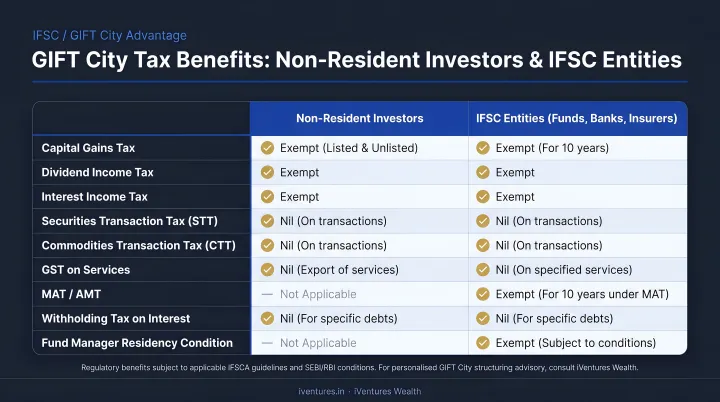
Source: IFSCA-hosted EY tax framework; Income Tax Department
Compliance Simplifications for Non-Residents
Under Rule 114AAB, eligible non-residents and eligible foreign investors may be exempt from obtaining a PAN card where their India-sourced income is limited to specified IFSC transactions in foreign currency. Contrast this with domestic NSE/BSE, where PAN, full KYC, a linked bank account, and demat account setup are mandatory for all investors.
Non-residents earning only certain categories of specified income (such as interest under Section 115A) may also be exempt from filing Indian income tax returns where TDS has been deducted at applicable rates.
The 10-Year Tax Holiday for IFSC Entities
Section 80LA provides IFSC-registered units a 100% income tax deduction for any 10 consecutive assessment years out of their first 15 years of operations. For family offices, fund managers, or corporates evaluating whether to set up an IFSC entity at GIFT City, this is a significant structural advantage — but qualifying requires careful entity structuring and proper advisory.
IFSCA regulations, FEMA, and the Income Tax Act each impose distinct conditions that interact in non-obvious ways — getting the structure wrong at formation can forfeit years of the benefit.
iVentures Wealth advises UHNI and family office clients on exactly this: GIFT City entity structuring, DTAA planning, LRS compliance, and cross-border tax efficiency, integrated into a coherent wealth strategy rather than addressed in isolation.
How to Start Investing Through GIFT City
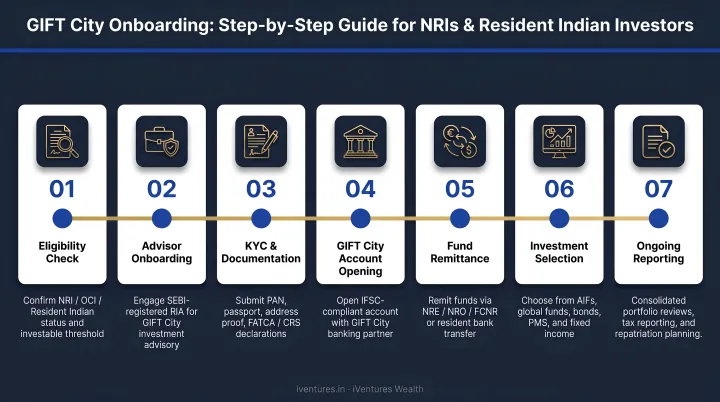
The practical steps differ depending on your residency status.
For NRIs and OCIs:
- Approach an IFSCA-licensed broker (verify against the IFSCA Directory)
- Open a foreign currency account with an IFSC Banking Unit (IBU) at GIFT City
- Complete KYC under IFSCA's framework — lighter-touch than domestic requirements for eligible investors
- Trade on NSE IFSC or India INX in USD; no mandatory PAN for eligible non-residents
For Resident Indians:
- Remit funds under the LRS (up to USD 250,000 per financial year per RBI guidelines)
- Open an account with an IFSCA-registered broker — not all domestic brokers have IFSC presence
- Access eligible products: GIFT Nifty contracts, NSE IFSC Receipts for US stocks, USD-denominated bonds
As of March 31, 2024, IFSCA's Annual Report recorded 67 broker-dealers on NSE IFSC and 59 on India INX — a growing but still selective pool compared to domestic exchange membership.
Common Mistakes Investors Make
Once the account is open, three misconceptions tend to create the most friction:
- Resident Indians can invest through LRS — the USD 250,000 annual cap is the constraint, not eligibility.
- IFSCA and SEBI are not interchangeable. IFSCA is the unified regulator for all IFSC activities; compliance obligations, exemptions, and registration requirements differ meaningfully from the domestic SEBI framework.
- Tax liability doesn't disappear at the GIFT City boundary. Non-residents benefit from significant exemptions, but resident Indians investing via LRS still carry full Indian income tax obligations on returns — and LRS remittances are subject to TCS provisions.
The interplay between LRS limits, FEMA regulations, income tax residency rules, and IFSCA-specific exemptions creates genuine structuring complexity.
Getting these intersections right — particularly for NRIs and families with cross-border holdings — is where advisory support from a firm like iVentures Wealth, which specializes in GIFT City and cross-border wealth structures, can make a material difference.
Frequently Asked Questions
How can I invest in GIFT City?
Resident Indians invest via the RBI's Liberalised Remittance Scheme (LRS), up to USD 250,000 per year, through an IFSCA-registered broker. NRIs and OCIs can invest directly through a foreign currency account at an IFSC Banking Unit — no domestic PAN or demat account required.
How do I buy US stocks from India through GIFT City?
US stocks are accessible via unsponsored depository receipts (NSE IFSC Receipts) traded on NSE IFSC, covering stocks like Amazon, Tesla, Apple, and Microsoft. Resident Indians purchase these under the LRS framework; NRIs access them directly through their GIFT City broker account in USD.
Is GIFT City regulated by SEBI?
GIFT City exchanges are regulated by the IFSCA (International Financial Services Centres Authority), not SEBI directly. Established under the IFSCA Act, 2019, it consolidates regulatory powers of RBI, SEBI, IRDAI, and PFRDA within the IFSC. Domestic SEBI rules apply only to mainland exchanges.
How many companies are listed on GIFT City exchanges?
GIFT City exchanges host equity derivatives, debt securities, and depository receipts rather than a traditional listed company count. As of March 2024, total debt listings across IFSC exchanges reached USD 56.5 billion. For current listed entity counts, check the official IFSCA directory and India INX's Global Securities Market listing portal directly.
What are the tax benefits of investing through GIFT City?
Non-residents benefit from several exemptions on IFSC exchange transactions:
- Transfers of specified securities are not a taxable transfer under Section 47(viiab)
- No STT, CTT, stamp duty, or GST applies to any transactions
- Eligible investors may be exempt from PAN and return filing requirements
Interest on IFSC-listed bonds issued after July 1, 2023 is taxed at 9% plus surcharge and cess.
Can resident Indians invest in GIFT City exchanges?
Yes. Resident Indians invest through the Liberalised Remittance Scheme (LRS), remitting up to USD 250,000 per financial year via an IFSCA-registered broker. Accessible products include GIFT Nifty contracts, NSE IFSC Receipts for US stocks, and USD-denominated bonds. Normal Indian income tax obligations still apply on returns.