
More investors are now crossing the ₹50 lakh mark in investable assets, which puts PMS within reach for the first time. That raises a real question: stick with the diversified, pooled comfort of mutual funds, or move toward a customised, direct-ownership portfolio?
India's ultra-high-net-worth population grew 6.1% in 2023 alone, from 12,495 to 13,263 individuals, according to Knight Frank's Wealth Report. That's a lot more people facing this exact decision.
Key Takeaways
- PMS provides SEBI-regulated, customised portfolios with direct stock ownership and a ₹50 lakh minimum
- Mutual funds pool money into diversified schemes, accessible via SIPs starting at ₹500
- Concentration and control define PMS, while diversification and simplicity define mutual funds
- Fees, taxation, and liquidity mechanics differ, directly affecting net returns
- Your choice should hinge on corpus size, risk appetite, and customisation needs
PMS vs Mutual Fund: Quick Comparison
Before going deeper, here's how the two stack up across the factors that matter most.
| Factor | PMS | Mutual Fund |
|---|---|---|
| Minimum Investment | ₹50 lakh (SEBI-mandated floor) | As low as ₹500 via SIP |
| Customisation & Ownership | Direct demat holdings, bespoke portfolio | Pooled units, shared scheme holdings |
| Cost Structure | Fixed/performance fees, negotiated with manager | AUM-linked expense ratio, regulatory cap |
| Taxation Trigger | Capital gains on every manager-executed trade | Tax only on investor redemption or switch |
| Liquidity & Transparency | No lock-in, but capped exit loads; periodic reports | Redemption in ~3 working days; daily NAV disclosure |
Minimum Investment
PMS requires at least ₹50 lakh in funds or securities under SEBI regulations. This floor isn't negotiable, though a market dip below that threshold doesn't force a top-up. Mutual funds, by contrast, welcome SIPs starting at ₹500 a month, per AMFI guidelines, making them accessible to nearly anyone with a bank account.
Customisation & Ownership
PMS investors own the actual stocks and bonds in their own demat account. A mutual fund investor owns units representing a share of a pooled scheme, with no direct say over which stock gets bought or sold.
Cost Structure
PMS fees are contractual: fixed, performance-linked (with a high-water mark), or a combination, plus operating expenses capped at 0.50% annually. Mutual fund expense ratios follow a regulatory slab, up to 2.25% for smaller equity schemes, tapering as AUM grows.
Taxation Trigger
Every trade a PMS manager makes inside your portfolio can trigger capital gains tax for you, the investor. Mutual funds shield you from that—internal churn inside the scheme isn't taxed; only your own redemption or switch is.
Liquidity & Transparency
PMS has no regulatory lock-in but can charge exit loads (up to 3% in year one, tapering to zero by year four). Mutual funds typically pay out redemptions within three working days and publish NAV daily, offering a more standardised process with less room for negotiation.
What is PMS?
Portfolio Management Services is a SEBI-regulated offering where a professional manager builds a bespoke portfolio of stocks, bonds, and other securities, held directly in the investor's own demat account rather than pooled with other investors' money.
This structure matters for HNIs and UHNIs because it allows strategies tailored to specific tax situations, concentration preferences, and legacy goals. A one-size-fits-all mutual fund scheme simply can't do that.
Core benefits of PMS include:
- Direct ownership of underlying securities, with full visibility into every holding
- Concentrated, high-conviction portfolios rather than 50-100 stock diversification
- Holding-level transparency through periodic client reporting
- Flexibility to align the portfolio with an investor's specific tax position
Three Types of PMS
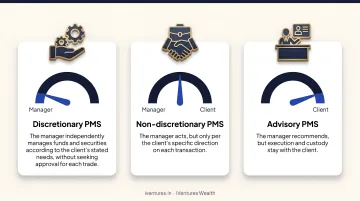
PMS comes in three forms, each giving the investor a different level of control:
- Discretionary PMS: the manager independently manages funds and securities according to the client's stated needs, without seeking approval for each trade
- Non-discretionary PMS: the manager acts, but only per the client's specific direction on each transaction
- Advisory PMS: the manager recommends, but execution and custody stay with the client
Use Cases of PMS
PMS typically works best as a satellite allocation: a high-conviction sleeve sitting alongside an investor's already-diversified core portfolio, not a replacement for it.
It's built for business owners, senior executives, and family offices who have crossed the ₹50 lakh threshold and want a portfolio reflecting their specific risk appetite rather than a generic scheme mandate.
Working with a SEBI-registered fiduciary advisor (rather than a distributor paid to push a particular product) matters here, since PMS suitability depends heavily on an investor's existing holdings, tax bracket, and concentration comfort.
As of March 2025, discretionary PMS AUM in India stood at ₹31,77,214 crore, up from ₹27,65,234 crore a year earlier. That's meaningful growth, though a large chunk of that figure includes EPFO and provident fund money, not purely discretionary HNI capital. Worth keeping in mind before treating PMS AUM growth as a retail-investor trend alone.
What is Mutual Fund?
A mutual fund pools money from thousands of investors into a scheme managed by an AMC-appointed fund manager, who invests according to a stated objective. You hold units, and their value moves with the fund's Net Asset Value.
This structure works for a much broader investor base. You don't need lakhs of rupees upfront. A monthly SIP gets you professional management, and SEBI/AMFI disclosure norms keep the scheme's holdings and performance visible.
Core benefits of mutual funds:
- Diversification across dozens or hundreds of securities in a single scheme
- Low entry barrier, with SIPs starting at ₹500 a month
- Liquidity through open-ended structures, with NAV published daily
- Regulatory oversight under SEBI's categorisation framework
Mutual funds fall into several broad categories: equity, debt, hybrid, index, and thematic or sectoral schemes, each carrying a different risk-return profile suited to different goals.
Use Cases of Mutual Funds
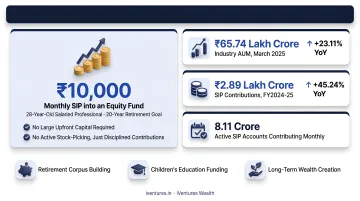
Mutual funds function as the core of most goal-based portfolios, covering retirement corpus building, children's education funding, and general long-term wealth creation. Beginners, salaried professionals, and first-time investors rely on them most, often starting with a modest SIP and increasing it as income grows.
Take a 28-year-old salaried professional starting a ₹10,000 monthly SIP into an equity fund for a 20-year retirement goal. This approach requires no large upfront capital and no active stock-picking, just consistent, disciplined contributions.
The scale here is substantial. Industry AUM touched ₹65.74 lakh crore in March 2025, a 23.11% jump year-on-year. SIP contributions for FY2024-25 reached ₹2.89 lakh crore, up 45.24% from the previous year, with 8.11 crore SIP accounts actively contributing each month. That's not a niche product anymore. It's how a large share of India invests.
PMS vs Mutual Fund: Which Is Better?
There's no universal winner here. The right answer depends on your investment corpus, risk appetite, need for customisation, tolerance for tax complexity, and time horizon.
A simple way to think about it:
- Choose mutual funds if you want diversification, low cost, and SIP-based discipline without managing individual stock decisions
- Choose PMS if you have ₹50 lakh or more, want direct ownership, and can stomach concentrated, higher-volatility positions
- Combine both if your portfolio already mixes ESOPs, overlapping funds, or concentrated single-stock exposure that needs coordinated oversight
The Core-Satellite Approach
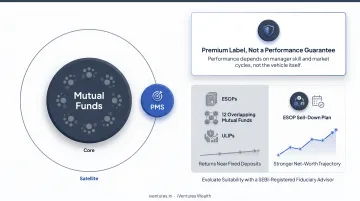
Many HNIs don't pick one over the other—they use both. Mutual funds form the diversified core, while PMS acts as a satellite sleeve for high-conviction bets. This avoids duplicating the same large-cap names across both structures while still capturing PMS's customisation upside.
One caution worth flagging: PMS carries a "premium" reputation, but that doesn't guarantee better returns. Performance depends on manager skill and market cycles, not on the vehicle itself. A mediocre PMS manager can underperform a well-run index fund.
We've seen this play out with clients directly. One senior executive came to iVentures holding ESOPs, twelve overlapping mutual funds, and a couple of ULIPs accumulated over the years without much coordination. Overall returns barely beat fixed deposits, weighed down by high-cost, underperforming products and heavy concentration risk from the ESOPs.
Our team ran a full portfolio review, exited the underperforming holdings, built a clear ESOP sell-down plan, and consolidated everything into a focused set of research-backed funds. The result: a materially stronger net-worth trajectory over the following market cycle, driven simply by a cleaner structure and coordinated decisions rather than more products.
The same principle applies when layering PMS on top of an existing mutual fund base: it works when there's a clear rationale, not because it sounds sophisticated.
Before committing capital, have a SEBI-registered fiduciary advisor evaluate suitability against your actual portfolio, not a generic risk questionnaire. iVentures Wealth's research-led team can walk through that assessment if you're weighing this decision.
Conclusion
The right choice between PMS and mutual funds comes down to corpus size, customisation needs, and how much concentrated risk you're comfortable holding. Mutual funds remain the sensible foundation for most long-term goals, while PMS can add value once capital and sophistication reach a certain point.
Getting this mix right benefits from a second, conflict-free set of eyes. An experienced advisor who isn't paid to push one product over another, such as iVentures Wealth, can help structure a portfolio that reflects your actual situation rather than a template.
Frequently Asked Questions
Are PMS better than mutual funds?
Neither is universally better. PMS suits HNIs wanting direct ownership and customisation, while mutual funds suit most investors seeking diversification, low cost, and accessibility.
Is PMS really worth it?
PMS can be worth it for investors with large corpuses who value direct ownership and tailored strategies. However, weigh the higher fees and transaction-level taxation against potential outperformance before committing.
What is the minimum investment required for PMS?
SEBI mandates a minimum of ₹50 lakh in funds or securities to open a PMS account. This threshold restricts PMS mainly to HNIs and UHNIs rather than retail investors.
How is PMS taxed differently from mutual funds?
PMS triggers capital gains tax each time the manager buys or sells a security within your portfolio. Mutual funds, by contrast, tax you mainly when you redeem or switch units yourself.
Can I invest in both PMS and mutual funds together?
Yes, this is common practice through a core-satellite approach: mutual funds as the diversified core, PMS as a high-conviction satellite. Just monitor portfolio overlap regularly.
Who should choose PMS over mutual funds?
Investors who have crossed the ₹50 lakh threshold, can stomach concentrated stock-level risk, and want a manager acting directly in their name are the best fit for PMS.