

Many founders and CFOs hit this exact wall. The confusion isn't about whether it's a good idea financially. It's about whether the Companies Act, 2013, SEBI regulations, and RBI rules actually permit it, and what compliance steps stand in the way.
This article walks through the legal basis, the fund types that suit corporate treasuries, the step-by-step investment process, taxation rules, and where expert advisory support — like the corporate treasury guidance we provide at iVentures Wealth — helps companies invest with confidence instead of guesswork.
Key Takeaways
- Private limited companies can invest in mutual funds once the MOA/AOA permits it and the board passes a resolution.
- SEBI regulates mutual funds directly; RBI rules mainly target banks and NBFCs, not standard operating companies.
- Match fund selection to cash flow timelines: liquid funds for short-term needs, equity or hybrid funds for long-term reserves.
- Keep documentation ready before the first transaction: incorporation certificate, PAN, MOA/AOA, board resolution, and KYC.
- Corporate tax treatment on mutual fund gains differs from individual taxation in key ways.
Legal and Regulatory Framework: Can a Private Limited Company Invest in Mutual Funds?
Yes, a private limited company can invest in mutual funds, and the legal basis starts with the board itself. Section 179(3)(e) of the Companies Act, 2013 requires the board to exercise investment powers through a formal resolution, with the option to delegate execution to a committee, managing director, or authorised officer.
Where Section 186 Fits (and Where It Doesn't)
Section 186(2)(c) governs a company's acquisition of securities in "another body corporate," capping exposure at the higher of 60% of paid-up capital plus reserves, or 100% of free reserves. Here's the nuance most business owners miss: mutual funds are structured as trusts, not body corporates, under Regulation 14 of the SEBI Mutual Funds Regulations, 1996.
The Institute of Company Secretaries of India (ICSI), in its Guidance Note 12, has interpreted this to mean mutual fund investments fall outside Section 186's numerical limits. This view finds support in judicial reasoning from Duli Chand v. Mahabir Pershad Trilok Chand Charitable Trust, which described a trust as an obligation on property rather than a distinct legal entity.
This is expert commentary, not an explicit MCA exemption, so prudent companies still set internal exposure caps rather than treating the limit as irrelevant.
SEBI and RBI: Who Regulates What
- SEBI regulates the mutual fund industry itself: scheme categorisation, risk disclosures, and AMC conduct. Companies investing as clients don't need separate SEBI registration.
- RBI rules primarily target banks and NBFCs. A regular private limited company can invest freely.
- The catch: if financial assets exceed 50% of total assets and income from those assets exceeds 50% of gross income, RBI's principal business criteria may classify the company as an NBFC, triggering stricter compliance requirements.
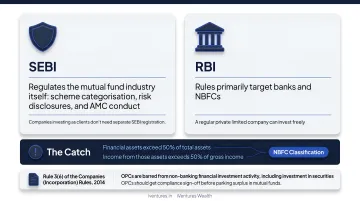
One Person Companies (OPCs) face a specific restriction. Rule 3(6) of the Companies (Incorporation) Rules, 2014 bars OPCs from non-banking financial investment activity, including investment in securities. Given this, OPCs should get compliance sign-off before parking surplus in mutual funds.
Types of Mutual Funds Suited for a Private Limited Company's Surplus Funds
Fund selection should mirror your cash flow calendar, not just chase returns.
Short-Term and Liquidity Management Options
For surplus you'll need within days to three months (payroll, vendor payments, GST instalments), liquid and overnight funds are the standard choice. They invest in instruments maturing within 91 days (liquid) or a single day (overnight), keeping capital accessible with minimal price swings.
For a slightly longer runway, up to a year, money market funds and ultra-short duration funds work well for operational treasury needs, holding instruments with a Macaulay duration of three to six months.
Medium to Long-Term Growth Options
| Fund Type | Horizon | Best For |
|---|---|---|
| Debt, corporate bond, gilt funds | 1–3 years | Stable returns above FD rates; moderate exit-load friction |
| Equity, index, hybrid funds | 3+ years | Long-term reserves, expansion capital; higher volatility |
| ETFs and Fund of Funds | Flexible | Efficient entry/exit for larger sums, diversification |
Corporate bond funds must hold at least 80% in top-rated corporate bonds; gilt funds hold a similar share in government securities. Both carry credit and interest-rate risk despite the "safe" perception.
Equity, index, and hybrid funds suit companies building reserves for expansion or acquisitions three years out, but the volatility means this money shouldn't be earmarked for near-term obligations.
The right approach: map your investment horizon and cash flow forecasts before picking a category. Then lean on a SEBI-registered investment adviser to build a diversified, need-based allocation rather than a one-size-fits-all fund pick.
Step-by-Step Process to Invest in Mutual Funds as a Private Limited Company
- Check your MOA/AOA. Confirm the object clause permits investment in securities or financial instruments. If it doesn't, amend the MOA through a shareholder resolution first, since skipping this step risks regulatory non-compliance later.
- Pass a board resolution. It should specify the investment amount, eligible fund categories, risk limits, and authorised signatories, recorded in board minutes for audit trail purposes.
- Gather corporate KYC documents:
- Certificate of Incorporation
- Company PAN card
- MOA/AOA copies
- Board resolution
- Shareholding pattern
- Latest audited financial statements
- Identity and address proof of authorised signatories
- Open the investment channel. Set up a corporate demat/trading account, or invest directly through AMC websites and registrars such as MFU, CAMS, or KFinTech. Link the company's official bank account for every transaction — no personal accounts.
- Select and purchase units. Check expense ratios, exit loads, and the fund manager's track record against your written investment policy before committing capital.
- Monitor and rebalance. Review NAV and returns periodically, rebalance based on shifting liquidity needs, and record each transaction correctly under applicable accounting standards.

This process plays out concretely in practice. Consider a family-owned enterprise we advised that was avoiding higher promoter salaries purely due to tax drag, which was capping long-term wealth creation. By deploying company surplus directly into a structured mutual fund allocation instead, the business built meaningful balance sheet reserves while deferring taxation across multiple years.
Taxation and Accounting Treatment for Corporate Mutual Fund Investments
Tax treatment hinges on fund type and holding period, and new rules took effect on July 23, 2024.
- Equity-oriented funds: Short-term gains (held up to 12 months) are taxed at 20%. Long-term gains above ₹1.25 lakh attract 12.5% under Section 112A of the Income Tax Act.
- Debt-heavy and specified mutual funds acquired on or after April 1, 2023 are deemed short-term under Section 50AA regardless of holding period, taxed at the company's applicable normal rate.
- Other non-equity funds: Long-term treatment now requires holding beyond 24 months, taxed at 12.5% without indexation on transfer after July 23, 2024.
TDS note: Section 194K mandates 10% TDS on mutual fund income exceeding ₹5,000 in a financial year, though the proviso excludes capital gains from this deduction.
On the accounting side, companies classify mutual fund holdings as current or non-current investments and value them at NAV on the reporting date.
Firms following Ind AS 109 measure these holdings at fair value through profit or loss, while those under AS 13 treat current investments (held under 12 months) at the lower of cost and fair value. Getting this classification right matters at audit time, so confirm which framework applies before booking the first entry.
Benefits, Risks, and Why Expert Guidance Matters
The Upside of Deploying Idle Cash
- Better returns than a current account. Liquid funds delivered a 6.92% one-year average return as of June 2025, while current accounts typically earn zero interest under RBI rules.
- Liquidity for operations. Overnight and liquid funds keep cash accessible within a day or two.
- Diversification of reserves. Spreading cash across instruments reduces dependence on a single bank relationship.
- Reduced reliance on external borrowing. Cash reserves cushion working capital crunches without needing to tap credit lines.
The Risks Worth Watching
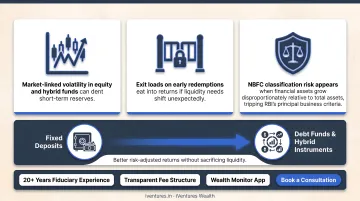
- Market-linked volatility in equity and hybrid funds can dent short-term reserves.
- Exit loads on early redemptions eat into returns if liquidity needs shift unexpectedly.
- NBFC classification risk appears when financial assets grow disproportionately relative to total assets, tripping RBI's principal business criteria.
We've seen this play out with an SME client who was parking working capital in conventional fixed deposits by default. Moving a portion into debt funds and hybrid instruments gave better risk-adjusted returns without sacrificing the liquidity the business needed.
Getting the compliance, tax planning, and fund selection right for a corporate treasury isn't a weekend project.
At iVentures Wealth, our team brings over 20 years of fiduciary, research-driven advisory experience to corporates and family offices. We back that experience with a transparent fee structure and the Wealth Monitor App for real-time portfolio tracking.
If your company is sitting on surplus cash and unsure where to start, book a consultation with our team.
Frequently Asked Questions
What is the 80% rule for mutual funds?
SEBI's categorisation norms require certain fund types, such as Large Cap Funds, ELSS, Corporate Bond Funds, and sectoral/thematic funds, to invest a minimum of 80% of assets in specific instruments matching their mandate. This keeps the fund true to its stated investment style.
Can a One Person Company (OPC) invest in mutual funds?
OPCs face restrictions under the Companies (Incorporation) Rules, 2014, which bar non-banking financial investment activity. Consult a compliance expert before an OPC commits surplus funds to mutual funds.
Does a private limited company need SEBI registration to invest in mutual funds?
No. SEBI registration requirements apply to the mutual fund, its AMC, and registered investment advisers, not to companies investing their own surplus as clients.
What documents are required for a company's mutual fund KYC?
You'll need the Certificate of Incorporation, company PAN, MOA/AOA, board resolution, shareholding pattern, and identity/address proofs for authorised signatories. AMCs and registrars may request additional documents on a case-by-case basis.
How are mutual fund gains taxed for a private limited company?
Taxation depends on whether the fund is equity-oriented or debt-heavy, and how long units were held. Rates and thresholds have changed recently, so confirm current figures with a tax professional before filing.
Can investing heavily in mutual funds turn a company into an NBFC?
Yes, potentially. If financial assets exceed 50% of total assets and income from them exceeds 50% of gross income, RBI's principal business criteria may classify the company as an NBFC, bringing stricter regulatory obligations.