

Introduction
Most NRIs spend hours picking the "best" mutual fund or stock. Few spend even thirty minutes deciding how much should sit in equity versus debt versus gold. That's backwards.
Asset allocation, not fund selection, is what actually drives long-term returns. Vanguard's 2024 research on multi-asset funds found that a portfolio's policy mix explains 92.1% of the variance in monthly returns. That finding comes from a decade of data across 1,514 multi-asset funds tracked by Morningstar.
For NRIs, getting this wrong costs more than it does for resident Indians. You're managing currency depreciation, dual tax exposure, FEMA repatriation limits, and the simple fact that you're not sitting in Mumbai watching the market daily. This guide breaks down what an NRI-specific allocation actually looks like.
Key Takeaways
- Asset allocation, not stock or fund picks, drives most of your long-term returns
- Your equity-debt-gold mix depends on where your goals sit, not a generic template
- Conservative, moderate, and aggressive models are only starting points; layer in currency and tax rules
- Review annually and rebalance when any asset class drifts over 5 percentage points
- Rules like 70/30 or 100-minus-age are useful shorthand, not finished NRI strategies
What Is Asset Allocation and Why Do NRIs Need a Different Approach?
Asset allocation is simply how you split your money across equity, debt, gold, real estate, and cash. That split matters more than which specific fund or stock you own inside each bucket.
The Vanguard study cited above comes with an important caveat: that 92.1% figure applies to short-term return variability. Over 10-year holding periods, allocation explains only 52.5% of variance in compound returns — the rest comes from active decisions like security selection and rebalancing timing. In other words, allocation sets your risk profile; execution still matters over the long haul.
Four things make NRI portfolios structurally different:
- Currency concentration risk — earning in USD, AED, or GBP while holding assets in INR creates a silent drag when the rupee weakens against your income currency
- Multi-jurisdiction tax complexity — India taxes certain income at source; your resident country may tax the same income again unless DTAA relief is claimed properly
- FEMA and repatriation constraints — NRE and NRO accounts carry different rules for moving money back overseas
- Remote oversight — you're not locally available to react to policy changes, rental disputes, or market swings the way a resident investor is
Core Asset Classes in an NRI Portfolio
Here's how the five major buckets typically function for an NRI:
- Equity — the growth engine, accessed via Indian mutual funds, direct stocks through the RBI's Portfolio Investment Scheme (PIS), index funds, and global equity funds for international diversification
- Debt instruments — NRE and NRO fixed deposits, debt mutual funds, and liquid funds. NRE FD interest is fully tax-exempt under Section 10(4)(ii); NRO FD interest is taxable and subject to withholding
- Real estate — offers rental income and appreciation, but liquidity is poor and returns need honest scrutiny (more below)
- Gold — a 5-10% hedge allocation, typically via Gold ETFs or digital gold. New Sovereign Gold Bonds (SGBs) are restricted to residents, but NRIs who bought them before moving abroad can hold them to maturity.
- Cash/liquid funds — your emergency reserve, held in NRE or NRO accounts per FEMA rules
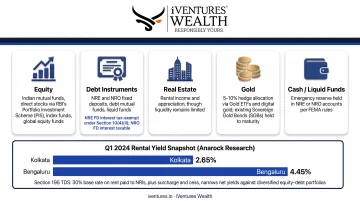
On real estate specifically: Q1 2024 data from Anarock Research showed gross residential rental yields ranging from 2.65% in Kolkata to 4.45% in Bengaluru. After Section 195 TDS (a flat 30% base rate on rent paid to non-residents, plus surcharge and cess), net yields often trail diversified equity-debt portfolios by a wide margin.
Property still has a place in an NRI portfolio — just not the outsized one many hold today.
Common Allocation Mistakes NRIs Make
- Over-concentrating in real estate because it feels tangible, despite yields below 4.5% gross and TDS eating into rental returns
- Parking 60-80% in fixed deposits, confusing capital safety with real, inflation-beating growth — NRO FD interest is taxable, further compressing post-tax returns
- Following generic resident-Indian advice or products pushed by commission-driven relationship managers, rather than strategies built around cross-border tax and currency realities
Ideal NRI Portfolio Allocation Models by Risk Profile and Goals
There's no single "ideal" number. Your allocation should reflect three inputs: risk appetite, time horizon, and — critically for NRIs — whether your goals sit in India or your country of residence. The frameworks below are illustrative starting points, not fixed formulas.
| Model | Equity | Debt/Liquid | Gold | Best suited for |
|---|---|---|---|---|
| Conservative | 20-30% | 60-70% | 5-10% | Near-retirement NRIs, or those funding near-term India expenses like parental support |
| Moderate/Balanced | 50-60% | 30-35% | 5-10% | Most NRIs with 10-20 year horizons |
| Aggressive | 65-75% | 15-25% | 5-10% | Younger, high-income NRIs with long horizons |
Conservative Allocation Model
This debt-heavy mix suits NRIs nearing retirement or those with near-term obligations, such as supporting parents in India or funding a goal within 3-5 years. The bulk sits in NRE FDs, debt mutual funds, and liquid funds, with a small equity and gold sleeve to keep pace with inflation without excessive volatility.
Moderate/Balanced Allocation Model
Most NRIs land here. A common question is whether a straight 70/30 or a 70/20/10 (equity/debt/alternative) split works — the honest answer is "it depends on where your goals sit."
If your children's education fund is in the US and your retirement is in India, a blended approach that weighs both currencies makes more sense than a fixed ratio borrowed from resident-Indian advice.
Aggressive Allocation Model
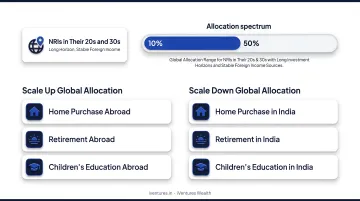
Suited to NRIs in their 20s and 30s with long horizons and stable foreign income. On the India-versus-global question, published NRI-specific guidance (rather than a fixed industry rule) suggests keeping 10-50% of the portfolio in global assets.
Scale up that global allocation if your future expenses (home purchase, retirement, children's education) will happen abroad, and scale down if they're India-centric.
Key Factors to Consider When Building Your NRI Portfolio Allocation
These six factors help you translate your personal situation into a specific, defensible allocation instead of copying a generic model.
Goal Location and Currency Matching
Match assets to the currency of future expenses. A US education fund should sit largely in USD-denominated assets; an India-based retirement plan should sit in INR. Mismatched currency exposure erodes real returns over time: a portfolio can grow on paper while losing purchasing power against your actual spending currency.
Time Horizon and Life Stage
Years to goal completion determine how much equity volatility you can absorb. A 15-year horizon tolerates market swings; a 2-year horizon demands capital preservation. Age matters, but it's the goal timeline that should set the equity ceiling.
Tax Efficiency Across Jurisdictions
- NRE FD interest is exempt under Section 10(4)(ii); NRO FD interest is taxable
- ELSS funds qualify for Section 80C deductions up to ₹1.5 lakh, but only under the old tax regime
- DTAA provisions under Section 90(2) apply the more beneficial rule between the Act and the treaty — but relief isn't automatic; you need a Tax Residency Certificate and Form 10F
Ignoring these details creates double-taxation drag that reduces net returns year after year.
Repatriation Rules and FEMA Compliance
NRE accounts allow full repatriation of principal and interest. NRO accounts restrict repatriation of current income after taxes, while other NRO balances are capped at roughly USD 1 million per financial year, subject to documentation. This affects which account should hold which asset: long-term global goals belong in NRE-linked structures, while India-source rental income naturally flows through NRO.
Risk Tolerance and Liquidity Needs
Your emergency fund should come first, regardless of how attractive a growth asset looks. Set your debt/liquid floor based on job stability and dependents, then build equity and gold exposure on top of that base.
Review and Rebalancing Discipline
Review your portfolio at least annually. Rebalance whenever any single asset class drifts more than 5 percentage points from its target weight. This keeps your risk profile intact without triggering excessive transaction costs or tax events from over-trading.
How iVentures Wealth Helps NRIs Build the Ideal Portfolio
Building this kind of allocation from another time zone, while juggling two tax systems, is genuinely hard to do alone. That's the gap iVentures Wealth was built to close.
iVentures Wealth is a SEBI-registered investment advisory firm (INA000019026), operating since 2005 with ₹1,146+ Cr in assets under advice across 150+ affluent families, UHNIs, and NRI/OCI clients.
Unlike a commission-driven relationship manager pushing whatever product pays the highest trail fee, iVentures operates as a fiduciary: recommendations are built around your goals, not a sales target.
What this looks like in practice:
- Personalised allocation strategies aligned to where your goals sit, whether in India, your country of residence, or both
- Consolidated tracking through the Wealth Monitor App, bringing NRE/NRO holdings, demat accounts, real estate, PMS, and AIFs into one INR/foreign-currency dashboard
- Tax and regulatory coordination across India and your resident country, so DTAA, FEMA, and repatriation rules don't work against you
- A CFA-led research team, headed by Krishna Makhariya, backing every recommendation with data rather than product incentives
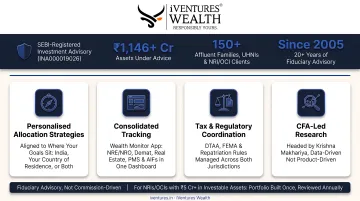
For NRIs/OCIs with ₹5 Cr or more in investable assets, this typically means a portfolio built once, reviewed annually, and adjusted as your life and currency exposure change.
Conclusion
There's no universal "best" portfolio for NRIs. The right mix is the one matched to your currency exposure, where your goals sit, and how much volatility you can genuinely stomach. Heuristics like 70/30, 70/20/10, or 100-minus-age are useful starting points — not finished strategies for someone managing money across borders.
Treat allocation as an ongoing process, not a one-time decision. Review it every year. And if the tax and FEMA complexity feels like more than a side project, a SEBI-registered advisor who understands cross-border rules — like iVentures Wealth's NRI advisory team — is worth the conversation.
Frequently Asked Questions
Is a 70/30 portfolio good for NRIs?
A 70% equity, 30% debt split can suit younger NRIs with long horizons and high risk tolerance. Adjust it based on where your goals are located and your currency exposure, since individual needs vary.
What is the 70/20/10 rule in investing?
It's shorthand for splitting a portfolio 70% into core/stable assets, 20% into measured growth assets, and 10% into higher-risk opportunities like gold or global equity. NRIs should adapt this ratio based on how much of their goals sit in India versus abroad.
What is the 7/5/3/1 rule in SIP?
It links minimum holding periods to asset classes: 7 years for equity, 5 for equity fund categories, 3 years to withstand emotional market phases, and 1 annual SIP step-up (typically 5-10%). It's a useful discipline check for NRIs running SIPs in Indian mutual funds.
What percentage of my portfolio should be in India vs global assets as an NRI?
There's no fixed industry benchmark here. Published NRI-specific guidance suggests keeping roughly 10-50% in global assets, shifting higher if future expenses such as education, retirement, or relocation will happen abroad.
How often should NRIs review and rebalance their portfolio?
At least once a year. Rebalance sooner if any single asset class drifts more than 5 percentage points from its original target weight.
Does the ideal asset allocation change with an NRI's age?
Yes, equity exposure typically reduces as you near your goals. But for NRIs, currency exposure and repatriation rules can override generic age-based formulas, so age alone shouldn't drive the decision.